
UNITED STATES
SECURITIES AND EXCHANGE COMMISSION
WASHINGTON, D.C. 20549
FORM
OR
For
the fiscal year ended
OR
For the transition period from _________ to _____________.
OR
Date of event requiring this shell company report:
Commission
file number:
(Exact name of Registrant as Specified in its Charter)
(Jurisdiction of Incorporation or Organization)
(Address of Principal Executive Offices)
(Name, Telephone, E-mail and/or Facsimile Number and Address of Company Contact Person)
Securities registered or to be registered pursuant to Section 12(b) of the Act:
None
(Title of Class)
Securities registered or to be registered pursuant to Section 12(g) of the Act:
None
(Title of Class)
Securities for which there is a reporting obligation pursuant to Section 15(d) of the Act:
Ordinary shares, par value US$0.00225 per share
The number of outstanding shares of each of the issuer’s classes of capital or common stock as of December 31, 2025, after giving retrospective effect to the subsequent share re-designation and reverse share splits effected on January 23, 2026, February 12, 2026 and May 4, 2026, was 18,427.00 Class A ordinary shares and 19,350.78 Class B ordinary shares, each with a par value of US$0.00225 per share, representing an aggregate of 37,777.78 ordinary shares outstanding.
Prior to the retrospective effect of the subsequent share re-designation and reverse share splits, the Company had ordinary shares outstanding with a par value of US$ per share as of December 31, 2025.
Indicate by check mark if the registrant is a well-known seasoned issuer, as defined in Rule 405 of the Securities Act.
Yes
☐
If this report is an annual or transition report, indicate by check mark if the registrant is not required to file reports pursuant to Section 13 or 15(d) of the Securities Exchange Act of 1934.
Yes
☐
Indicate by check mark whether the registrant (1) has filed all reports required to be filed by Section 13 or 15(d) of the Securities Exchange Act of 1934 during the preceding 12 months (or for such shorter period that the registrant was required to file such reports), and (2) has been subject to such filing requirements for the past 90 days.
Yes
☐
Indicate by check mark whether the registrant has submitted electronically every Interactive Data File required to be submitted and posted pursuant to Rule 405 of Regulation S-T (§232.405 of this chapter) during the preceding 12 months (or for such shorter period that the registrant was required to submit and post such files).
Indicate by check mark whether the registrant is a large accelerated filer, an accelerated filer, or a non-accelerated filer. See definition of “accelerated filer and large accelerated filer” in Rule 12b-2 of the Exchange Act. (Check one):
| Large accelerated filer ☐ | Accelerated filer ☐ | Emerging growth company |
If
an emerging growth company that prepares its financial statements in accordance with U.S. GAAP, indicate by check mark if the registrant
has elected not to use the extended transition period for complying with any new or revised financial accounting standards† provided
pursuant to Section 13(a) of the Exchange Act.
Indicate by check mark which basis of accounting the registrant has used to prepare the financial statements included in this filing:
| ☒ | ☐ | International Financial Reporting Standards as issued by the International Accounting Standards Board | ☐ | Other |
Indicate by check mark whether the registrant has filed a report on and attestation to its management’s of assessment of the effectiveness of its internal control over financial reporting under Section 404(b) of the Sarbanes-Oxley Act (15 U.S.C. 7262 (b)) by the registered public accounting firm that prepared or issued its audit report.
Yes
☐ No
If
securities are registered pursuant to Section 12(b) of the Act, indicate by check mark whether the financial statements of the registrant
included in the filing reflect the correction of an error to previously issued financial statements.
Indicate by check mark whether any of those error corrections are restatements that required a recovery analysis of incentive based compensation received by any of the registrant’s executive officers during the relevant recovery period pursuant to §240.10D-1(b). ☐
If “Other” has been checked in response to the previous question, indicate by check mark which financial statement item the registrant has elected to follow: Item 17 ☐ Item 18 ☐
If
this is an annual report, indicate by check mark whether the registrant is a shell company (as defined in Rule 12b-2 of the Exchange
Act). Yes ☐ No
(APPLICABLE ONLY TO ISSUERS INVOLVED IN BANKRUPTCY PROCEEDINGS DURING THE PAST FIVE YEARS)
Indicate by check mark whether the registrant has filed all documents and reports required to be filed by Sections 12, 13 or 15 (d) of the Securities Exchange Act of 1934 subsequent to the distribution of securities under a plan confirmed by a court:
Yes ☐ No ☐
TABLE OF CONTENTS
| 1 |
CONVENTIONS THAT APPLY TO THIS ANNUAL REPORT
Unless otherwise indicated or the context otherwise requires, all references in this annual report to the terms the “Company”, “we”, “us”, “our” and “our Group” or their grammatical variations is a reference to Fitness Champs Holdings Limited, the Cayman Islands entity that will issue the Class A Ordinary Shares being offered and/or any of our subsidiaries, where applicable.
Throughout this annual report, we use a number of key terms and provide a number of key performance indicators used by management. Unless the context otherwise requires, the following definitions apply throughout where the context so admits:
| “Amended and Restated Memorandum and Articles of Association” | : | the second amended and restated memorandum and articles of association of our Company adopted on January 23, 2026 and as supplemented, amended or otherwise modified from time to time and as in place at the time of this annual report. A copy of the Amended and Restated Memorandum and Articles of Association is filed as Exhibit 3.1 to our Registration Statement of which this annual report forms a part |
| “Big Treasure” | : | Big Treasure Investments Limited, a company incorporated in the BVI and wholly-owned by Ms. Lee |
| “Biostar” | : | Biostar Developments Limited, a company incorporated in the BVI and wholly-owned by Ms. Yau Ying Ying, an Independent Third Party. |
| “Board” | : | the board of directors of our Company |
| “Business Day” | : | a day (other than a Saturday, Sunday or public holiday in the U.S.) on which licensed banks in the U.S. are generally open for normal business to the public |
| “BVI” | : | British Virgin Islands |
| “Class A Ordinary Shares” | : | The Class A ordinary shares of the Company, par value US$0.00225 per share, after giving retrospective effect to the 15-for-1 reverse share split effected on February 12, 2026 and the 30-for-1 reverse share split effected on May 4, 2026. |
| “Class B Ordinary Shares” | : | The Class B ordinary shares of the Company, par value US$0.00225 per share, after giving retrospective effect to the 15-for-1 reverse share split effected on February 12, 2026 and the 30-for-1 reverse share split effected on May 4, 2026. |
| “Company” | : | Fitness Champs Holdings Limited, an exempted company incorporated in the Cayman Islands with limited liability under the Companies Act on February 15, 2024 |
| “Companies Act” | : | the Companies Act (2025 Revision) of the Cayman Islands, as amended |
| “Creative Path” | : | Creative Path Holdings Limited, a company incorporated in the BVI and wholly-owned by Ms. Lim Shu Qi, an Independent Third Party |
| “Directors” | : | the directors of our Company as at the date of this annual report, unless otherwise stated |
| “Exchange Act” | : | the United States Securities Exchange Act of 1934, as amended |
| “Executive Directors” | : | the executive Directors of our Company as at the date of this annual report, unless otherwise stated |
| “Executive Officers” | : | the executive officers of our Company as at the date of this annual report s, unless otherwise stated |
| “Fitness Aquatics” | : | Fitness Champs Aquatics Pte. Ltd, a company incorporated in Singapore on July 15, 2015 and an indirect wholly-owned subsidiary of our Company |
| “Fitness Champs” | : | Fitness Champs Pte. Ltd, a company incorporated in Singapore on December 5, 2012 and an indirect wholly-owned subsidiary of our Company |
| 2 |
| “Fitness Champs (Dubai)” | Fitness Champs Excellence Sports Academy LLC, a company incorporated in Dubai on October 30, 2025 and a wholly-owned subsidiary of Fitness Aquatics. | |
| “Fuji” | : | Fuji Investment Limited, a company incorporated in the BVI and wholly-owned by Mr. Chang Kin Man, an Independent Third Party. |
| “Independent Directors” | : | the independent non-Executive Directors of our Company |
| “Independent Third Party” | : | a person or company who or which is independent of and is not a 5% owner of, does not control and is not controlled by or under common control with any 5% owner and is not the spouse or descendant (by birth or adoption) of any 5% owner of our Company |
| “MOE” | Ministry of Education of Singapore | |
| “Mr. Koh” | : | Mr. Koh Yong Mong, our Executive Director and chief operating officer. Mr. Koh is the spouse of Ms. Lee |
| “Ms. Lee” | : | Ms. Joyce Lee Jue Hui, our Chair of the Board of Directors, Executive Director, chief executive officer and an indirect controlling shareholder of our Company. Ms. Lee is the spouse of Mr. Koh |
| “Northen Star” | : | Northen Star Limited, a company incorporated in the BVI and wholly-owned by our Company and which is the immediate holding company of Fitness Champs and Fitness Aquatics |
| “NWSC” | : | National Water Safety Council of Singapore |
| “S$” or “SGD” or “Singapore Dollars” | : | Singapore dollar(s), the lawful currency of Singapore |
| “SEC” or “Securities and Exchange Commission” | : | the United States Securities and Exchange Commission |
| “Securities Act” | : | the U.S. Securities Act of 1933, as amended
|
| “Sport Singapore” | : | Sporting advocacy program under Singapore’s Ministry of Culture, Community & Culture |
| “SwimSafer” | : | a mandatory national program in Singapore for primary school students under the Sport Singapore dedicated to promoting safety and education to public about the importance of water safety and to raise the standard of swimming proficiency in Singapore. The SwimSafer program comprises of six stages from beginner to advance levels as follows: SwimSafer Stage 1-Introduction to Water Skills; SwimSafer Stage 2-Fundamental Water Skills; SwimSafer Stage 3-Personal and Stroke Development Skills; SwimSafer Stage 4-Personal Survival & Stroke Improvement Skills; SwimSafer Stage 5-Intermediate Personal Survival & Stroke Refinement Skills; and SwimSafer Stage 6-Advance Personal Survival & Swimming Skill Proficiency |
| “True Height” | : | True Height Limited, a company incorporated in the BVI and wholly-owned by Mr. Ee Zhi Chang, an Independent Third Party
|
| “U.S.” | United States of America | |
| “US$”, “$” or “USD” or “United States Dollars” | : | United States dollar(s), the lawful currency of the United States of America |
| 3 |
DISCLOSURE REGARDING FORWARD-LOOKING STATEMENTS
This annual report contains forward-looking statements that relate to our current expectations and views of future events. These statements relate to events that involve known and unknown risks, uncertainties and other factors, including those listed under “Risk Factors,” which may cause our actual results, performance or achievements to be materially different from any future results, performance or achievements expressed or implied by the forward-looking statements.
In some cases, these forward-looking statements can be identified by words or phrases such as “believe”, “plan”, “expect”, “intend”, “should”, “seek”, “estimate”, “will”, “aim” and “anticipate”, or other similar expressions, but these are not the exclusive means of identifying such statements. All statements other than statements of historical facts included in this document, including those regarding future financial position and results, business strategy, plans and objectives of management for future operations (including development plans and dividends) and statements on future industry growth are forward-looking statements. In addition, we and our representatives may from time to time make other oral or written statements which are forward-looking statements, including in our periodic reports that we will file with the SEC, other information sent to our shareholders and other written materials.
These forward-looking statements are subject to risks, uncertainties and assumptions, some of which are beyond our control. In addition, these forward-looking statements reflect our current views with respect to future events and are not a guarantee of future performance. Actual outcomes may differ materially from the information contained in the forward-looking statements as a result of a number of factors, including, without limitation, the risk factors set forth in “Risk Factors” and the following:
| ● | changes in the laws, regulations, policies and guidelines in Singapore; | |
| ● | the regulatory environment in Singapore; | |
| ● | competition in the sports education industry in Singapore; | |
| ● | developments related to the COVID-19 pandemic; | |
| ● | breaches of laws or regulations in the operation and management of our current and future businesses and assets; | |
| ● | the overall economic environment and general market and economic conditions in Singapore; | |
| ● | our ability to execute our strategies; | |
| ● | changes in the need for capital and the availability of financing and capital to fund these needs; | |
| ● | our ability to anticipate and respond to changes in the sports education market, and in customer demands, trends and preferences; | |
| ● | war, acts of international or domestic terrorism, civil disturbances, occurrences of catastrophic events, man-made disasters and acts of God such as floods, earthquakes, typhoons and other adverse weather and natural conditions that affect our business or assets; | |
| ● | the loss of key personnel and the inability to replace such personnel on a timely basis or on terms acceptable to us; and | |
| ● | legal, regulatory and other proceedings arising out of our operations. |
The forward-looking statements made in this annual report relate only to events or information as of the date on which the statements are made in this annual report. Except as required by law, we undertake no obligation to update or revise publicly any forward-looking statements, whether as a result of new information, future events or otherwise, after the date on which the statements are made or to reflect the occurrence of unanticipated events. You should not place undue reliance on these forward-looking statements.
| 4 |
You should read this annual report and the documents that we reference in this annual report and have filed as exhibits to the registration statement, of which this annual report is a part, completely and with the understanding that our actual future results or performance may be materially different from what we expect.
Recent Events
On March 20, 2026, at an extraordinary general meeting, our shareholders approved a share consolidation in a range of 2 to 1 to not more than 250 to 1, with the exact ratio set at 30 to 1 by our board of directors, which share consolidation went go into effect on May 4, 2026.
On January 23, 2026, at an extraordinary general meeting, our shareholders approved that the shares of the Company be re-designated and re-classified such that the currently authorised share capital of the Company shall be re-classified and re-designated from (i) US$500,000 divided into 100,000,000,000 shares of a nominal or par value of US$0.000005 each to (ii) US$500,000 divided into (a) 80,000,000,000 class A ordinary shares of a nominal or par value of US$0.000005 each, (b) 10,000,000,000 class B ordinary shares of a nominal or par value of US$0.000005 each, and (c) 10,000,000,000 preferred shares of a nominal or par value of US$0.000005 each, by the re-designation and re-classification of (x) 79,991,707,850 unissued shares of a nominal or par value of US$0.000005 each into 79,991,707,850 unissued Class A ordinary shares of a nominal or par value of US$0.000005 each, (y) 9,991,292,150 unissued shares of a nominal or par value of US$0.000005 each into 9,991,292,150 unissued Class B ordinary shares of a nominal or par value of US$0.000005 each, and (z) 10,000,000,000 unissued shares of a nominal or par value of US$0.000005 each into 10,000,000,000 unissued preferred shares of a nominal or par value of US$0.000005 each, and the currently issued 17,000,000 shares of a nominal or par value of US$0.000005 each in the Company be and are re-designated and re-classified into 8,292,150 Class A ordinary shares of a nominal or par value of US$0.000005 each with 1 vote per share, 8,707,850 Class B ordinary shares of a nominal or par value of US$0.000005 each with 50 votes per share and 0 preferred shares of a nominal or par value of US$0.000005 each, on a one for one basis. As a result of this reclassification and redesignation, Big Treasure held 8,707,850 Class B ordinary shares and the remaining shareholders held 8,292,150 Class A ordinary shares. The shareholders also approved a share consolidation in a range of 2 to 1 to not more than 250 to 1, with the exact ratio was set at 15 to 1 by our board of directors, which share consolidation went into effect on March 23, 2026.
Unless otherwise stated, the disclosures in this annual report for the fiscal year ended December 31, 2025 reflect the impact of the share consolidation and reverse share split effected in 2026.
PART I
Item 1. Identity of Directors, Senior Management and Advisers
Not applicable.
Item 2. Offer Statistics and Expected Timetable
Not applicable.
Item 3. Key Information
A. Reserved.
B. Capitalization and Indebtedness.
Not applicable.
C. Reasons for the Offer and Use of Proceeds.
Not applicable.
D. Risk Factors.
Investing in our Class A Ordinary Shares is highly speculative and involves a significant degree of risk. You should carefully consider the following risks, as well as other information contained in this annual report, before making an investment in our Company. The risks discussed below could materially and adversely affect our business, prospects, financial condition, results of operations, cash flows, ability to pay dividends and the trading price of our shares. Additional risks and uncertainties not currently known to us or that we currently deem to be immaterial may also materially and adversely affect our business, prospects, financial condition, results of operations, cash flows and ability to pay dividends, and you may lose all or part of your investment.
This annual report also contains forward-looking statements having direct and/or indirect implications on our future performance. Our actual results may differ materially from those anticipated by these forward-looking statements due to certain factors, including the risks and uncertainties faced by us, as described below and elsewhere in this annual report.
Risks Related to Our Business and Industry
Our operation is subject to certain regulatory requirements of the Sport Singapore, Singapore Aquatics and the National Registry of Coaches.
If we are unable to obtain or renew the relevant registrations, certifications, or such registration or certifications are suspended or revoked by the relevant regulatory authorities in Singapore, our operation will have to be suspended and our business, operating and financial results may be materially and adversely affected. As at the date of this annual report, the Group is in compliance with all applicable regulatory requirements in Singapore.
| 5 |
We may be unable to enforce the restrictive covenants of the services agreements against our coaches to prevent them from directly competing with us.
Our services contracts with our coaches contain restrictive covenants that prevent them from poaching or directly competing with us during an agreed period. If any dispute arises between any of the coaches and our Group, we may be unable to enforce the restrictive covenants in the services agreements which are governed by Singapore law against the coaches and the enforceability of the restrictive covenants may only be determined by the courts on a case-by-case basis. It is thus difficult to predict the outcome of the proceedings or gauge the level of legal protection that such awards or proceedings may provide. If we cannot enforce the restrictive covenants with our coaches, those who leave our Group may join a competitor or form a competing company immediately after leaving our Group, which may disrupt our business and materially and adversely affect our financial condition, results of operations and profits.
Our intellectual property as to the development and preparation of course materials, swimming or training methodology and techniques may be infringed or we may inadvertently infringe on another entity’s intellectual property.
We, in conjunction with our coaching team, are responsible for the development and preparation of course materials, swimming and training methodology and techniques for use in our classes. Our course materials, methodology and techniques may contain content or structure similar to third party sources. There is no assurance that our course materials, lessons, methodology and techniques will not infringe third party intellectual property rights. If we were subject to third party litigation for infringement of third-party intellectual property rights, defending these can be expensive and time consuming, and their outcome is uncertain. Furthermore, any intellectual property infringement claims against us, or any publication containing such events could materially and adversely affect our image and reputation which could materially affect our business and operating results.
We depend on the supply of students from primary schools in Singapore under the SwimSafer program.
For each of the two years ended December 31, 2024 and 2025, we derived approximately 40.3% and 41.0% respectively, of our total revenue from students from primary schools that engage us to provide our services under the SwimSafer program. As we are one of five schools/institutions registered with Sport Singapore and the MOE that can provide courses under the MOE’s SwimSafer program, we expect such services to continue to be a significant and important source of our revenue in the near future, subject to renewal of our Company by the MOE as a certified provider, which renewal is not assured. Revenue generated from new sources may not increase to a level that would significantly reduce our reliance on students that we engage through the SwimSafer program offering through primary schools. Our contract with the MOE was renewed in October 2024 for a term through December 2026. If our contract with the MOE is not renewed beyond 2026, or we experience any event that negatively affects our relationship with the primary schools or our Sport Singapore and MOE certification, our overall business and results of operations could be materially and adversely affected.
In addition, part of our revenue growth after COVID-19 was due to a back-log of students who were unable to take SwimSafer classes during shut downs that limited access to swimming pools. We expect that government sector revenues will go back to levels that they were prior to the pandemic.
We rely on our coaching team, in particular our contracted coaches, to develop and provide courses, a failure of which could affect our brand, results of operations and profitability.
For each of the three years ended December 31, 2023, 2024 and 2025, we had a coaching team of 238, 240 and 252 individuals, respectively. We rely on our team, in particular our coaches, to develop and provide classes and structured programs to our students. As such, we believe that the ability of our coaching team to provide support to our students in their pursuit of the ability to swim and swim well remains critical to the trust in which students and their parents place in our brand and our teaching style, methodology and technique.
| 6 |
We rely on our “Fitness Champs” brand and our reputation as a leading provider of comprehensive swimming lessons services and our inability to maintain this brand strength and reputation could affect our operating results and business.
The “Fitness Champs” brand is instrumental to the success of our business. As of December 2025, we have certified a total of over 190,000 students through the SwimSafer Program. We rely on the strength of our brand to enhance our reputation as a trustworthy swimming services provider/educator for our students in their extra-curricular and leisure endeavors. If the value of our brand or image and reputation is diminished or tarnished, we may fail to continue to attract students and our business, financial condition and results of operations could be materially and adversely affected.
We may be unable to continue to attract students to enroll in our courses.
Our revenue is primarily generated from tuition fees we receive from students who have enrolled in our swimming courses. Our ability to continue to maintain and attract students to enroll in our courses is critical to the continued success and growth of our business. This in turn depends on several factors, including our ability to develop safe and effective courses and techniques that are successful, pique our students’ interest and are compliant with relevant licensing, safety and regulatory requirements. Inefficiency or failure to maintain or achieve the aforesaid could materially and adversely affect our revenue and profitability.
Our coaching team’s actions or inaction could subject us to claims, either regulatory or through litigation, regarding conduct or services that we deliver.
We rely on our coaching team and in particular our coaches to provide courses and services in accordance with the terms of their engagements. Our coaches are responsible for the safety and well-being of children, many of whom are just learning to swim, which is an inherently dangerous activity. As our coaches are granted extensive contact with children, the MOE conducts background checks on our coaches to help ensure that all of our instructors have the credentials to be working with children and are adequately trained to supervise and handle emergency situations that may arise. Any negative, harmful or negligent actions on the part of our coaches and other staff, or any failure by us to properly manage our coaching team and swimming activities may result in undesirable or unexpected outcomes such as serious injury or even death, which could result in regulatory impacts or litigation exposure, all of which would negatively impact our brand.
Our unauthorized disclosure of student and staff information and other sensitive data could expose us to costly litigation or could materially and adversely affect our reputation.
In connection with our business operations, we come into contact and store proprietary and confidential information on our students, coaches and staff, such as names, addresses, age, gender and other personal information. This information is primarily stored in our computer database located in our headquarters and in cloud servers. We have taken measures to address data security, including having a dedicated Data Protection Officer who oversees compliance of the collection, use and protection of personal data, as well as the management and response to any data protection incidents or breachers. Notwithstanding these measures, our information technology system and computer networks may be vulnerable to unauthorized access, hacking, computer viruses and other security problems. A user who circumvents security measures could misappropriate proprietary information or cause interruptions to or malfunctions in our operations. Any leakage or misappropriation of information from our system could have a material and adverse effect on our reputation and business operations. Moreover, if our security measures are breached as a result of actions by third parties, employee error, malfeasance or otherwise, third parties may receive or be able to access student records and personal details which could subject us to litigation, liabilities, interrupt our business and materially and adversely impact our reputation. We also run the risk that our staff or third parties could misappropriate or illegally disclose confidential information in our Group’s possession, although we have sought to mitigate this risk by requiring all of our employees to agree to confidentiality and to data protection measures as part of their employment. Notwithstanding these measures, we may be subject to data breaches and we may be required to expend significant resources to alleviate problems caused by these breaches.
| 7 |
Our advertising and marketing campaigns may not lead to higher course or student enrollments nor increased revenue.
From time to time, we launch various advertising and marketing campaigns to further increase public awareness of our business and enhance our brand recognition. We advertise on social media platforms such as Facebook, Instagram, Tik Tok and Xiao Hong Shu as well as on our own websites. Despite our efforts and the costs incurred in promoting our brand and business, such efforts and costs may not necessarily lead to higher course or student enrollments, which in turn may not lead to increased revenue for us.
The swim coaches we engage may be unable to maintain qualifications and/or certifications.
Our coaches need to be trained, certified and competent in coaching. If a significant number of our coaches are unable to maintain appropriate certifications and upkeep training, we may not have enough qualified staff to meet demand, which may result in us losing students, and our business, operating and financial results may be materially and adversely affected.
Our business operations are subject to adverse weather conditions.
As a majority of our swimming classes are held outdoors, our ability to conduct swimming classes is susceptible to extreme weather conditions such as heavy rains, lightning, extreme or prolonged heat waves and high winds. Lightning and heavy rainstorms are prevalent in Singapore and some of our classes cannot be held outdoors during periods of lightning and extreme weather conditions as we utilize some outdoor pools. Heavy rainfall can dilute the chemicals in the pools we use to hold our classes and create a pH imbalance that may be harmful to our students. Rain also washes bacteria, dirt, algae spores, and other debris into the pools we use, which can attack the active chlorine and mitigate its effects. Singapore is generally hot all year round, as such, the heat also poses risks to water quality by breaking down the chlorine content in the water faster as well as the pools being more susceptible to algae growth causing a risk for our students. If we cannot effectively contain any such risks such as moving all of our lessons indoors, our ability to hold our swimming classes could be restricted and our revenues reduced, causing material adverse impact on our business and results of operations.
Natural disasters and other catastrophic events beyond our control, including but not limited to the COVID-19 pandemic, have and could continue in the future to adversely affect our business operations and financial performance.
The occurrence of the global COVID-19 pandemic negatively affected our business between 2020 and 2022 due to the inability to hold classes and/or gathering of students. The occurrence of one or more other natural disasters, such as fires, hurricanes, tornados, tsunamis, floods and earthquakes; geo-political events or military activities disrupting transportation, communication or utility systems; or other highly disruptive events, such as nuclear accidents, pandemics, unusual weather conditions or cyberattacks, could adversely affect our operations and financial performance. The occurrence of these events or another global pandemic could result in, among other things, operational disruptions, the lack of an adequate workforce in parts or all of our operations and communications and transportation disruptions, which in turn could also cause consumer confidence and spending to decrease or result in increased volatility in Singapore, the United States and global financial markets and economy.
We operate in a competitive market.
The leading swimming training providers generally engage in two business lines including (i) provision of training services to students under different training programs funded by the Singapore Government and (ii) provision of customized swimming training services to customers of all ages. We are in constant competition with other swimming services providers to provide quality and the same or better scope of services with well-trained and effective swimming staff. Further, the pricing and demand for our services are affected by the intensity of competition we face. Some of our competitors may be able to foresee the upcoming market trends more accurately or may be more responsive than we are. If we are unable to compete successfully with our competitors, we may experience a reduction in market share, which may have a material adverse effect on our business performance, results operations and financial conditions.
| 8 |
Changes in existing laws, regulations and government policies may cause us to incur additional costs.
Our business operations are governed by various laws, regulations and government policies in Singapore and we operate in a highly-regulated industry. The licensing, membership, registration and certification requirements for us may change from time to time. We may be unable to comply with all these requirements in time or at all or we may need to incur substantial costs to be compliant, which may adversely affect our business operations and financial condition.
We are exposed to risk of accidents and injuries in the course of our business.
We are in the business of providing swimming lessons to children, as well as aquatic swim classes, and there is an inherent risk that accidents and injuries may occur during our swimming lessons and aquatic sports classes, even where there are lifeguards and/or trained on-site personnel on duty. Claims may be made against us for such accidents and/or fatalities on grounds such as negligence or any failure by us to properly manage our coaching team or swimming activities. If we cannot successfully defend ourselves against such claims, we could incur substantial liabilities. Regardless of merit or eventual outcome, liability claims may result in:
| ■ | loss of revenue; | |
| ■ | substantial monetary awards; | |
| ■ | significant time and costs to defend the related litigation; | |
| ■ | increased insurance costs; and | |
| ■ | loss of reputation and significant negative publicity and media attention. |
Any such outcomes could materially and adversely affect our business, financial condition, results of operations and growth prospects.
We may implement business strategies and future plans that may not be successful
The successful implementation of our business strategies and future plans depends on a number of factors including general market conditions, government policies, the availability of funds, competition and our ability to retain and recruit competent coaches. There is no assurance that our business strategies and future plans can be implemented effectively and successfully as some of these factors are beyond our control. If any implementation of these strategies and plans fails or is delayed, we may be adversely affected by investment expenses that have not led to the anticipated results, by the distraction of management from our core business or by damage to our brand or reputation. Additionally, if we fail to secure adequate funds in a timely manner, we may also be unable to pursue opportunities to expand our business.
Our current insurance coverage may not sufficiently protect us against all the risks we are exposed to and our insurance premiums may increase.
There can be no assurance that our current insurance will cover all our risks or adequately protect us against all liabilities arising from claims and litigation against us. We will have to bear any losses, damages or liabilities in the course of our operations arising from events for which we do not have adequate insurance coverage. Further, our insurance premiums depend on various factors, including the scope and estimated contract sum set out in the service contracts with our customers and our insurance claim track record. There is no assurance that our insurance premiums will not increase or that our insurance coverage will not be reduced in the future. If we were held liable for uninsured losses, the amounts of claims for insured losses exceed the limits of our insurance coverage or the insurance premium payable by us increases significantly, our business, results of operations and financial condition may be materially and adversely affected.
| 9 |
Our Executive Officers have no prior experience in operating a U.S. public company, and their inability to operate the public company aspects of our business could harm us. Further, planned increases to our Executive Officer compensation will raise our operating costs and our failure to generate commensurately higher revenue could result in negative impacts to our financial results.
Our Executive Officers have no experience in operating a U.S. public company, which makes our ability to comply with applicable laws, rules and regulations uncertain. Our failure to comply with all laws, rules and regulations applicable to U.S. public companies could subject us or our management to regulatory scrutiny or sanction, which could harm our reputation and share price.
We recently raised the compensation of our Executive Officers and need to make commensurately higher revenue in order to maintain profitability. Our failure to perform at levels to generate enough revenue to pay these higher operating costs could negatively impact our financial results.
If we fail to maintain an effective system of internal controls, we may be unable to accurately or timely report our results of operations or prevent fraud, and investor confidence and the market price of our Class A Ordinary Shares may be materially and adversely affected.
We are a smaller company with limited accounting personnel. Our management has performed an assessment of the effectiveness of our internal control over financial reporting and we conduct regular management reviews of financial performance and variances, and our independent registered public accounting firm has not conducted an audit of our internal control over financial reporting. Effective internal control over financial reporting is necessary for us to provide reliable financial reports and, together with adequate disclosure controls and procedures, is designed to prevent fraud.
While we believe that we have the systems in place to ensure timely preparation and review of our consolidated financial statements in accordance with U.S. GAAP and SEC reporting requirements, our failure to implement and maintain effective internal controls over financial reporting could result in errors in our financial statements that could result in a restatement of our financial statements, cause us to fail to meet our reporting obligations and cause investors to lose confidence in our reported financial information, which may result in volatility in and a decline in the market price of our Class A Ordinary Shares.
We are a public company in the United States subject to the Sarbanes- Oxley Act of 2002. Section 404 of the Sarbanes-Oxley Act of 2002, or Section 404, which requires that we include a report of management on our internal control over financial reporting in our annual report on Form 20-F. In addition, if we cease to be an “emerging growth company” as such term is defined in the JOBS Act, our independent registered public accounting firm must attest to and report on the effectiveness of our internal control over financial reporting on an annual basis. Our management may conclude that our internal control over financial reporting is ineffective. Moreover, even if our management concludes that our internal control over financial reporting is effective, our independent registered public accounting firm, after conducting its own independent testing, may issue a report that is qualified if it is not satisfied with our internal controls or the level at which our controls are documented, designed, operated or reviewed, or if it interprets the relevant requirements differently from us.
During the course of documenting and testing our internal control procedures, in order to satisfy the requirements of Section 404, we may identify material weaknesses and deficiencies in our internal control over financial reporting. The Public Company Accounting Oversight Board, or PCAOB, has defined a material weakness as “a deficiency, or a combination of deficiencies in internal control over financial reporting, such that there is a reasonable possibility that a material misstatement of the annual or interim statements will not be prevented or detected on a timely basis.”
| 10 |
In addition, if we fail to maintain the adequacy of our internal control over financial reporting, as these standards are modified, supplemented or amended from time to time, we may be unable to conclude on an ongoing basis that we have effective internal control over financial reporting in accordance with Section 404. Generally speaking, if we fail to achieve and maintain an effective internal control environment, we could suffer material misstatements in our financial statements and fail to meet our reporting obligations, which would likely cause investors to lose confidence in our reported financial information. This could, in turn, limit our access to capital markets, harm our results of operations and lead to a decline in the trading price of our Class A Ordinary Shares. Additionally, ineffective internal control over financial reporting could exposes us to increased risk of fraud, misuse of corporate assets and legal actions under the United States securities laws and subject us to potential delisting from Nasdaq, to regulatory investigations and to civil or criminal sanctions.
We believe that we have personnel adequately trained in and have appropriate knowledge of U.S. GAAP and SEC reporting requirements to properly address complex U.S. GAAP accounting issues and related disclosures to fulfill U.S. GAAP and SEC financial reporting requirements. However, our failure to do so could result in (i) our failure to maintain effective internal control over financial reporting, (ii) errors in our financial statements; (iii) failure to meet our reporting obligations; and (iv) loss of confidence by the investors in our financial information. We are implementing a number of measures to address this issue, such as(i) engaging an external consulting firm to assist us with our financial in U.S. GAAP; (ii) allocating resources to improve financial oversight function; (iii) introducing formal business performance review process, and preparing and reviewing the consolidated financial statements and related disclosures in accordance with U.S. GAAP and SEC reporting requirements; and (iv) providing our relevant finance staff with appropriate training in connection with the requirements of U.S.GAAP.
We will be subject to changing laws, rules and regulations in the U.S. regarding regulatory matters, corporate governance and public disclosure that will increase both our costs and the risks associated with non-compliance.
As a publicly traded company, we are subject to rules and regulations by various governing bodies and self-regulatory organizations, including, for example, the SEC and the Nasdaq Capital Market, which are charged with the protection of investors and the oversight of companies whose securities are publicly traded, and to new and evolving regulatory measures under applicable law. While we are seeking to build on our experience as a U.S. public company subject to U.S. GAAP, SEC and Nasdaq reporting and compliance requirements, with guidance from our independent directors and management team, our efforts to comply with new and changing laws and regulations have resulted in and are likely to continue to result in increased general and administrative expenses and a diversion of management time and attention from revenue-generating activities to compliance activities.
Moreover, as these laws, regulations and standards are subject to varying interpretations, their application in practice may evolve over time as new guidance becomes available. This evolution may result in continuing uncertainty regarding compliance matters and additional costs necessitated by ongoing revisions to our disclosure and governance practices. If we fail to address and comply with these regulations and any subsequent changes, we may be subject to penalty and our business may be harmed.
Risks Related to Our Securities and This Annual Report
We have received a notice from Nasdaq that we no longer meet the listing requirements of the Nasdaq Capital Market and our failure to regain compliance would mean there is no active market for investors to make transactions in our Class A Ordinary Shares.
On November 6, 2025, we received a letter from the Listing Qualifications staff of The Nasdaq Stock Market (“Nasdaq”) notifying us that based on the closing bid price of the Company for the period from September 24, 2025 to November 5, 2025, we no longer meet the continued listing requirement of Nasdaq under Nasdaq Listing Rules 5550(a)(2), to maintain a minimum bid price of $1 per share. We effected a share consolidation of 15 to 1 on March 23, 2026, thereby raising our share price above $1. On March 20, 2026, at an extraordinary general meeting, our shareholders approved a share consolidation in a range of 2 to 1 to not more than 250 to 1, with the exact ratio set at 30 to 1 by our board of directors, which share consolidation went into effect on May 4, 2026. The purpose of the 30 to 1 share consolidation to keep us in compliance with Nasdaq Listing Rules 5550(a)(2).
| 11 |
There are no assurances that the price of our Ordinary Shares will not fall below the listing requirement again, particularly in light of the fact that this annual report may result in significant dilution. In addition to the minimum bid price, Nasdaq has specific continued listing requirements related to public float and market value of publicly held shares that could be negatively impacted by this annual report.
If we are unable to meet all of Nasdaq’s continued listing requirements, and the Nasdaq Capital Market delists our Ordinary Shares and we are unable to list our Ordinary Shares on another national securities exchange, we expect our Ordinary Shares could be quoted on an over-the-counter market in the United States. If this were to occur, we could face significant material adverse consequences, including:
| ● | a limited availability of market quotations for our Ordinary Shares; | |
| ● | reduced liquidity for our Ordinary Shares; | |
| ● | a determination that our Ordinary Shares are “penny stock,” which will require brokers trading in our Shares to adhere to more stringent rules and possibly result in a reduced level of trading activity in the secondary trading market for our Ordinary Shares; | |
| ● | a limited amount of news and analyst coverage; and | |
| ● | a decreased ability to issue additional securities or obtain additional financing in the future. |
The trading price of our Ordinary Share has been volatile, which could result in substantial losses to investors, and has resulted in legal claims being raised against us.
The trading price of our Class A Ordinary Shares has been subject to rapid and substantial volatility, which could make it difficult for prospective investors to assess the rapidly changing value of our Class A Ordinary Shares and result in substantial losses to investors.
There have been instances of extreme share price run-ups followed by rapid price declines and strong share price volatility with recent initial public offerings, especially among those with relatively smaller public floats. As a relatively small-capitalization company with relatively small public float, we have experienced greater share price volatility, extreme price run-ups, lower trading volume and less liquidity than large-capitalization companies. In particular, our Class A Ordinary Shares have been, and may continue to be subject to rapid and substantial price volatility, low volumes of trades and large spreads in bid and ask prices. Such volatility, including any stock-run up, may be unrelated to our actual or expected operating performance and financial condition or prospects, making it difficult for prospective investors to assess the rapidly changing value of our Class A Ordinary Shares.
The trading price of our Class A Ordinary Shares may continue to be volatile and could fluctuate widely due to factors beyond our control and for reasons that are unrelated to our actual or expected performance. In addition, if the trading volumes of our Class A Ordinary Shares are low, persons buying or selling in relatively small quantities may easily influence prices of our Class A Ordinary Shares. This low volume of trades could also cause the price of our Class A Ordinary Shares to fluctuate greatly. Holders of our Class A Ordinary Shares may also not be able to readily liquidate their investment or may be forced to sell at depressed prices due to low volume trading. Broad market fluctuations and general economic and political conditions may also adversely affect the market price of our Class A Ordinary Shares.
| 12 |
In addition to market and industry factors, the price and trading volume for our Class A Ordinary Shares may be highly volatile for factors specific to our own operations, including the following:
| ● | fluctuations in our revenues, earnings and cash flow; | |
| ● | changes in financial estimates by securities analysts; | |
| ● | additions or departures of key personnel; | |
| ● | release of lock-up or other transfer restrictions on our issued and outstanding equity securities or sales of additional equity securities; and | |
| ● | Actual or potential additional litigation or regulatory investigations. |
Shareholders of public companies have often brought securities class action suits against those companies following periods of instability in the market price of their securities. We have been named as a defendant in a class action lawsuit that could divert a significant amount of our management’s attention and other resources from our business and operations and require us to incur significant expenses to defend the suit, which could harm our results of operations. See “Legal Proceedings” for description of the class action lawsuit. Any such class action suit, whether or not successful, could harm our reputation and restrict our ability to raise capital in the future. In addition, if a claim is successfully made against us, we may be required to pay significant damages, which could have a material adverse effect on our financial condition and results of operations.
If securities or industry analysts do not publish research or reports about our business, or if they adversely change their recommendations regarding our Class A Ordinary Shares, the market price for our Class A Ordinary Shares and trading volume could decline.
The trading market for our Class A Ordinary Shares will be influenced by research or reports that industry or securities analysts publish about our business. If one or more analysts downgrade our Class A Ordinary Shares, the market price for our Class A Ordinary Shares would likely decline. If one or more of these analysts cease to cover us or fail to regularly publish reports on us, we could lose visibility in the financial markets, which in turn could cause the market price or trading volume for our Class A Ordinary Shares to decline.
Short selling may drive down the market price of our Class A Ordinary Shares.
Short selling is the practice of selling shares that the seller does not own but rather has borrowed from a third party with the intention of buying identical shares back at a later date to return to the lender. The short seller hopes to profit from a decline in the value of the shares between the sale of the borrowed shares and the purchase of the replacement shares, as the short seller expects to pay less in that purchase than it received in the sale. As it is in the short seller’s interest for the price of the shares to decline, many short sellers publish, or arrange for the publication of, negative opinions and allegations regarding the relevant issuer and its business prospects in order to create negative market momentum and generate profits for themselves after selling the shares short. These short attacks have, in the past, led to selling of shares in the market. If we were to become the subject of any unfavorable publicity, whether such allegations are proven to be true or untrue, we could have to expend a significant amount of resources to investigate such allegations and/or defend ourselves. While we would strongly defend against any such short seller attacks, we may be constrained in the manner in which we can proceed against the relevant short seller by principles of freedom of speech, applicable state law or issues of commercial confidentiality.
If we are classified as a passive foreign investment company, United States taxpayers who own our securities may have adverse United States federal income tax consequences.
We are a non-U.S. corporation and, as such, we will be classified as a passive foreign investment company, which is known as a PFIC, for any taxable year if, for such year, either
| ● | At least 75% of our gross income for the year is passive income; or | |
| ● | The average percentage of our assets (determined at the end of each quarter) during the taxable year that produce passive income or that are held for the production of passive income is at least 50%. |
Passive income generally includes dividends, interest, rents, royalties (other than rents or royalties derived from the active conduct of a trade or business) and gains from the disposition of passive assets.
If we are determined to be a PFIC for any taxable year (or portion thereof) that is included in the holding period of a U.S. taxpayer who holds our securities, the U.S. taxpayer may be subject to increased U.S. federal income tax liability and may be subject to additional reporting requirements.
| 13 |
It is possible that, for our current taxable year or for any subsequent year, more than 50% of our assets may be assets which produce passive income. We will make this determination following the end of any particular tax year. For purposes of the PFIC analysis, in general, a non-U.S. corporation is deemed to own its pro rata share of the gross income and assets of any entity in which it is considered to own at least 25% of the equity by value.
For a more detailed discussion of the application of the PFIC rules to us and the consequences to U.S. taxpayers if we were determined to be a PFIC, see “Material Tax Considerations — Passive Foreign Investment Company Considerations.”
As a “controlled company” within the meaning of the Nasdaq Capital Market or another national securities exchange Rules, we may rely on exemptions from certain corporate governance requirements that provide protection to shareholders of other companies.
We are and, will continue to be a “controlled company” as defined under the Nasdaq Capital Market or another national securities exchange Rules, because one of our shareholders, Big Treasure, holds more than 50% of our voting power. As a result, for so long as we remain a controlled company as defined under that rule, we are permitted to elect to rely, and in the future may rely, on certain exemptions from corporate governance rules of the Nasdaq Capital Market or another national securities exchange Rules including:
| ● | an exemption from the rule that a majority of our Board must be independent directors; | |
| ● | an exemption from the rule that the compensation of our chief executive officer must be determined or recommended solely by independent directors; and | |
| ● | an exemption from the rule that our director nominees must be selected or recommended solely by independent directors. |
The exemption we intend to rely on is that our director nominees need not be selected or recommended solely by independent directors. As a result, you may not have the same protection afforded to shareholders of companies that are subject to these corporate governance requirements.
Ms. Lee, our Executive Director and an indirect controlling shareholder, will continue to have significant influence over us, including control over decisions that require the approval of shareholders, which will limit your ability to influence the outcome of matters submitted to shareholders for a vote.
We are currently controlled, will continue to be controlled, indirectly by Ms. Lee. Ms. Lee, through Big Treasure, currently controls 51.22% of the voting power of our Ordinary Shares. We expect that she will continue to retain voting control as she holds shares of Class B Ordinary Shares given the super voting powers of our Class B Ordinary Shares. As long as Ms. Lee directly or indirectly owns or controls at least a majority of our outstanding voting power, she will have the ability to exercise substantial control over all corporate actions requiring shareholder approval, irrespective of how our other shareholders may vote, including the election and removal of Directors and the size of our Board of Directors, any amendment of our charter documents, or the approval of any merger or other significant corporate transaction, including a sale of substantially all of our assets. Even if Ms. Lee’s indirect ownership falls below 50%, she will continue to be able to strongly influence or effectively control our decisions. Additionally, Ms. Lee’s interests, or the interests of our Executive Officers and Directors as a whole, may not align with the interests of our other shareholders.
| 14 |
As a company incorporated in the Cayman Islands, we are permitted to adopt certain home country practices in relation to corporate governance matters that differ significantly from Nasdaq Capital Market corporate governance listing standards. If we chose to rely on these exemptions in the future, these practices may afford less protection to shareholders.
As a foreign private issuer listed on the Nasdaq Capital Market, we are permitted to rely on a provision in the Nasdaq Capital Market or another national securities exchange corporate governance listing standards that allows us to follow Cayman Islands law with regard to certain aspects of corporate governance. This would allow us to follow certain corporate governance practices that differ in significant respects from the corporate governance requirements applicable to U.S. companies listed on the Nasdaq Capital Market or another national securities exchange.
For example, we are exempt from Nasdaq Capital Market or another national securities exchange regulations that require a listed U.S. company to:
| ● | require non-management directors to meet on a regular basis without management present; and | |
| ● | seek shareholder approval for the implementation of certain equity compensation plans and dilutive issuances of Ordinary Shares, such as transactions, other than a public offering, involving the sale of 20% or more of our Ordinary Shares for less than the greater of book or market value of the Shares. |
Although we are permitted to follow certain corporate governance rules that conform to Cayman Islands requirements in lieu of many of the Nasdaq Capital Market or another national securities exchange corporate governance rules, we intend to comply with the Nasdaq Capital Market or another national securities exchange corporate governance rules applicable to private issuers.
You may face difficulties in protecting your interests, and your ability to protect your rights through U.S. courts may be limited, because we are incorporated under Cayman Islands law.
We are an exempted company incorporated under the laws of the Cayman Islands with limited liability. Our corporate affairs are governed by our Amended and Restated Memorandum and Articles of Association, the Companies Act and the common law of the Cayman Islands. We will also be subject to the U.S. securities laws. The rights of shareholders to take action against our Directors and us, actions by minority shareholders and the fiduciary duties of our Directors to us under Cayman Islands law are governed by our Amended and Restated Memorandum and Articles of Association, the Companies Act and the common law of the Cayman Islands. The common law of the Cayman Islands is derived in part from comparatively limited judicial precedent in the Cayman Islands (as compared to the U.S. law) as well as from English common law. The decisions of the English courts are of highly persuasive authority but are not binding on Cayman Islands courts (except for those decisions handed down from the Judicial Committee of the Privy Council to the extent that these have been appealed from the Cayman Islands courts). The rights of our shareholders and the fiduciary duties of our Directors under Cayman Islands law are broadly similar to those in other common law jurisdictions, but there may be differences in the statutes or judicial precedent in some jurisdictions in the United States. In particular, the Cayman Islands have a different body of securities laws than the United States and provide significantly less protection to investors. In addition, if shareholders want to proceed against the Company outside of the Cayman Islands, they will need to demonstrate that they have the standing to initiate a shareholder derivative action in a federal court of the United States.
Shareholders of Cayman Islands exempted companies like us have no general rights under Cayman Islands law to inspect corporate records (other than the Amended and Restated Memorandum and Articles of Association, the register of mortgages and charges and any special resolutions passed by shareholders) or to obtain copies of lists of shareholders of these companies. Our Directors are not required under our Amended and Restated Memorandum and Articles of Association to make our corporate records available for inspection by our shareholders. This may make it more difficult for you to obtain the information needed to establish any facts necessary for a shareholder resolution or to solicit proxies from other shareholders in connection with a proxy contest.
| 15 |
Certain corporate governance practices in the Cayman Islands, which is our home country, differ significantly from requirements for companies incorporated in other jurisdictions such as U.S. states. Currently, we do not plan to rely on home country practice with respect to corporate governance matters. In the event we choose to do so in the future, our shareholders may be afforded less protection than they otherwise would under rules and regulations applicable to U.S. domestic issuers.
As a result, shareholders may have more difficulty in protecting their interests in the face of actions taken by our management, members of the Board or controlling shareholders than they would as shareholders of a company incorporated in a U.S. state. For a discussion of significant differences between the provisions of the Companies Act and the laws applicable to companies incorporated in a U.S. state and their shareholders, see “Certain Cayman Islands Company Considerations — Differences in Corporate Law.”
Recently introduced economic substance legislation of the Cayman Islands may impact us or our operations.
The Cayman Islands, together with several other non-European Union jurisdictions, have recently introduced legislation aimed at addressing concerns raised by the Council of the European Union as to offshore structures engaged in certain activities which attract profits without real economic activity. Effective January 1, 2019, the International Tax Co-operation (Economic Substance) Act (as amended) (the “Substance Law”) and issued Regulations and Guidance Notes came into force in the Cayman Islands introducing certain economic substance requirements for “relevant entities” which are engaged in certain “relevant activities,” which in the case of exempted companies incorporated before January 1, 2019, will apply in respect of fiscal years commencing July 1, 2019, onwards. A “relevant entity” includes an exempted company incorporated in the Cayman Islands; however, it does not include an entity that is tax resident outside the Cayman Islands. Accordingly, for so long as we are a tax resident outside the Cayman Islands, we are not required to satisfy the economic substance test under the Substance Law. Although it is presently anticipated that the Substance Law will have little material impact on us or our operations, as the legislation is new and remains subject to further clarification and interpretation it is not currently possible to ascertain the precise impact of these legislative changes on us.
Certain judgments obtained against us by our shareholders may not be enforceable.
We are a Cayman Islands exempted company with limited liability and substantially all of our assets are located outside of the United States. In addition, all of our current Directors and Executive Officers are nationals and residents of countries other than the United States and substantially all of the assets of these persons are located outside the United States. Service of court documents on a Cayman Islands company can be effected by serving the documents at the company’s registered office and it may be is possible to enforce foreign judgments in the Cayman Islands against a Cayman Islands company, subject to some exceptions. However, if investors wish to serve documents on and/or enforce foreign judgments against our Directors and Executive Officers, they will need to ensure that they comply with the rules of the jurisdiction where our Directors and Executive Officers are located. As a result, it may be difficult for a shareholder to effect service of process within the United States upon these persons or to enforce against us or them judgments obtained in United States courts, including judgments predicated upon the civil liability provisions of the securities laws of the United States or any state in the United States. Even if you are successful in bringing an action of this kind, the laws of the Cayman Islands and Singapore may render you unable to enforce a judgment against our assets or the assets of our Directors and Executive Officers. For more information regarding the relevant laws of the Cayman Islands, see “Enforcement of Civil Liabilities.” As a result of all of the above, our shareholders may have more difficulties in protecting their interests through actions against us or our Executive Officers, Directors or major shareholders than would shareholders of a corporation incorporated in a jurisdiction in the United States, depending on where our Directors and Executive Officers are located.
| 16 |
We are an emerging growth company within the meaning of the Securities Act and may take advantage of certain reduced reporting requirements.
We are an “emerging growth company,” as defined in the JOBS Act, and we may take advantage of certain exemptions from various requirements applicable to other public companies that are not emerging growth companies including, most significantly, not being required to comply with the auditor attestation requirements of Section 404 for so long as we are an emerging growth company. As a result, if we elect not to comply with such auditor attestation requirements, our investors may not have access to certain information they may deem important.
The JOBS Act also provides that an emerging growth company does not need to comply with any new or revised financial accounting standards until such date that a private company is otherwise required to comply with such new or revised accounting standards. In other words, an “emerging growth company” can delay the adoption of certain accounting standards until those standards would otherwise apply to private companies. We have elected to take advantage of the extended transition period. As a result of this election, our future financial statements may not be comparable to other public companies that comply with the public company effective dates for these new or revised accounting standards.
We are a foreign private issuer within the meaning of the Exchange Act, and as such we are exempt from certain provisions applicable to United States domestic public companies.
Because we are a foreign private issuer under the Exchange Act, we are exempt from certain provisions of the securities rules and regulations in the United States that are applicable to U.S. domestic issuers, including:
| ● | the rules under the Exchange Act requiring the filing of quarterly reports on Form 10-Q or current reports on Form 8-K with the SEC; | |
| ● | the sections of the Exchange Act regulating the solicitation of proxies, consents, or authorizations in respect of a security registered under the Exchange Act; | |
| ● | our officers, directors are exempt from the short-swing profit recovery provisions contained in Section 16 of the Exchange Act. and our principal shareholders are exempt from the reporting and short-swing profit recovery provisions contained in Section 16 of the Exchange Act; and | |
| ● | the selective disclosure rules by issuers of material non-public information under Regulation FD. |
We will be required to file an annual report on Form 20-F within four months of the end of each fiscal year. In addition, we intend to publish our financial results on a semi-annual basis through press releases distributed pursuant to the rules and regulations of the Nasdaq Capital Market or another national securities exchange. Press releases relating to financial results and material events will also be furnished to the SEC on Form 6-K. However, the information we are required to file with or furnish to the SEC will be less extensive and less timely compared to that required to be filed with the SEC by U.S. domestic issuers. As a result, you may not be afforded the same protections or information that would be made available to you if you were investing in a U.S. domestic issuer.
We may lose our foreign private issuer status in the future, which could result in significant additional costs and expenses to us.
As discussed above, we are a foreign private issuer, and therefore, we are not required to comply with all of the periodic disclosure and current reporting requirements of the Exchange Act. The determination of foreign private issuer status is made annually on the last business day of an issuer’s most recently completed second financial quarter. In the future, we would lose our foreign private issuer status if (i) more than 50% of our outstanding voting securities are owned by U.S. residents; and (ii) a majority of our Directors or Executive Officers are U.S. citizens or residents, or we fail to meet additional requirements necessary to avoid the loss of foreign private issuer status. If we lose our foreign private issuer status, we will be required to file with the SEC periodic reports and registration statements on U.S. domestic issuer forms, which are more detailed and extensive than the forms available to a foreign private issuer. We will also have to comply with U.S. federal proxy requirements, and our officers, Directors and 10% shareholders will become subject to the short-swing profit disclosure and recovery provisions of Section 16 of the Exchange Act. In addition, we will lose our ability to rely upon exemptions from certain corporate governance requirements under the listing rules of the Nasdaq Capital Market or another national securities exchange. As a U.S. listed public company that is not a foreign private issuer, we will incur significant additional legal, accounting and other expenses that we will not incur as a foreign private issuer.
| 17 |
We incur significant costs and devote substantial management time as a result being a public company listed on the Nasdaq Capital Market.
We incur significant legal, accounting and other expenses as a public reporting company, and these costs will go up after we cease to qualify as an emerging growth company. For example, we are required to comply with the additional requirements of the rules and regulations of the SEC and the Nasdaq Capital Market, including applicable corporate governance practices. Compliance with these requirements has increased our legal and financial compliance costs and makes some activities more time-consuming and costly. In addition, our management and other personnel must divert attention from operational and other business matters to devote substantial time to these public company requirements.
In addition, changing laws, regulations and standards relating to corporate governance and public disclosure are creating uncertainty for public companies, increasing legal and financial compliance costs and making some activities more time-consuming. These laws, regulations and standards are subject to varying interpretations, in many cases due to their lack of specificity, and, as a result, their application in practice may evolve over time as new guidelines are provided by regulatory and governing bodies. This could result in continuing uncertainty regarding compliance matters and higher costs necessitated by ongoing revisions to disclosure and governance practices. We intend to invest resources to comply with evolving laws, regulations and standards, and this investment may result in increased general and administrative expenses and a diversion of management’s time and attention from revenue-generating activities to compliance activities. If our efforts to comply with new laws, regulations and standards differ from the activities intended by regulatory or governing bodies due to ambiguities related to their application and practice, regulatory authorities may also initiate legal proceedings against us and our business may be adversely affected.
We have been notified by Nasdaq for failure to meet listing qualifications. If we do not cure this failure, or if we fail to meet other applicable listing requirements, Nasdaq Capital Market delist our Shares from trading, in which case we expect the liquidity and market price of our Shares would decline.
We have received a notice from the Nasdaq Capital Market on November 6, 2025 that the Company no longer meets the continued listing requirement of Nasdaq under Nasdaq Listing Rules 5550(a)(2), to maintain a minimum bid price of $1 per share. While we have the opportunity to regain compliance, we cannot assure you that we will be able to meet the continued listing standards of Nasdaq Capital Market or another national securities exchange in the future. If we fail to comply with the applicable listing standards and Nasdaq Capital Market delists our Ordinary Shares, we and our shareholders could face significant material adverse consequences, including:
| ● | a limited availability of market quotations for our Ordinary Shares; | |
| ● | reduced liquidity for our Ordinary Shares; | |
| ● | a determination that our Ordinary Shares are “penny stock”, which would require brokers trading in our Ordinary Shares to adhere to more stringent rules and possibly result in a reduced level of trading activity in the secondary trading market for our Ordinary Shares; | |
| ● | a limited amount of news about us and analyst coverage of us; and | |
| ● | a decreased ability for us to issue additional equity securities or obtain additional equity or debt financing in the future. |
| 18 |
The National Securities Markets Improvement Act of 1996, which is a federal statute, prevents or pre-empts the states from regulating the sale of certain securities, which are referred to as “covered securities.” Because we expect that our Ordinary Shares will be listed on Nasdaq Capital Market or another national securities exchange, such securities will be covered securities. Although the states are pre-empted from regulating the sale of our securities, the federal statute does allow the states to investigate companies if there is a suspicion of fraud, and, if there is a finding of fraudulent activity, then the states can regulate or bar the sale of covered securities in a particular case. Further, if we were no longer listed on Nasdaq Capital Market or another national securities exchange, our securities would not be “covered securities” and we would be subject to regulations in each state in which we offer our securities.
Item 4. Information on the Company
History
Our principal subsidiary, Fitness Champs, was incorporated as an exempt private company limited by shares in Singapore in 2012 under the Singapore Companies Act of 1967, as amended (the “Singapore Companies Act”) under the name of “Fitness Champs Pte. Ltd.” Previously, the business was a sole proprietorship operated by Ms. Lee under the business name “Fitness Champs.” Fitness Champs operates school-based swimming lessons. In 2015, Fitness Aquatics was incorporated as an exempt private company limited by shares company in Singapore under the Singapore Companies Act under the name of “Fitness Champs Aquatics Pte. Ltd.,” mainly to provide private swimming and aquatic sports lessons.
In 2020, Fitness Champs won the tender by the Singapore Government (represented by the MOE) to provide swimming lessons to public schools in Singapore as part of the SwimSafer program. As of the date of this annual report, Fitness Champs is one of five vendors contracted by the Singapore Government (through the MOE) and in 2023 was the largest program as measured by bookings to provide swimming lessons under the SwimSafer program in Singapore, serving approximately 30% of the students that participated in this program in 2023.
In 2022, we purchased an office located at 7030 Ang Mo Kio Avenue 5 #09-102 Singapore 569880 with an approximate area of 850 square feet. In 2024, we shifted to larger premises at 7030 Ang Mo Kio Avenue 5 #04-48 Northstar@AMK Singapore 569880 with an approximate area of 1,036 square feet, to accommodate additional manpower as we continue to grow our business.
Over the last decade, we have become one of the biggest sports education school specializing in swimming in Singapore.
As of the date of this annual report, our Group is comprised of the Company and its subsidiaries, Northen Star, Fitness Champs and Fitness Aquatics.
| Year | Milestones | ||
| 1999 | Ms. Lee first obtained her swim coach certification | ||
| 2009 | The sole proprietorship business was awarded its first contract to provide swimming lessons to public schools by the Singapore Government | ||
| 2012 | Fitness Champs was established to take over the business carried on under the sole proprietorship | ||
| 2015 | Fitness Aquatics was established to provide private swimming classes and aquatic sports lessons | ||
| 2016 | Fitness Champs was recognized as a Top 100 SME (Small and Medium Enterprise) in Singapore by the Singapore Award Association | ||
| 2020 | Fitness Champs was granted the tender from the Singapore Government (represented by the MOE) to provide swimming lessons under the SwimSafer program in Singapore | ||
| 2022 | Purchased an office located at 7030 Ang Mo Kio Avenue 5 #09-102 Singapore 569880 | ||
| 2024 | Moved to larger premises at 7030 Ang Mo Kio Avenue 5 #04-48 Northstar@AMK Singapore 569880 | ||
| 2025 | Closed an initial public offering on September 5, 2025. Created Fitness Champs (Dubai) in anticipation of expanding to Dubai in 2026. | ||
| 2026 | Expanded swim lesson offerings in Dubai. |
| 19 |
Corporate Structure
Our Company was incorporated in the Cayman Islands on February 15, 2024 under the Companies Act as an exempted company with limited liability. Our authorized share capital at such time was US$500,000 divided into 500,000,000 Ordinary Shares, par value of US$0.001 each. Following incorporation, one ordinary share was transferred to Ms. Lee for cash at par. Ms. Lee then transferred such one share to her wholly-owned company, Big Treasure, on June 19, 2024. On December 15, 2023, Fuji entered into an agreement with Ms. Lee to acquire 4.90% of the issued share capital of the proposed holding company of Fitness Champs and Fitness Aquatics for US$470,000. On June 19, 2024, Big Treasure, Easy Builder, Creative Path, Fuji, Biostar, and True Height subscribed for approximately 64.72%, 19.09%, 4.90%, 4.90%, 4.44% and 1.95% of the issued share capital of our Company respectively. On June 19, 2024, Big Treasure and Fuji transferred their entire equity interest in Northen Star to us in consideration of our allotment and issue to each of them one Share credited as fully paid.
On October 2, 2024, for purposes of recapitalization in anticipation of the initial public offering, the Company effected a 1:200 forward stock split and changed authorized share capital to $500,000 divided into 100,000,000,000 ordinary shares, par value of $0.000005 each. Concurrently, Big Treasure surrendered 3,235,950 ordinary shares, Creative Path surrendered 245,000 ordinary shares, Easy Builder surrendered 954,500 ordinary shares, Biostar surrendered 222,000 ordinary shares, True Height surrendered 97,500 ordinary shares and Fuji surrendered 245,050 ordinary shares to the Company, respectively or 25.0% of their shareholdings each.
Historically, our Group was comprised of Fitness Champs and Fitness Aquatics. We have undertaken a reorganization whereby the entire share capital of Northen Star was transferred to us resulting in our holding of the entire issued share capital of Northen Star directly and indirectly in Fitness Champs and Fitness Aquatics.
On January 23, 2026, at an extraordinary general meeting, our shareholders approved (i) a reverse share split of at least 2 shares to 1 and up to 50 shares to 1; and (ii) on a pre-reverse share split basis, a reclassification of shares whereby authorized share capital of the Company was re-classified and re-designated such that the share capital of the Company is US$500,000 divided into (a) 80,000,000,000 Class A Ordinary Shares of a nominal or par value of US$0.000005 each, (b) 10,000,000,000 Class B Ordinary Shares of a nominal or par value of US$0.000005 each, and (c) 10,000,000,000 preferred shares of a nominal or par value of US$0.000005. On February 12, 2026, our board of directors approved a 15:1 reverse share split of our issued and authorized shares, such that the share capital of the Company will be US$500,000 divided into (a) 5,333,333,333.33 Class A Ordinary Shares of a nominal or par value of US$0.000075 each, (b) 666,666,666.66 Class B Ordinary Shares of a nominal or par value of US$0.000075 each, and (c) 666,666,666.66 preferred shares of a nominal or par value of US$0.000075.
On March 20, 2026, at an extraordinary general meeting, our shareholders approved a share consolidation in a range of 2 to 1 to not more than 250 to 1, with the exact ratio set at 30 to 1 by our board of directors, which share consolidation went go into effect on May 4, 2026.
Unless otherwise indicated, all share and per share information in this annual report supplement reflect this reverse share split. The financial statements and other financial information incorporated by reference into this annual report supplement as of the date of this annual report supplement do not reflect the reverse share split and continue to present historical share and per share amounts on a pre-reverse split basis.
| 20 |
On March 24, 2026, our board of directors approved a 30:1 reverse share split of our issued and unissued shares, to be effective on a date to be further determined by our board of directors, such that upon the reverse share split becoming effective, the share capital of our Company will become US$500,000 divided into (a) 177,777,777.78° class A ordinary shares of a nominal or par value of US$0.00225 each; (b) 22,222,222.22° class B ordinary shares of a nominal or par value of US$0.00225 each; and (c) 22,222,222.22° preferred shares of a nominal or par value of US$0.00225 each. On April 29, 2026, our board of directors have further resolved that the reverse share split will take effect on May 4, 2026.
The currently issued 37,777.78 shares of a nominal or par value of US$0.00225 each in the Company were re-designated and re-classified such that the ordinary shares previously held by Big Treasure were re-designated and re-classified as 19,350.78 Class B Ordinary Shares each with 50 votes per share and the 18,427 shares held by the remaining shareholders were re-designated and re-classified as Class A Ordinary Shares each with 1 vote per share.
Organization Chart
The chart below sets out our corporate structure as at the date of this form.
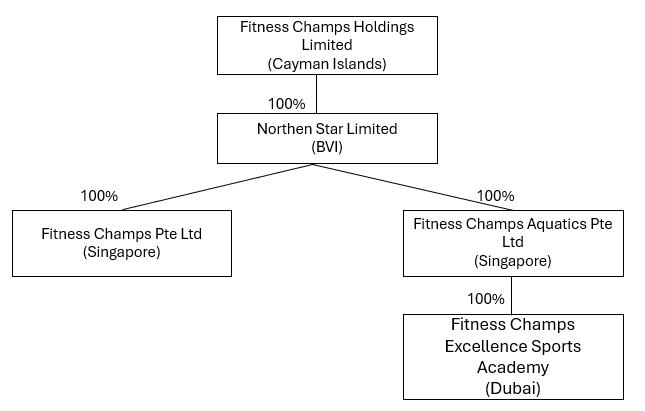
A description of our principal operating subsidiaries is set out below.
Fitness Champs
Fitness Champs was incorporated in Singapore on December 5, 2012. Fitness Champs is our indirect wholly-owned subsidiary and has an issued share capital of 10,000 shares, all of which are held by Northen Star Limited, our direct wholly-owned subsidiary following an internal group reorganization on June 19, 2024. Fitness Champs carries on the business of sports education in the form of swimming lessons provided through government related contracts through Singapore’s national SwimSafer program.
Fitness Aquatics
Fitness Aquatics was incorporated in Singapore on July 15, 2015. Fitness Aquatics is our indirect wholly-owned subsidiary and has an issued share capital of 1,000 shares, all of which are held by Northen Star, our direct wholly-owned subsidiary following an internal reorganization on June 19, 2024. Fitness Aquatics provides sports education in the form of private swimming lessons.
| 21 |
Business strategies
Our principal objective is to sustain continuous growth in our business and strengthen our market position in the provision of swimming lessons and aquatic sports by implementing the following business strategies and plans:
| ● | Geographical expansion into new markets in the region | |
| ● | Expansion of our business through acquisitions, joint ventures and/or strategic alliances |
Item 4A. Unresolved Staff Comments
None.
Item 5. Operating And Financial Review and Prospects
Overview
Fitness Champs is a distinguished sports education provider, playing a pivotal role in shaping the aquatic landscape in Singapore. Through our wholly-owned subsidiaries, Fitness Champs and Fitness Aquatics (collectively referred to as the “Group”), we believe that we are a leader in the domain of sports education, specializing in swimming programs for students. We are expanding into other markets, most recently entering into contracts to offering swimming lessons to residential towers in Dubai.
Our diverse portfolio of business activities reflects our commitment to fostering a culture of water safety and proficiency. The core components of our operations include:
● School-Based Swimming Lessons:
As a certified partner of the Singapore Government, we are actively engaged in the SwimSafer program, administered by the MOE. This national initiative aims to instill water safety awareness and equip students in public schools with essential swimming and survival skills. By contributing to this program, we play a vital role in elevating the overall standard of swimming proficiency across Singapore.
● Private Swimming Lessons and Aquatic Sports:
We extend our expertise beyond school programs, offering comprehensive swimming lessons to a diverse demographic ranging from children as young as 4 years old to youths and adults. With the flexibility of solo swim classes at any preferred location and classes held at various public swimming pools, we cater to the unique needs and preferences of our students. Additionally, our commitment to aquatic sports shines through classes encompassing competitive swimming, and lifesaving.
● Merchandise:
Complementing our educational endeavors, we proudly offer a range of carefully curated merchandise and apparel. From swimming goggles, swim caps, and swimsuits to various flotation devices, our merchandise is not only functional but also bears the distinct mark of our identity. Adorned with the company’s logo and brand name, “Fitness Champs,” in deep marine blue and white, our merchandise represents a tangible connection to the values we uphold. While this does not generate material revenue, we feel this is an important aspect of marketing our brand.
As of the date of this annual report, our Group has successfully obtained more than 1,042 contracts with schools through our designation by the MOE as a SwimSafer provider, and more than 191,000 students have been certified by our coaches in the SwimSafer program since 2013. During the same time period, we have worked with more than 12,000 students through private swim classes. Our founder, Ms. Lee, has been a swim coach for more than 26 years since 1999 and is registered with the NROC.
| 22 |
Key Factors Affecting Results of Operations
We believe our financial condition and results of operations have been and will continue to be affected by a number of factors, many of which may be beyond our control, including those factors set out in the section headed “Risk Factors” in this annual report and those set out below:
| ● | Government Policies and Regulations: |
Changes in government policies, especially in the education sector, may affect our programs and contracts.
| ● | Economic Conditions: |
Economic fluctuations can influence consumer spending on non-essential services, impacting our revenue from private lessons and merchandise.
| ● | Competition: |
Intense competition in the aquatics sports education sector may affect our market share and pricing strategies.
| ● | Customer Demand and Preferences: |
Shifting trends in customer preferences or declining demand for swimming programs may impact our revenue.
| ● | Instructor Availability: |
A shortage of certified swim coaches may affect our ability to meet the demand for lessons and programs.
| ● | Public Health Events |
Outbreaks of diseases or pandemics can disrupt operations, affecting both program delivery and customer participation.
| ● | Government support |
During the COVID-19 pandemic, the Singapore government provided significant assistance to support all industries. To cope with the elevated manpower costs resulting from Leave of Absence, Stay-Home Notice and the closure of the public spacing and facilities due to Circuit Breaker. Additionally, the government has helped companies address their acute worker shortages in the immediate term by increasing the inflow of new workers and bringing back existing workers. Any reduction or termination of such pandemic-era governmental support may negatively impact the business’s operations and cashflow.
Regular monitoring, strategic adaptation, and proactive management of these factors are crucial to maintaining the resilience and success of our group’s operations.
Results of Operations and Comparison for the Years ended December 31, 2024 and 2025
The following discussion is based on our Group’s historical results of operations and may not be indicative of our Group’s future operating performance.
| 23 |
5.A. Operating Results.
The following table sets forth certain operational data for the years ended December 31, 2023, 2024 and 2025
| Years ended December 31, | |||||||||||||||||||
| Note | 2023 | 2024 | 2025 | 2025 | |||||||||||||||
| S$’000 | S$’000 | S$’000 | US$’000 Note 2(d) | ||||||||||||||||
| Revenues | 3,13 | 4,650 | 4,216 | 4,150 | 3,232 | ||||||||||||||
| Cost of revenue | (2,660 | ) | (2,694 | ) | (3,015 | ) | (2,348 | ) | |||||||||||
| Gross profit | 1,990 | 1,522 | 1,135 | 884 | |||||||||||||||
| Operating expenses: | |||||||||||||||||||
| Selling and distribution | (25 | ) | (173 | ) | (333 | ) | (260 | ) | |||||||||||
| General and administrative | (759 | ) | (1,303 | ) | (2,274 | ) | (1,771 | ) | |||||||||||
| Total operating expenses | (784 | ) | (1,476 | ) | (2,607 | ) | (2,031 | ) | |||||||||||
| Profit/(Loss) from operations | 1,206 | 46 | (1,472 | ) | (1,147 | ) | |||||||||||||
| Other income (expense): | |||||||||||||||||||
| Interest income | 3 | 6 | 4 | 3 | |||||||||||||||
| Interest expense | (22 | ) | (25 | ) | (19 | ) | (15 | ) | |||||||||||
| Government grants | 48 | 114 | 94 | 74 | |||||||||||||||
| Rental income | - | 30 | 32 | 25 | |||||||||||||||
| Total other income, net | 29 | 125 | 111 | 87 | |||||||||||||||
| Income/(Loss) before income tax | 1,235 | 171 | (1,361 | ) | (1,060 | ) | |||||||||||||
| Income tax (expense) benefit | 14 | (117 | ) | 1 | (4 | ) | (3 | ) | |||||||||||
| NET INCOME/(LOSS) | 1,118 | 172 | (1,365 | ) | (1,063 | ) | |||||||||||||
| Other comprehensive income | |||||||||||||||||||
| Items that may be reclassified subsequently to profit or loss: | |||||||||||||||||||
| Currency translation differences arising from consolidation | - | - | (7 | ) | (6 | ) | |||||||||||||
| TOTAL COMPREHENSIVE INCOME/(LOSS) | 1,118 | 172 | (1,372 | ) | (1,069 | ) | |||||||||||||
| Earnings/(Loss) per ordinary share | |||||||||||||||||||
| Basic and diluted | 1,118 | 20.98 | (141.69 | ) | (110.34 | ) | |||||||||||||
| Weighted average number of ordinary shares | |||||||||||||||||||
| Basic and diluted* | - | ** | 8,197 | 9,634 | 9,634 | ||||||||||||||
* Retrospectively presented for the effect of (i) the issuance of 1 ordinary share on February 15, 2024 in preparation of the Company’s initial public offering, (ii) the 1:200 share subdivision and 5,000,000 share surrender approved on October 2, 2024, (iii) the 15 for 1 reverse share split effected on February 12, 2026, and (iv) the 30 for 1 reverse share split effected on May 4, 2026.
** Below S$1,000/US$1,000
| 24 |
As set forth in the following table, for the years ended December 31, 2024 and 2025 respectively, our revenue was derived from the following segment:
| For the years ended December 31, | ||||||||||||||||||||
| 2024 | 2025 | |||||||||||||||||||
| S$’000 | % | S$’000 | US$’000 | % | ||||||||||||||||
| Government sector | 1,700 | 40.3 | 1,701 | 1,325 | 41.3 | |||||||||||||||
| Private sector | 2,516 | 59.7 | 2,449 | 1,907 | 58.7 | |||||||||||||||
| Total | 4,216 | 100.0 | 4,150 | 3,232 | 100.0 | |||||||||||||||
Our revenue for the years ended December 31, 2024 and 2025 is diversified across public and private sectors. Public sector income is driven by school-based programs and made up approximately 40% of our revenue for the years ended December 31, 2024 and 2025. In the private sector, revenue is mainly from private lessons and aquatic sports, pickleball, and sales of merchandise products, accounting for approximately 60% of our revenue for the years ended December 31, 2024 and 2025.
Total revenue decreased by approximately S$66,000 or 1.6% to approximately S$4.150 million (US$3.232 million) for the year ended December 31, 2025 from approximately S$4.216 million for the year ended December 31, 2024.
There was a reduction in revenue in both sectors for the year ended 2025 as compared to the year ended 2024 mainly attributed slightly lower enrolment levels during the financial year in 2025.
Revenue by geographical location
For the years ended December 31, 2024 and 2025, all of our net revenue was derived from customers located in Singapore.
Cost of revenue
Our cost of revenue primarily consists of test fees, certification fees and coaches’ fees. For the years ended December 31, 2024 and 2025, our cost of revenue was S$2.694 million and S$3.015 million (US$2.348 million), respectively. Our cost of revenue increased by S$321,000 or 12.0% mainly due to an increase in coaches’ fees.
Coaches’ fees increased by approximately S$322,000, or 13.9%, to approximately S$2.638 million (US$2.056 million) for the year ended December 31, 2025, compared to S$2.317 million for the year ended December 31, 2024. The increase was primarily attributable to higher hourly rates paid to coaches, as well as the continued engagement of coaches to support our training programs despite lower revenue recognized during the financial year.
Assessment fees and certification fees increased by approximately S$11,000, or 5.3% to approximately S$220,000 (US$171,000) compared to S$209,000 in the year ended December 31, 2024. Assessment fees increased slightly by approximately S$11,000, generally due to an overall rise in assessment cost during the year.
Merchandise cost has decreased by approximately S$34,000, or 47.2% to approximately S$38,000 (US$30,000) compared to S$72,000 in the year ended December 31, 2024. The decrease was primarily attributable to higher purchases of merchandise in the prior year, which reduced the need for purchases in the current year.
| 25 |
Gross profit and gross profit margin
The table below sets forth our gross profit and gross profit margin by segments for the years indicated as follows:
| For the years ended December 31, | ||||||||||||||||||
| 2024 | 2025 | |||||||||||||||||
Gross profit S$’000 | Gross profit margin% | Gross profit S$’000 | Gross profit US$’000 | Gross profit margin% | ||||||||||||||
| Government sector | 232 | 13.6 | 179 | 139 | 10.5 | |||||||||||||
| Private sector | 1,290 | 51.3 | 956 | 745 | 39.0 | |||||||||||||
| Total | 1,522 | 36.1 | 1,135 | 884 | 27.3 | |||||||||||||
The decline in the gross profit margin from 36.1% for the year ended December 31, 2024 to 27.3% for the year ended December 31, 2025 can be attributed to an increase in coaches’ fees, which resulted in lower profit margins.
Our gross profit decreased by approximately S$387,000 or 25.4% during the year ended December 31, 2025 from the corresponding year before, due to drop in the number of students.
Gross profit margin for sales derived from the government sector decreased by 3.1% to 10.5% for the year ended December 31, 2025 from 13.6% for the corresponding year in 2024 mainly due to a decrease in school related projects.
Gross profit margin for sales derived from private sector decreased by 12.3% to 39.0% for the year ended December 31, 2025 from 51.3% for the year ended December 31, 2024 mainly to a reduction in student enrolments and less than optimal class sizes.
The overall decline in our gross profit margin was primarily attributable to lower class ratios and a reduction in the number of MOE contracts during the financial year. The reduction in MOE contracts was mainly due to the normalization of demand following the COVID-19 pandemic. During the pandemic, swimming lessons under school programmes were suspended or disrupted due to lockdown restrictions, resulting in students being unable to complete their swimming modules. After restrictions were lifted, programmes gradually resumed and multiple cohorts of students participated to catch up on delayed lessons, leading to higher participation levels in FY2023 and FY2024. As most of these backlog cohorts have since completed their programmes, participation levels in FY2025 have normalized to the typical annual cohort size, which largely comprises Primary 3 students under the existing programme structure, resulting in fewer MOE contracts compared to the prior periods. In addition, enrolment in the private sector is declined as activities and enrichment options normalized following the reopening of the economy, leading to increased availability of alternative activities for students.
Selling and distribution
Our selling and distribution expenses primarily consist of marketing and entertainment expenses. For the years ended December 31, 2024 and 2025, selling and distribution expenses were S$173,000 and S$333,000 (US$260,000), respectively. The increase was primarily attributable to a company-wide rebranding initiative, including updates to our logo, flyers, and letterheads. In addition, we engaged a marketing firm to support lead generation and other promotional activities.
| For the years ended December 31, | ||||||||||||||||||||
| 2024 | 2025 | |||||||||||||||||||
| S$’000 | % | S$’000 | US$’000 | % | ||||||||||||||||
| Entertainment expenses | - | - | 2 | 2 | 0.8 | |||||||||||||||
| Marketing expenses | 173 | 100.0 | 331 | 258 | 99.2 | |||||||||||||||
| Total | 173 | 100.0 | 333 | 260 | 100.0 | |||||||||||||||
| 26 |
General and administrative
The following table sets forth the breakdown of our general and administrative expenses for the periods indicated:
| For the years ended December 31, | ||||||||||||||||||||
| 2024 | 2025 | |||||||||||||||||||
| S$’000 | % | S$’000 | US$’000 | % | ||||||||||||||||
| Bank charges | 10 | 0.8 | 10 | 8 | 0.5 | |||||||||||||||
| Depreciation and amortization | 84 | 6.4 | 101 | 78 | 4.4 | |||||||||||||||
| Director’s fee | - | - | 46 | 36 | 2.1 | |||||||||||||||
| Legal and professional fees | 157 | 12.1 | 449 | 350 | 20.0 | |||||||||||||||
| Staff costs | 984 | 75.5 | 1,368 | 1,065 | 60.6 | |||||||||||||||
| Stakeholder engagement event | - | - | 128 | 100 | 5.7 | |||||||||||||||
| Others | 68 | 5.2 | 172 | 134 | 6.7 | |||||||||||||||
| Total | 1,303 | 100.0 | 2,274 | 1,771 | 100.0 | |||||||||||||||
Our general and administrative expenses incurred were approximately S$1.303 million and S$2.274million (US$1.771 million), for the years ended December 31, 2024 and 2025, respectively, representing approximately 85.6%, and 198.5% of our gross profit for the corresponding years.
Bank charges mainly represent charges incurred on trade-related activities such as remittance charges.
Depreciation expense is charged on our plant and equipment, which includes (i) computer & software; (ii) renovation expenses; (iii) investment property; and (v) furniture and fittings
Amortization relates to the allocation charges over the useful life of the software purchased for our student portal management system.
Directors’ fees for the year ended December 31, 2025 relate to remuneration for our independent directors appointed following the listing of the company on September 4, 2025. As such, there is no comparative figure for the year ended December 31, 2024.
Legal and professional fees primarily consist of auditor’s remuneration, outsourced legal advice, corporate secretarial services, and investor relations support. For the years ended December 31, 2024 and 2025, legal and professional fees amounted to S$157,000 and S$449,000 (US$350,000), respectively. The increase was mainly attributable to higher professional service fees incurred in connection with ongoing compliance and corporate governance requirements as a publicly listed company, including the engagement of legal counsel, corporate secretarial services, auditors, and investor relations support.
Staff costs primarily comprised salaries, employee benefits, retirement contributions for administrative employees, and directors’ remuneration. For the years ended December 31, 2024 and 2025, staff costs amounted to approximately S$984,000 and S$1.368 million (US$1.065 million), respectively, reflecting an increase of about S$384,000. This increase was mainly attributable to higher directors’ remuneration and the hiring of additional administrative staffs to support overall business growth. These costs include employee salaries, bonuses, allowances, and contributions to the Singapore Central Provident Fund.
Stakeholder engagement event, a one-off event, amounted to approximately S$128,000 (US$100,000) for the year ended December 31, 2025. The event brought together coaches, students, and other key stakeholders, and included activities such as a dinner, lucky draw, and other engagement initiatives.
Miscellaneous expenses were comprised of insurance expenses, office supplies, repair and maintenance and other general expenses.
| 27 |
Total other income (expense), net
The following table sets forth the breakdown of total other income (expense), net, for the years indicated:
| For the years ended December 31, | ||||||||||||
| 2024 | 2025 | |||||||||||
| S$’000 | S$’000 | US$’000 | ||||||||||
| Interest income | 6 | 4 | 3 | |||||||||
| Interest expense | (25 | ) | (19 | ) | (15 | ) | ||||||
| Other Income | 11 | 6 | 5 | |||||||||
| Government grants | 103 | 88 | 69 | |||||||||
| Rental income | 30 | 32 | 25 | |||||||||
| Total | 125 | 111 | 87 | |||||||||
Our net total other income was S$125,000 for the year ended December 31, 2024 and S$111,000 (US$87,000) for the year ended December 31, 2025, primarily as a result of government grants net of interest expenses.
Interest income
Interest income earned from bank fixed deposit.
Interest expense
Our interest expense arose from secured bank loans. Interest expenses were approximately S$25,000 and S$19,000 (US$15,000) for the years ended December 31, 2024 and 2025 respectively. For more details of our bank borrowings, please see the paragraph headed “Bank Indebtedness” in this section.
Other income
Other Income of approximately S$6,000 (US$5,000) comprise of government paid leave and corporate income tax rebates for the year ended December 31, 2025 and S$11,000 for the year ended December 31, 2024.
Government grants
Government grants comprise mainly grants received for Jobs Growth Incentive (“JGI”), Progressive Wage Credit (“PWCS”), Senior Employment Credit, and Small Business Recovery Grant.
The JGI is an initiative introduced by the Singapore Government in August 2020 to support local hiring from September 2020 to March 2023, to provide wage support to employers to help them in hiring local employees by co-funding monthly salaries paid to each local employee.
The PWCS is an initiative introduced by the Singapore Government in 2022 to provide transitional wage support for employers to adjust to upcoming mandatory wage increases for lower-wage workers covered by the Progressive Wage and Local Qualifying Salary requirements and to voluntarily raise wages of lower-wage workers. Under the scheme, the Singapore Government will co-fund wage increases of eligible resident employees from 2022 to 2026 and receive the payout for the respective year by the first quarter of the following year.
For the year ended December 31, 2025, government grants of approximately S$13,000 (US$10,000) from PWCS and Senior Employment Credit and S$42,000 (US$ 33,000) from Enterprise Singapore Business Matching in Korea and digital marketing campaigns. For the year ended December 31, 2024, government grants of S$49,000 (US$36,000) from PWCS and Senior Employment Credit and S$52,000 (US$ 38,000) from Enterprise Singapore Business Matching in Korea and digital marketing campaign.
Rental income
Rental income of approximately S$32,000 (US$ 25,000) and S$30,000 primarily relates to the rental of office space recognized in the year ended December 31, 2025 and 2024.
| 28 |
Income tax expense
Income tax expense for the year ended December 31, 2024 comprised current year tax of S$4,000, net of an overprovision of S$5,000 relating to the prior year. For the year ended December 31, 2025, income tax expense comprised current year tax, adjusted for a under provision of S$4,000 (US$3,000) in the prior year.
Net Income/(Loss)
As a result of the foregoing, our net income amounted to approximately S$172,000 and loss of S$1.344 million (US$1.046 million) for the years ended December 31, 2024 and 2025, respectively.
Liquidity and Capital Resources
Our liquidity and working capital requirements primarily relate to our operating expenses. Historically, we have met our working capital and other liquidity requirements through a combination of cash generated from our operations, loans from banking facilities and net proceeds received from initial public offering. Going forward, we expect to fund our working capital and other liquidity requirements from various sources, including but not limited to cash generated from our operations, loans from banking facilities, the net proceeds from initial public offering, the net proceeds from future offering and other equity and debt financings, as and when appropriate.
Material Cash Requirements
Our cash requirements consist primarily of day-to-day operating expenses, capital expenditures and contractual obligations with respect to facility leases and other operating leases. We lease our office premises. We expect to make future payments on existing leases from cash generated from operations. We have limited credit available from our major vendors and are required to prepay the majority of our consumable purchases, which further constraints our cash liquidity.
We had the following contractual obligations as of December 31, 2025:
| Contractual Obligations in S$’000 | Total | Less than 1 year | 2 – 3 years | 3 – 5 years | More than 5 years | |||||||||||||||
| Property loans | 398 | 10 | 11 | 35 | 342 | |||||||||||||||
| Refund liability | 92 | 92 | - | - | - | |||||||||||||||
| Total obligations | 490 | 102 | 11 | 35 | 342 | |||||||||||||||
Cash flows – 2024 and 2025
The following table summarizes our cash flows for the years ended December 31, 2024 and 2025:
| Years ended December 31, | ||||||||||||
| 2024 | 2025 | |||||||||||
| S$’000 | S$’000 | US$’000 | ||||||||||
| Cash and cash equivalent at beginning of the year | 815 | 314 | 230 | |||||||||
| Net cash provided by operating activities | 82 | 614 | 447 | |||||||||
| Net cash used in investing activities | (86 | ) | (28 | ) | (22 | ) | ||||||
| Net cash (used in)/provided by financing activities | (497 | ) | 1,097 | 877 | ||||||||
| Effect of Exchange Rate Changes on Cash | - | (7 | ) | (17 | ) | |||||||
| Net change in cash and cash equivalent | (501 | ) | 1,683 | 1,302 | ||||||||
| Cash and cash equivalent as at end of the year | 314 | 1,990 | 1,549 | |||||||||
| 29 |
Cash flows from operating activities
For the year ended December 31, 2025, our net cash provided by operating activities was approximately S$614,000 (US$447,000), primarily reflecting net loss after tax of approximately S$1.365 million (US$1.063 million), as adjusted by the following:
(a) positive changes of approximately S$101,000 (US$77,000) in non-cash items primarily including depreciation and amortization;
(b) an increase of approximately S$19,000 (US$15,000) in interest expense;
(c) a decrease of approximately S$4,000 (US$3,000) in interest income;
(d) a decrease of approximately S$7,000 (US$36,000) in foreign reserve; and
(e) positive changes of approximately S$1,842,000 (US$1,403,000) in working capital primarily reflecting (i) a decrease of approximately S$1,304,000 (US$951,000) in deposit, prepayment and other receivables, (ii) an increase of approximately S$555,000 (US$466,000) in payable and (iv) a decrease of approximately S$4,000 (US$3,000) in income tax payable.
For the year ended December 31, 2024, our net cash provided by operating activities was approximately S$82,000 (US$61,000), primarily reflecting net profit after tax of approximately S$172,000 (US$126,000), as adjusted by the following:
(a) positive changes of approximately S$84,000 (US$62,000) in non-cash items primarily including depreciation and amortization;
(b) an increase of approximately S$25,000 (US$18,000) in interest expense;
(c) a decrease of approximately S$6,000 (US$4,000) in interest income; and
(d) negative changes of approximately S$193,000 (US$141,000) in working capital primarily reflecting (i) an increase of approximately S$1,000 (US$1,000) in accounts receivable (ii) a decrease of approximately S$85,000 (US$63,000) in deposit, prepayment and other receivables, (iii) an increase of approximately S$77,000 (US$57,000) in payable and (iv) a decrease of approximately S$186,000 (US$136,000) in income tax payable.
Cash flows from investing activities
For the year ended December 31, 2025, our net cash used in investing activities totaled approximately S$28,000 (US$22,000). This figure primarily comprised a purchase of property, plant, and equipment amounting to S$1,000 (US$1,000) and intangible asset amounting to S$31,000 (US$24,000). It was partially offset by the interest income of S$4,000 (US$3,000).
For the year ended December 31, 2024, our net cash used in investing activities totaled approximately S$86,000 (US$63,000). This figure primarily comprised a purchase of property, plant, and equipment amounting to S$33,000 (US$24,000) and intangible asset amounting to S$59,000 (US$43,000). It was partially offset by the interest income of S$6,000 (US$4,000).
Cash flows from financing activities
For the year ended December 31, 2025, our net cash provided by financing activities was approximately S$1.10 million (US$877,000), primarily consisting of proceeds from the issuance of share capital of approximately S$2.127 million (US$1.656 million); repayment of a loan of approximately S$62,000 (US$27,000), interest paid of approximately S$19,000 (US$15,000); lease payment of S$37,000 (US$27,000), advances of loan from Director to Company of S$730,000 (US$568,000) and repayments of loans to a director of S$1.641 million (US$1.278 million).
For the year ended December 31, 2024, our net cash used in financing activities was approximately S$497,000 (US$364,000), primarily consisting of a dividend of S$300,000 (US$220,000) paid to a shareholder of the Company; repayment of a loan of approximately S$112,000 (US$82,000), interest paid of approximately S$22,000 (US$16,000); lease payment of S$38,000 (US$28,000); advances of loan from Director to Company of S$1.254 million (US$920,000); repayments of loans from a director of S$125,000 (US$92,000) and advance payment of transaction cost in connection to the issuance of shares of S$1.15 million (US$845,000).
| 30 |
Capital Expenditures
There were capital expenditures of S$92,000 and S$32,000 incurred in the years ended December 31, 2024 and December 31, 2025, respectively.
We plan to fund our future capital expenditures with our existing cash balance and proceeds from the initial public offering. We will continue to make capital expenditures to meet the expected growth of our business.
Working Capital
We believe that we have sufficient working capital for our requirements for at least the next 12 months from the date of this annual report, in the absence of unforeseen circumstances, considering the financial resources presently available to us, including cash and cash equivalents on hand and cash flows from our operations.
Accounts receivable
For the year ended December 31, 2024 and December 31, 2025, there were no amount outstanding from trade receivables.
We determine, on a continuing basis, the probable losses and an allowance for doubtful accounts, based on several factors including internal risk ratings, customer credit quality, payment history, historical bad debt/write-off experience and forecasted economic and market conditions. Accounts receivables are written off after exhaustive collection efforts occur and the receivable is deemed uncollectible. In addition, receivable balances are monitored on an ongoing basis and we believe that our exposure to bad debts is nominal.
Amount due from (to) director
Amount due to director had a balance S$1.129 million and S$218,000 (US$170,000) as of December 31, 2024 and December 31, 2025 respectively. The amount due from (to) director is non-trade, unsecured, interest free and repayable on demand.
Accounts payable and accrued liabilities
| Years ended December 31, | ||||||||||||
| 2024 | 2025 | |||||||||||
| S$’000 | S$’000 | US$’000 | ||||||||||
| Accounts payable | 79 | 16 | 13 | |||||||||
| Other payables | 21 | 569 | 444 | |||||||||
| Accruals | 168 | 208 | 162 | |||||||||
| Deposit received | 99 | 92 | 71 | |||||||||
| Deferred revenue | 352 | 389 | 302 | |||||||||
| Total | 719 | 1,274 | 992 | |||||||||
Our account payable was approximately S$719,000 as of December 31, 2024 and S$1.274 million (US$992,000) as of December 31, 2025. The majority of the account payable consists of deposit received and deferred revenue received. Although these fees are classified under accounts payable, the nature of it is the same as deferred revenue as fees are collected before swimming classes are provided.
Deferred revenue is a contract liability in that the Company is obligated to transfer services to customers for which the Company has received advance swimming fees from customers in the form of cash. The balance of “deferred revenue” represents unfulfilled performance obligations in the sales agreement, i.e. services that have not yet been rendered. Once the service has been rendered, the amount in the “Deferred revenue” account is shifted to a revenue account.
| 31 |
Deferred revenue recognized as revenue during the respective years ended December 31, 2024 and 2025 was S$462,000 and S$352,000 (US$257,000), respectively.
We did not have any material default in payment of accounts payable during the years ended December 31, 2024 and 2025.
Contractual Obligations
We believe that we have sufficient working capital for our requirements for at least the next 12 months from the date of this annual report, absent unforeseen circumstances, taking into account the financial resources presently available to us, including cash and cash equivalents on hand and cash flows from our operations.
We had the following contractual obligations as of December 31, 2025:
| Contractual Obligations in S$’000 | Total | Less than 1 year | 2 – 3 years | 3 – 5 years | More than 5 years | |||||||||||||||
| Property loans | 398 | 10 | 11 | 35 | 342 | |||||||||||||||
| Refund liability | 92 | 92 | - | - | - | |||||||||||||||
| Total obligations | 490 | 102 | 11 | 35 | 342 | |||||||||||||||
We had the following contractual obligations and lease commitments as of December 31, 2024:
| Contractual Obligations in S$’000 | Total | Less than 1 year | 1 – 3 years | 3 – 5 years | More than 5 years | |||||||||||||||
| Property loans | 407 | 9 | 20 | 22 | 356 | |||||||||||||||
| Working capital loans | 53 | 53 | — | — | — | |||||||||||||||
| Operating lease liabilities | 37 | 37 | — | — | — | |||||||||||||||
| Refund liability | 94 | 94 | — | — | — | |||||||||||||||
| Total obligations | 591 | 193 | 20 | 22 | 356 | |||||||||||||||
Bank indebtedness
| Bank Borrowings | Terms of Repayments | Annual Interest Rate (%) | As of December 31, 2025 | |||||||||||||
| S$’000 | US$’000 | |||||||||||||||
| Property loan | 27 years | 3.75 | 398 | 310 | ||||||||||||
| Total | 398 | 310 | ||||||||||||||
| Bank Borrowings | Terms of Repayments | Annual Interest Rate (%) | As of December 31, 2024 | |||||||||||||
| S$’000 | US$’000 | |||||||||||||||
| Term loan | 5 years | 2.50 | 53 | 39 | ||||||||||||
| Property loan | 27 years | 4.82 | 407 | 298 | ||||||||||||
| Total | 460 | 337 | ||||||||||||||
The term loan of S$500,000 was an unsecured borrowing from OCBC bank obtained in 2020 with an annual fixed interest rate of 2.50%. The loan is for a period of 5 years up to 2025. This amount was used to finance the expansion of our business. The term loan has matured by June 30, 2025.
| 32 |
The mortgage loan of S$420,000 was a secured borrowing from OCBC bank obtained in 2023. The loan is for a period of 27 years up to 2050 with an annual variable interest rate of 3.75%. This amount was used to finance the purchasing of our office at 7030 Ang Mo Kio Avenue 5 #09-102 Singapore 569880.
The Company’s bank borrowings currently are guaranteed by a personal guarantee from Ms. Lee, a director and shareholder of the Company.
Comparison of operating results for the years ended December 31, 2023 and 2024
The following discussion is based on our Group’s historical results of operations and may not be indicative of our Group’s future operating performance.
Revenue
As set forth in the following table, for the years ended December 31, 2023 and 2024 respectively, our revenue was derived from the following segment:
| For the years ended December 31, | ||||||||||||||||||||
| 2023 | 2024 | |||||||||||||||||||
| S$’000 | % | S$’000 | US$’000 | % | ||||||||||||||||
| Government sector | 1,994 | 42.9 | 1,700 | 1,244 | 40.3 | |||||||||||||||
| Private sector | 2,656 | 57.1 | 2,516 | 1,842 | 59.7 | |||||||||||||||
| Total | 4,650 | 100.0 | 4,216 | 3,086 | 100.0 | |||||||||||||||
Our revenue for the years ended December 31, 2024 and 2023 is diversified across public and private sectors. Public sector income is driven by school-based programs and made up approximately 40% of our revenue for the years ended December 31, 2023 and 2024. In the private sector, revenue is mainly from private lessons and aquatic sports, and sales of merchandise products, accounting for approximately 60% of our revenue for the years ended December 31, 2023 and 2024.
Total revenue decreased by approximately S$434,000 or 9.3% to approximately S$4.216 million (US$3.086 million) for the year ended December 31, 2024 from approximately S$4.650 million for the year ended December 31, 2023.
There was a reduction in revenue in both sectors for the year ended 2024 as compared to the year ended 2023 mainly attributed to fewer MOE contracts being awarded and closure of certain swimming pools in early 2024, resulting in a reduction of students as some customers found it inconvenient to travel to new locations.
Revenue by geographical location
For the years ended December 31, 2023 and 2024, all of our net revenue was derived from customers located in Singapore. We do have plans to expand beyond Singapore.
Cost of revenue
Our cost of revenue primarily consists of test fees, certification fees and coaches’ fees. For the years ended December 31, 2023 and 2024, our cost of revenue was S$2.660 million and S$2.694 million (US$1.972 million), respectively. Our cost of revenue increased by S$34,000 or 1.3% mainly due to an increase in coaches’ fees and cost of merchandise.
Coaches’ fees increased by approximately S$8,000, or 0.3% to approximately S$2.317 million (US$1.702 million) compared to S$2.309 million for the year ended December 31,2023. The increase was as a result of efforts to introduce more classes to the students and hence, we increased class offerings that necessitated higher coaches’ fees. However, overall student enrollment was still lower than in 2023 because even though we increased the number of classes offered, these classes were not at maximum enrollment.
| 33 |
Entrance fees decreased by approximately S$31,000, or 13.1% to approximately S$209,000 (US$153,000) compared to S$240,000 in the year ended December 31, 2023. The reduction in students in 2024 led to a decrease in overall entrance fee expenses.
Assessment fees decreased by approximately S$11,000, or 13.5% to approximately S$71,000 (US$52,000) compared to S$82,000 in the year ended December 31, 2023. The reduction in students in 2024 led to a decrease in overall assessment fees and certifications.
Cost of goods sold – merchandise and related shipment cost increased by approximately S$47,000, or 1673% to approximately S$75,000 (US$55,000) compared to S$28,000 in the year ended December 31, 2023. The increase in 2024 was due to a change in the design of our apparel to enhance our corporate image in our re-branding exercise in the first half year of 2024.
Gross profit and gross profit margin
The table below sets forth our gross profit and gross profit margin by segments for the years indicated as follows:
| For the years ended December 31, | ||||||||||||||||||
| 2023 | 2024 | |||||||||||||||||
Gross profit S$’000 | Gross profit margin% | Gross profit S$’000 | Gross profit US$’000 | Gross profit margin% | ||||||||||||||
| Government sector | 299 | 15.0 | 232 | 170 | 13.7 | |||||||||||||
| Private sector | 1,691 | 63.7 | 1,290 | 944 | 51.2 | |||||||||||||
| Total | 1,990 | 42.8 | 1,522 | 1,114 | 36.1 | |||||||||||||
The decline in the gross profit margin from 42.8% for the year ended December 31, 2023 to 36.1% for the year ended December 31, 2024 can be attributed to an increase in coaches’ fees, which resulted in lower profit margins.
Our gross profit decreased by approximately S$468,000 or 23.5% during the year ended December 31, 2024 from the corresponding year before, due to a dip in class ratio and a drop in the number of students due to pool closure for retrofitting.
Gross profit margin for sales derived from the government sector decreased by 1.3% to 13.7% for the year ended December 31, 2024 from 15.0% for the corresponding year in 2023 mainly due to a decrease in school related projects.
Gross profit margin for sales derived from private sector decreased by 12.5% to 51.2% for the year ended December 31, 2024 from 63.7% for the year ended December 31, 2023 mainly to a reduction in student enrolments and less than optimal class sizes.
The overall decline in our gross profit margin can be attributed mainly to dip in class ratio and fewer MOE contracts. The fewer MOE contracts are a result of the trickle-down effect of the COVID-19 pandemic as for the years after the pandemic. Students were unable to swim due to the lock down restrictions and classes were gradually reinstated and students were catching up after the easing of restrictions, hence we had multiple years of students taking classes through MOE contracts. Going forward, only Primary 3 grade students will participate in the MOE program so overall MOE numbers are down from recent prior years as a result.
Selling and distribution
Our selling and distribution expenses primarily consist of marketing and entertainment expenses. For the years ended December 31, 2023 and 2024, our selling and distribution expenses were S$25,000 and S$173,000 (US$126,000) respectively. The increase is attributed to the increase of digital advertisement and trade mission to regional countries.
| 34 |
| For the years ended December 31, | ||||||||||||||||||||
| 2023 | 2024 | |||||||||||||||||||
| S$’000 | % | S$’000 | US$’000 | % | ||||||||||||||||
| Entertainment expenses | 5 | 20.0 | - | - | - | |||||||||||||||
| Marketing expenses | 20 | 80.0 | 173 | 126 | 100.0 | |||||||||||||||
| Total | 25 | 100.0 | 173 | 126 | 100.0 | |||||||||||||||
General and administrative
The following table sets forth the breakdown of our general and administrative expenses for the periods indicated:
| For the years ended December 31, | ||||||||||||||||||||
| 2023 | 2024 | |||||||||||||||||||
| S$’000 | % | S$’000 | US$’000 | % | ||||||||||||||||
| Bank charges | 33 | 4.3 | 10 | 7 | 0.7 | |||||||||||||||
| Depreciation and amortization | 31 | 4.1 | 84 | 62 | 6.5 | |||||||||||||||
| Legal and professional fees | 1 | 0.1 | 157 | 115 | 12.1 | |||||||||||||||
| Staff costs | 645 | 85.0 | 984 | 720 | 75.5 | |||||||||||||||
| Others | 49 | 6.5 | 68 | 50 | 5.2 | |||||||||||||||
| Total | 759 | 100.0 | 1,303 | 954 | 100.0 | |||||||||||||||
Our general and administrative expenses incurred were approximately S$759,000 and S$1.3 million (US$954,000), for the years ended December 31, 2023 and 2024, respectively, representing approximately 38.2%, and 85.6% of our gross profit for the corresponding years.
Bank charges mainly represent charges incurred on trade-related activities such as remittance charges.
Depreciation expense is charged on our plant and equipment, which includes (i) computer & software; (ii) renovation expenses; (iii) investment property; and (v) furniture and fittings
Amortization relates to the allocation charges over the useful life of the software purchased for our student portal management system.
Legal and professional fees mainly represented auditor’s remuneration and outsourced of legal advice. Legal and professional fees for the years ended December 31, 2023 and 2024 amounted to S$1,000 and S$157,000 (US$115,000), respectively. The increase was mainly due to higher professional service fees as a result of the costs related to our initial public offering.
Staff costs primarily comprised salaries, employee benefits, retirement contributions for administrative employees, and directors’ remuneration. For the years ended December 31, 2023, and 2024, staff costs amounted to approximately S$645,000 and S$984,000 (US$720,000), respectively, reflecting an increase of about S$339,000. This increase was mainly attributable to higher directors’ remuneration and the hiring of additional administrative staff to support overall business growth. These costs include employee salaries, bonuses, allowances, and contributions to the Singapore Central Provident Fund.
Miscellaneous expenses were comprised of accounting fees, corporate secretarial and tax fees, insurance expenses, office supplies, repair and maintenance and other general expenses.
| 35 |
Total other income (expense), net
The following table sets forth the breakdown of total other income (expense), net, for the years indicated:
| For the years ended December 31, | ||||||||||||
| 2023 | 2024 | |||||||||||
| S$’000 | S$’000 | US$’000 | ||||||||||
| Interest income | 3 | 6 | 4 | |||||||||
| Interest expense | (22 | ) | (25 | ) | (18 | ) | ||||||
| Other Income | - | 11 | 8 | |||||||||
| Government grants | 48 | 103 | 75 | |||||||||
| Rental income | - | 30 | 22 | |||||||||
| Total | 29 | 125 | 91 | |||||||||
Our net total other income was S$29,000 for the year ended December 31, 2023 and S$125,000 (US$91,000) for the year ended December 31, 2024, primarily as a result of government grants net of interest expenses.
Interest income
Interest income earned from bank fixed deposit.
Interest expense
Our interest expense arose from secured bank loans. Interest expenses were approximately S22,000 and S$25,000 (US$18,000) for the years ended December 31, 2023 and 2024 respectively. For more details of our bank borrowings, please see the paragraph headed “Bank Indebtedness” in this section.
Other income
Other Income of approximately S$11,000 (US$8,000) comprise of government paid leave and corporate income tax rebates for the year ended December 31, 2024 and S$ nil for the year ended December 31, 2023.
Government grants
Government grants comprise mainly grants received for Jobs Growth Incentive (“JGI”), Progressive Wage Credit (“PWCS”), Senior Employment Credit, and Small Business Recovery Grant.
The JGI is an initiative introduced by the Singapore Government in August 2020 to support local hiring from September 2020 to March 2023, to provide wage support to employers to help them in hiring local employees by co-funding monthly salaries paid to each local employee.
The PWCS is an initiative introduced by the Singapore Government in 2022 to provide transitional wage support for employers to adjust to upcoming mandatory wage increases for lower-wage workers covered by the Progressive Wage and Local Qualifying Salary requirements and to voluntarily raise wages of lower-wage workers. Under the scheme, the Singapore Government will co-fund wage increases of eligible resident employees from 2022 to 2026 and receive the payout for the respective year by the first quarter of the following year.
For the year ended December 31, 2024, government grants of approximately S$49,000 (US$36,000) from PWCS and Senior Employment Credit and S$52,000 (US$ 38,000) from Enterprise Singapore Business Matching in Korea and digital marketing campaigns. For the year ended December 31, 2023, government grants of approximately S$48,000 comprised mainly from JGI and PWCS respectively.
Rental income
Rental income of approximately S$30,000 (US$ 22,000) primarily relates to the rental of office space recognized in the year ended December 31, 2024. In 2023, no rental income was recognized as the properties were used for the Group’s own operations.
| 36 |
Income tax expense
Income tax expense comprised current tax expense for the year ended December 31, 2023 and there is an overprovision of S$5,000 in prior year net of current year tax expense S$4,000 (US$3,000) for the year ended December 31, 2024.
Net Income
As a result of the foregoing, our net income amounted to approximately S$1.118 million and S$172,000 (US$126,000) for the years ended December 31, 2023 and 2024, respectively.
Liquidity and Capital Resources
Our liquidity and working capital requirements primarily relate to our operating expenses. Historically, we have met our working capital and other liquidity requirements through a combination of cash generated from our operations and loans from banking facilities. Going forward, we expect to fund our working capital and other liquidity requirements from various sources, including but not limited to cash generated from our operations, loans from banking facilities, the net proceeds from this initial public offering and other equity and debt financings, as and when appropriate.
Material Cash Requirements
Our cash requirements consist primarily of day-to-day operating expenses, capital expenditures and contractual obligations with respect to facility leases and other operating leases. We lease our office premises. We expect to make future payments on existing leases from cash generated from operations. We have limited credit available from our major vendors and are required to prepay the majority of our consumable purchases, which further constraints our cash liquidity.
We had the following contractual obligations and lease commitments as of December 31, 2024:
| Contractual Obligations in S$’000 | Total | Less than 1 year | 1 – 3 years | 3 – 5 years | More than 5 years | |||||||||||||||
| Property loans | 407 | 9 | 20 | 22 | 356 | |||||||||||||||
| Working capital loans | 53 | 53 | - | - | - | |||||||||||||||
| Operating lease liabilities | 37 | 37 | - | - | - | |||||||||||||||
| Refund liability | 94 | 94 | - | - | - | |||||||||||||||
| Total obligations | 591 | 193 | 20 | 22 | 356 | |||||||||||||||
Cash flows – 2023 and 2024
The following table summarizes our cash flows for the years ended December 31, 2023 and 2024:
| Years ended December 31, | ||||||||||||
| 2023 | 2024 | |||||||||||
| S$’000 | S$’000 | US$’000 | ||||||||||
| Cash and cash equivalent at beginning of the year | 504 | 815 | 596 | |||||||||
| Net cash provided by operating activities | 1,296 | 82 | 61 | |||||||||
| Net cash used in investing activities | (608 | ) | (86 | ) | (63 | ) | ||||||
| Net cash used in financing activities | (377 | ) | (497 | ) | (364 | ) | ||||||
| Net change in cash and cash equivalent | 311 | (501 | ) | (366 | ) | |||||||
| Cash and cash equivalent as at end of the year | 815 | 314 | 230 | |||||||||
| 37 |
Cash flows from operating activities
For the year ended December 31, 2024, our net cash provided by operating activities was approximately S$82,000 (US$61,000), primarily reflecting net profit after tax of approximately S$172,000 (US$126,000), as adjusted by the following:
(a) positive changes of approximately S$84,000 (US$62,000) in non-cash items primarily including depreciation and amortization;
(b) an increase of approximately S$25,000 (US$18,000) in interest expense;
(c) a decrease of approximately S$6,000 (US$4,000) in interest income; and
(d) negative changes of approximately S$193,000 (US$141,000) in working capital primarily reflecting (i) an increase of approximately S$1,000 (US$1,000) in accounts receivable (ii) a decrease of approximately S$85,000 (US$63,000) in deposit, prepayment and other receivables, (iii) an increase of approximately S$77,000 (US$57,000) in payable and (iv) a decrease of approximately S$186,000 (US$136,000) in income tax payable.
For the year ended December 31, 2023, our net cash provided by operating activities was approximately S$1.296 million (US$981,000), primarily reflecting net income after tax of approximately S$1.118 million (US$847,000), as adjusted by the following:
(a) positive changes of approximately S$31,000 (US$23,000) in non-cash items primarily including depreciation of property and equipment;
(b) an increase of approximately S$22,000 (US$17,000) in interest expense;
(c) a decrease of approximately S$3,000 (US$3,000) in interest income; and
(d) positive changes of approximately S$128,000 (US$97,000) in working capital primarily reflecting (i) a decrease of approximately S$1,000 (US$1,000) in accounts receivable, (ii) a decrease of approximately S$127,000 (US$96,000) in deposits, prepayment and other receivables, (iii) an increase of approximately S$203,000 (US$154,000) in payable and (iv) an increase of approximately S$53,000 (US$40,000) in income tax payable.
Cash flows from investing activities
For the year ended December 31, 2024, our net cash used in investing activities totaled approximately S$86,000 (US$63,000). This figure primarily comprised a purchase of property, plant, and equipment amounting to S$33,000 (US$24,000) and intangible asset amounting to S$59,000 (US$43,000). It was partially offset by the interest income of S$6,000 (US$4,000).
For the year ended December 31, 2023, our net cash used in investing activities totaled approximately S$608,000 (US$460,000). This figure primarily comprised a purchase of property, plant, and equipment amounting to S$611,000 (US$463,000).
Cash flows from financing activities
For the year ended December 31, 2024, our net cash used in financing activities was approximately S$497,000 (US$364,000), primarily consisting of a dividend of S$300,000 (US$220,000) paid to a shareholder of the Company; repayment of a loan of approximately S$112,000 (US$82,000), interest paid of approximately S$22,000 (US$16,000); lease payment of S$38,000 (US$28,000); net balances of loans from a director of S$1.129 million (US$827,000) and advance payment of transaction cost in connection to the issuance of shares of S$1.154 million (US$845,000).
For the year ended December 31, 2023, our net cash used in financing activities was approximately S$377,000 (US$286,000), primarily consisting of a loan drawdown of approximately S$420,000 (US$318,000) offset by a repayment of loan of approximately S$105,000 (US$79,000), interest paid of approximately S$22,000 (US$17,000), net balances of loans to and from the director of S$670,000 (US$508,000) and dividends amounting to S$1.236 million (US$937,000) were paid by offsetting them from the amount due from a director.
| 38 |
Capital Expenditures
There were capital expenditures of S$611,000 and S$92,000 incurred in the years ended December 31, 2023 and December 31, 2024, respectively.
We plan to fund our future capital expenditures with our existing cash balance and proceeds from this public initial offering. We will continue to make capital expenditures to meet the expected growth of our business.
Going concern
As of December 31, 2024, the Company’s negative operating cash flow and net current liability position raise substantial doubt about the Company’s ability to continue as a going concern. In assessing the going concern, management and the Board have considered the following:
1. Ongoing support from our chief executive officer, demonstrated by the substantial related-party financing.
2. Potential equity financing or capital infusion as indicated by the historical increase in paid-in capital.
3. Cost management and lean operations.
4. Revenue improvement initiatives not reflected in balance sheet alone.
If management is unable to execute this plan, there would likely be a material adverse effect on the Company’s business. These consolidated financial statements have been prepared on a going concern basis, which assumes that the Company will be able to continue in operation for the foreseeable future and will be able to realize its assets and discharge its liabilities and commitments in the normal course of business.
Accounts receivable
There are no accounts receivable as of December 31, 2024 and approximately S$1,000 (<US$1,000) as of December 31, 2023. This decrease in net account receivable was due to the amount fully billed and collected from MOE schools.
We did not charge any interest on or hold any collaterals as security over these accounts receivable balances. We generally offer credit periods of 30 days to our customers. We have not had, and do not expect to have, issues collecting payment from these longer aging invoices.
The following table sets forth the ageing analysis of our accounts receivable based on the invoiced date as of the dates mentioned below:
| As of December 31, | ||||||||||||
| 2023 | 2024 | |||||||||||
| S$’000 | S$’000 | US$’000 | ||||||||||
| Within 30 days | 1 | - | - | |||||||||
| Over 30 days | - | - | - | |||||||||
For the year ended December 31, 2023, net trade receivable was <S$1,000 and was within the credit term agreed with the customer.
For the year ended December 31, 2024, there was no amount outstanding from trade receivables.
We determine, on a continuing basis, the probable losses and an allowance for doubtful accounts, based on several factors including internal risk ratings, customer credit quality, payment history, historical bad debt/write-off experience and forecasted economic and market conditions. Accounts receivables are written off after exhaustive collection efforts occur and the receivable is deemed uncollectible. In addition, receivable balances are monitored on an ongoing basis and we believe that our exposure to bad debts is nominal.
Amount due from (to) director
Amount due to director had a balance S$nil and S$1.129 million (US$827,000) as of December 31, 2023 and December 31, 2024 respectively. The amount due from (to) director is non-trade, unsecured, interest free and repayable on demand. The amount has been fully offset by an interim dividend paid by the Company during the year ended December 31, 2023.
| 39 |
Accounts payable and accrued liabilities
| Years ended December 31, | ||||||||||||
| 2023 | 2024 | |||||||||||
| S$’000 | S$’000 | US$’000 | ||||||||||
| Accounts payable | 67 | 79 | 57 | |||||||||
| Other payables | - | 21 | 16 | |||||||||
| Accruals | 24 | 168 | 123 | |||||||||
| Deposit received | 89 | 99 | 73 | |||||||||
| Deferred revenue | 462 | 352 | 257 | |||||||||
| Total | 642 | 719 | 526 | |||||||||
Our account payable was approximately S$642,000 as of December 31, 2023 and S$719,000 (US$526,000) as of December 31, 2024. The majority of the account payable consists of deposit received and deferred revenue received. Although these fees are classified under accounts payable, the nature of it is the same as deferred revenue as fees are collected before swimming classes are provided.
Deferred revenue is a contract liability in that the Company is obligated to transfer services to customers for which the Company has received advance swimming fees from customers in the form of cash. The balance of “deferred revenue” represents unfulfilled performance obligations in the sales agreement, i.e. services that have not yet been rendered. Once the service has been rendered, the amount in the “Deferred revenue” account is shifted to a revenue account.
Deferred revenue recognized as revenue during the respective years ended December 31, 2023 and 2024 was S$355,000 and S$462,000 (US$338,000), respectively.
We did not have any material default in payment of accounts payable during the years ended December 31, 2023 and 2024.
Contractual Obligations
We believe that we have sufficient working capital for our requirements for at least the next 12 months from the date of this annual report, absent unforeseen circumstances, taking into account the financial resources presently available to us, including cash and cash equivalents on hand, cash flows from our operations and the estimated net proceeds from the initial public offering.
We had the following contractual obligations as of December 31, 2024:
| Contractual Obligations in S$’000 | Total | Less than 1 year | 1 – 3 years | 3 – 5 years | More than 5 years | |||||||||||||||
| Property loans | 407 | 9 | 20 | 22 | 356 | |||||||||||||||
| Working capital loans | 53 | 53 | — | — | — | |||||||||||||||
| Operating lease liabilities | 37 | 37 | — | — | — | |||||||||||||||
| Refund liability | 94 | 94 | — | — | — | |||||||||||||||
| Total obligations | 591 | 193 | 20 | 22 | 356 | |||||||||||||||
| 40 |
We had the following contractual obligations and lease commitments as of December 31, 2023:
| Contractual Obligations in S$’000 | Total | Less than 1 year | 1 – 3 years | 3 – 5 years | More than 5 years | |||||||||||||||
| Property loans | 416 | 9 | 19 | 21 | 367 | |||||||||||||||
| Working capital loans | 157 | 104 | 53 | — | — | |||||||||||||||
| Operating lease liabilities | 72 | 37 | 35 | — | — | |||||||||||||||
| Refund liability | 89 | 89 | — | — | — | |||||||||||||||
| Total obligations | 734 | 239 | 107 | 21 | 367 | |||||||||||||||
Bank indebtedness
| Bank Borrowings | Terms of Repayments | Annual Interest Rate (%) | As of December 31, 2024 | |||||||||||||
| S$’000 | US$’000 | |||||||||||||||
| Term loan | 5 years | 2.50 | 53 | 39 | ||||||||||||
| Property loan | 27 years | 4.82 | 407 | 298 | ||||||||||||
| Total | 460 | 337 | ||||||||||||||
The term loan of S$500,000 was an unsecured borrowing from OCBC bank obtained in 2020 with an annual fixed interest rate of 2.50%. The loan is for a period of 5 years up to 2025. This amount was used to finance the expansion of our business.
The mortgage loan of S$420,000 was a secured borrowing from OCBC bank obtained in 2023. The loan is for a period of 27 years up to 2050 with an annual variable interest rate of 4.82%. This amount was used to finance the purchasing of our new office at 7030 Ang Mo Kio Avenue 5 #09-102 Singapore 569880.
The Company’s bank borrowings currently are guaranteed by a personal guarantee from Ms. Lee, a director and shareholder of the Company. We will seek a waiver for future guarantees following the completion of the initial public offering.
Capital commitments
As of December 31, 2024 and December 31, 2023, we did not have any capital commitments.
Off-Balance Sheet Transactions
As of December 31, 2024 and December 31, 2023, we had not entered into any material off-balance sheet transactions or arrangements.
We have not entered into any financial guarantees or other commitments to guarantee the payment obligations of any third parties. In addition, we have not entered into any derivative contracts that are indexed to our own shares and classified as shareholders’ equity, or that are not reflected in our consolidated financial statements. Furthermore, we do not have any retained or contingent interest in assets transferred to an unconsolidated entity that serves as credit, liquidity or market risk support to such entity. Moreover, we do not have any variable interest in an unconsolidated entity that provides financing, liquidity, market risk or credit support to us or engages in leasing, hedging or research and development services with us.
Taxation
Cayman Islands
We are an exempted company incorporated in the Cayman Islands. The Cayman Islands currently levies no taxes on individuals or corporations based upon profits, income, gains or appreciation and there is no taxation in the nature of estate duty or inheritance tax. There are no other taxes likely to be material to us levied by the government of the Cayman Islands except for stamp duties that may be applicable on instruments executed in, or after execution brought within the jurisdiction of the Cayman Islands. The Cayman Islands is not party to any double tax treaties that are applicable to any payments made to or by our company. There are no exchange control regulations or currency restrictions in the Cayman Islands. In addition, the Cayman Islands does not impose withholding tax on dividend payments.
| 41 |
Singapore
Fitness Champs and Fitness Aquatics are operating in Singapore and are subject to the Singapore tax law at the corporate tax rate at 17% on the assessable income arising in Singapore during its tax year.
Item 6. Directors, Senior Management and Employees
6.A. Directors and Senior Management
The following table provides information regarding our directors and executive officers as of the date of this annual report:
| Name | Age | Position(s) | ||
| Executive Directors and Executive Officers | ||||
| Ms. Joyce Lee Jue Hui | 45 | Executive Director and Chief Executive Officer | ||
| Mr. Koh Yong Mong | 57 | Executive Director and Chief Operating Officer | ||
| Key Personnel/Executive Officers | ||||
| Ms. Chia Nyoke Yee | 33 | Financial Controller (Principal Financial Officer) | ||
| Ms. Lian Lai Hong, Jerrica | 45 | Head of Administration/ Business Development | ||
| Mr. Yao Peikang | 43 | Head of Training | ||
| Independent Director Nominee | ||||
| Mr. Lay Shi Wei | 40 | Independent Director | ||
| Mr. Liu Junting Jason | 42 | Independent Director | ||
| Mr. Tang Poh Lu | 39 | Independent Director |
No arrangement or understanding exists between any such Executive Director, Executive Officer or Independent Director Nominee and any other persons pursuant to which any Executive Director or Executive Officer was elected as a Director or Executive Officer. Our Directors (including our Executive Director, Executive Officer or Independent Director elected annually and serve until their successors take office or until their death, resignation or removal. The Executive Officers serves at the pleasure of our Board.
| 42 |
The following is a brief biography of each of our Executive Directors and Executive Officers, key personnel, and Independent Directors:
Executive Directors and Executive Officers
Ms. Joyce Lee Jue Hui
Ms. Joyce Lee Jue Hui is our Executive Director and chief executive officer, and is also the spouse of our chief operating officer, Mr. Koh. Ms. Lee is responsible for the overall operation and management of our business and formulation of our business plans and growth strategies. Ms. Lee has over 22 years of experience in the sports-education related industry.
Ms. Lee obtained her Bachelor of Arts degree from the National University of Singapore in 2002. Ms. Lee worked at Singapore Swimming Club as a swimming executive from April 2002 to May 2004. From June 2004 to June 2007, she was a swimming executive at Chinese Swimming Club. She assisted in developing and implementing swimming programs, setting goals and planning for the club’s growth during such period.
In November 2012, Ms. Lee set up Fitness Champs and Fitness Aquatics where she developed her own swimming programs and engaged freelance coaches to assist in the coaching of swimming classes. She oversees the strategic planning, operations, and management of Fitness Champs and Fitness Aquatics, and handles the day-to-day operations and administrative work needed for the smooth-running of the swim school.
Mr. Koh Yong Mong
Mr. Koh Yong Mong is our Executive Director and chief operating officer, and is also the spouse of our chief executive officer, Ms. Lee. Mr. Koh is responsible for overseeing our daily operations in each of our departments.
Mr. Koh obtained his Higher Diploma in Hotel Education at the Singapore Hotel Association Training and Education Centre in 1993. He was as an assistant housekeeper of Orchard Hotel Singapore from 1993 to 1997, and an assistant housekeeper at Ritz Carton Millenia Singapore from 1995 to 1997. Thereafter, Mr. Koh worked as a housekeeping executive at Singapore Swimming Club from 1997 to 2006 and as an assistant executive housekeeper at Orchard Hotel Singapore from 2006 to 2008.
From 2008 to 2018, Mr. Koh joined the Institute of Technical Education and worked as a senior lecturer where he gave lectures to students on hotel-related topics, ranging from service excellence to housekeeping, as well as information technology and international trade matters.
In 2018, Mr. Koh joined Fitness Champs as a general manager and oversees the daily operation in Fitness Champs.
Key Personnel/Executive Officers
Ms. Chia Nyoke Yee
Ms. Chia is our principal financial officer and has served in this role since November 2025.
Ms. Chia is responsible for the following matters:
| ● | financial reporting of our managing accounting operations, statutory financial audit reporting and coordinating corporate tax submissions; | |
| ● | preparation of budget and financial forecasts; and | |
| ● | development and implementation of financial policies and procedures in business process. |
Ms. Chia, age 33, has served as our Financial Controller and principal financial officer since November 2025. Prior to joining our Company, Ms. Chia was a manager to CLA Global TS PAC (formerly known as Nexia TS PAC). She was promoted to manager in January 2024, prior to which she served as an assistant manager. While at CLA Global TS PAC, Ms. Chia assisted with companies listing on the SGX (Singapore Exchange). Ms. Chia began her career in September 2015 as an audit associate with Baker Tilly Monteiro Heng PLT, where she served until July 2021, having been promoted over time and most recently serving as an Assistant Manager.
| 43 |
Ms. Chia received a Bachelor of Business, majoring in Accounting, Banking and Finance, from Victoria University, Sunway University KL campus, graduating in June 2015, and is a current member of CPA Australia, having completed the program in 2022.
Ms. Lian Lai Hong (Jerrica)
Ms. Lian Lai Hong (Jerrica) is our Head of Administration/ Business Development and is responsible for the following matters relating to our Group:
| ● | developing marketing strategies and achieving goals within our Group’s budget; | |
| ● | managing, planning and distributing daily administrative tasks for swimming class operations; | |
| ● | formulating annual sales targets and development plans; | |
| ● | identifying potential customers and managing existing customer relationships by providing customized service plans according to customer needs and program plans; and | |
| ● | oversees the daily operations and administrative duties. |
Ms. Lian has over 26 years of experience across various industries and she joined Fitness Aquatics in April 2022.
From August 2003 to May 2004, Ms. Lian worked as the laboratory technician of the merchandise testing center at J.C.Penney Purchasing Corporation (Singapore) Pte Ltd, where she provided technical support in conducting a series of tests on textile and garments. From June 2004 to December 2005, she worked as an assistant engineer of environment detoxification at DSO National Laboratories, where she provided technical support in conducting different decontamination methods. From March 2006 to July 2012, Ms. Lian worked as a flight attendant of Singapore Airlines, where she provided exceptional in-flight services to passengers and trained junior flight attendants, after which she took a hiatus from the work force.
From September 2017 to April 2021, Ms. Lian worked in a variety of positions at Prudential Assurance Co. Singapore (Pte) Ltd. including as a claims assessor, a talent acquisition specialist, a learning and development specialist and a human resources service advisor.
Ms. Lian left Prudential Assurance Co. Singapore (Pte) Ltd in April 2021 and worked as a patient service supervisor of the clinic operation department in TLC Medical Practice Pte Ltd from May 2021 to November 2021 where she was in charged of operating and running of daily clinic operations. From November 2021 to March 2022, Ms. Lian worked as the clinical operations manager at Integrated Wellness Clinic Pte Ltd. managing and planning counter and operation team staffing and arranging training. She joined Fitness Aquatics in April 2022.
Ms. Lian obtained her bachelor of science degree in the University College of Dublin in April 2013 with a major in human resource management.
Mr. Yao Peikang
Mr. Yao Peikang is our Head of Training, and is responsible for developing training plans and programs of our Group.
Mr. Yao has over 11 years of professional experience teaching and coaching various sports. From January 2006 to February 2013, he worked as a sports coordinator and youth worker at Beyond Social Services where he organized and conducted sports programs for at risk youth from low-income families. From March 2013 to December 2013, he worked as the COE-U-15 Coach for the Hougang United Football Club, where he coached the U15 soccer team and conducted outreach programs for primary and secondary schools. From January 2014 to December 2014, he worked as a COE U-17 coach where he coached the U17 soccer team and conducted and conducted outreach programs for primary and secondary schools.
Mr. Yao joined our Group in January 2016 as a swim coach. Mr. Yao plans our swim training programs for children from 4 to 14 years old of different abilities, as well as conducting swim classes.
| 44 |
Mr. Yao obtained his Diploma in Sport and Wellness Management from Nan Yang Polytechnic in Singapore in June 2003. He is a certified swimming instructor and SwimSafer instructor. He also obtained AFC “B” Certificate from Asian Football Confederation, and is cardiopulmonary resuscitation procedure and automated external defibrillator certified.
Independent Directors
Mr. Lay Shi Wei
Mr. Lay Shi Wei is an Independent Director and began serving as an Independent Director as of March 31, 2025. Mr. Lay serves as the chairman of the audit committee and as member of the nominating and corporate governance and remuneration committees.
Mr. Lay has experience in accounting and finance. Since November 2023, Mr. Lay has served as the Vice President and a Registered Professional of Evolve Capital Advisory Private Limited (“ECA”), a boutique corporate investment bank in Singapore. ECA is a Capital Market Services license holder licensed by the Monetary Authority of Singapore (“MAS”) and a Full Sponsor approved by the Singapore Exchange. From May 2017 to October 2023, he was Associate Director, Team Lead, Registered Professional at RHT Capital Pte. Ltd., a Capital Market Services license holder licensed by the MAS and a Full Sponsor approved by the Singapore Exchange. During his tenure with RHT Capital Pte. Ltd., he led his team in several successful IPOs and acted as the financial adviser in projects which involve the privatization and buyout of listed companies. From June 2016 to May 2017, Mr. Lay served as the Manager at Prime Partners Corporate Finance Pte. Ltd., a Capital Market Services license holder licensed by the MAS and a Full Sponsor approved by the Singapore Exchange, where he was involved in the IPO projects and reverse take-over. Between December 2011 to June 2016, Mr. Lay was an associate to Manager at Provenance Capital Pte. Ltd., a Capital Market Services license holder licensed by the MAS, where he advised on various capital markets transactions in Singapore. From July 2010 to December 2011, he worked as an associate at KPMG Services Pte. Ltd., a global auditing firm. Since April 2024, Mr. Lay has been an Independent Director and chairman of the audit committee of China Yuanbang Property Holdings Limited, a company listed on the Mainboard of the Singapore Exchange and an Independent Director and chairman of the nominating committee of Sen Yue Holdings Limited, a company listed on the Catalist of the Singapore Exchange.
Mr. Lay obtained his bachelor’s degree of Business Administration (Accountancy) from the National University of Singapore in 2010. He is a Chartered Accountant of Singapore.
Mr. Liu Junting (Jason)
Mr. Liu Junting (Jason) is an Independent Director and began serving as an Independent Director as of March 31, 2025. Mr. Liu serves as the chairman of the renumeration committee and as member of the nominating and corporate governance and audit committees.
Mr. Liu has over 12 years of experience in business-to-business sales and key account management serving large corporates, financial institutions and small-and-medium enterprises across various industries.
From September 2008 to February 2010, Mr. Liu was the platform system engineer of Defence Science Technology Agency. From March 2010 to June 2011, he was the business financial manager of Standard Chartered Bank. From July 2011 to August 2013, he was the senior business financial manager of United Overseas Bank Limited. From September 2013 to November 2017, Mr. Liu served as the associate director of the global enterprise banking team of Overseas Chinese Banking Corporation Limited.
From December 2017 to July 2018, Mr. Liu was the regional business development manager for Singapore and Australia of S&P Global Platts, where he was responsible for, inter alia, creating strategic commercial and market plans to implement commercial agreements. From July 2018 to August 2021, Mr. Liu was the vice president of United Overseas Bank Limited’s corporate banking team, managing a portfolio of large corporates and medium size enterprises.
| 45 |
Mr. Liu is currently the head of business development of Contour Pte. Ltd., a financial institution leading the sales and marketing of the proprietary DLT trade financing platform to financial institutions and corporates globally.
Mr. Liu obtained his Bachelor of Engineering (Mechanical Engineering) degree with a specialization in marine and offshore engineering, and minor in business in 2008 from Nanyang Technological University in Singapore. He further obtained a professional certificate from the School of Computing for Fintech SG at National University of Singapore.
Mr. Tang Poh Lu
Mr. Tang Poh Lu is an Independent Director and began serving as an Independent Director as of March 31, 2025. Mr. Tang serves as the chairman of the nominating and corporate governance committee and as a member of the audit and remuneration committees.
Mr. Tang has over 13 years of experience in financial and marketing business across various industries.
From August 2010 to October 2013, Mr. Tang was the senior associate of the assurance/business risk services department of Ernst & Young LLP, Singapore. From November 2013 to March 2015, he was a senior financial analyst with Micron Semiconductor Asia Pte. Ltd.
Mr. Tang then worked as various roles in Decathlon Singapore Pte. Ltd from March 2015 to December 2020. He was its financial controller from March 2015 to July 2017. He was the sports leader of Decathlon Singapore Pte. Ltd. who managed fitness apartment sales performance, merchandising, retail operation, inventory management and team training and development from July 2017 to December 2018. From January 2019 to December 2020, Mr. Tang was its chief financial officer and director, where he managed audit, tax and corporate secretarial matters for retail entities and drove financial performance of the company.
From December 2020 to March 2023, Mr. Tang was the retail general manager and city leader of Nanjing, Yangzhou and Zhenjiang of Decathlon (Shanghai) Sports Co., Ltd (Nanjing Yuhua Branch). He set up the City Group Project to collectively drive corporate strategies and local business objectives. Mr. Tang then held a key management position as digital commercial & marketing leader in Decathlon Singapore Pte. Ltd. from April 2023 to August 2024, and where he was responsible for planning, leading and executing national branding and marketing campaigns, as well as managing marketing budget.
As of September 2024. Mr. Tang is now serving as the Singapore Country Manager for MST Golf, a golf specialty retailer that is publicly listed in Malaysia.
Mr. Tang obtained his Bachelor of Accountancy degree from Nanyang Technological University in Singapore in 2010. He has been a member of the Institute of Certified Public Accountants in Singapore since 2011.
Family Relationships
Ms. Lee and Mr. Koh are spouses. Other than that, there are no family relations in respect of any member of the Board.
6.B. Compensation
Compensation of Directors and Executive Officers
For the fiscal year ended December 31, 2025, we paid an aggregate of approximately S$1,123,000 in cash to our Executive Directors and Executive Officers. For the fiscal year ended December 31, 2024, we paid an aggregate of approximately S$690,000 in cash to our Executive Directors and Executive Officers, as set forth in the table below.
| 46 |
Bonuses are not payable pursuant to a bonus plan, but rather are made on a discretionary basis in consideration of contributions and profitability of the Company for the year under which such bonus was paid. The Company does not have a profit sharing or equity incentive plan.
| Name | Title | Year | Salary (S$’000) | Bonus (S$’000) | Other Compensation (S$’000) | ||||||||||||
| Ms. Joyce Lee Jue Hui | Executive Director and Chief Executive Officer | 2024 | 190 | 27 | - | ||||||||||||
| 2025 | 420 | 84 | - | ||||||||||||||
| Mr. Koh Yong Mong | Executive Director and Chief Operating Officer | 2024 | 175 | 26 | - | ||||||||||||
| 2025 | 240 | 53 | - | ||||||||||||||
| Ms. Chia Nyoke Yee* | Financial Controller | 2024 | - | - | - | ||||||||||||
| 2025 | 15 | - | - | ||||||||||||||
| Ms. Lian Lai Hong, Jerrica | Head of Administration / Business Development | 2024 | 78 | 17 | - | ||||||||||||
| 2025 | 84 | 23 | - | ||||||||||||||
| Mr. Yao Peikang | Head of Training | 2024 | 54 | 5 | - | ||||||||||||
| 2025 | 60 | 17 | - | ||||||||||||||
| Ms. Alice Teoh Siew Thim ** | Chief Financial Officer | 2024 | 109 | 9 | - | ||||||||||||
| 2025 | 86 | 45 | - | ||||||||||||||
Salary and bonus amounts shown are before contribution to the Singapore Central Provident Fund.
*Ms. Chia was hired in 2025.
**Ms. Teoh was hired in 2024 and resigned in 2025.
Employment Agreements
Employment Agreement between Ms. Lee and Fitness Champs Holdings Limited
We have entered into an employment agreement with Ms. Lee pursuant to which she will be employed as an Executive Director and the Chief Executive Officer of the Company. The agreement provides for an annual base salary equal to S$420,000. Under the terms of the agreement, Ms. Lee’s employment will begin for an initial term of one year. The initial term will automatically renew for successive one-year terms subject to termination by either party to the agreement upon 60 days’ prior written notice or the equivalent salary in lieu of such notice and until the Director successor is duly elected and qualified. The agreement also provides that Ms. Lee shall not, during the term of the agreement and for 12 months after cessation of employment, carry on business in competition with our Group.
Employment Agreement between Mr. Koh and Fitness Champs Holdings Limited
We have entered into an employment agreement with Mr. Koh pursuant to which he will be employed as an Executive Director and the Chief Operating Officer of the Company. The agreement provides for an annual base salary equal to S$240,000. Under the terms of the agreement, Mr. Koh’s employment will begin for an initial term of one year. The initial term will automatically renew for successive one-year terms subject to termination by either party to the agreement upon 60 days’ prior written notice or the equivalent salary in lieu of such notice and until the Director successor is duly elected and qualified. The agreement also provides that Mr. Koh shall not, during the term of the agreement and for 12 months after cessation of employment, carry on business in competition with our Group.
| 47 |
Employment Agreement between Ms. Chia Nyoke Yee and Fitness Champs Holdings Limited
We have entered into an employment agreement with Ms. Chia pursuant to which she will be employed as our principal financial officer. The agreement provides for an annual base salary equal to S$90,000. Under the terms of the agreement, Ms. Chia’s employment will continue indefinitely, subject to termination by either party to the agreement upon 30 days’ written notice or the equivalent salary in lieu of such notice. The agreement also provides that Ms. Chia shall not, during the term of the agreement and for 6 months after cessation of employment, carry on business in competition with our Group.
Employment Agreement between Ms. Lian and Fitness Champs Holdings Limited
We have entered into an employment agreement with Ms. Lian pursuant to which she will be employed as the Head of Administration / Business Development. The agreement provides for an annual base salary equal to S$96,000. Under the terms of the agreement, Ms. Lian’s employment will continue indefinitely, subject to termination by either party to the agreement upon 60 days’ written notice or the equivalent salary in lieu of such notice. The agreement also provides that Ms. Lian shall not, during the term of the agreement and for 12 months after cessation of employment, carry on business in competition with our Group.
Employment Agreement between Mr. Yao and Fitness Champs Holdings Limited
We have entered into an employment agreement with Mr. Yao pursuant to which he will be employed as the Head of Training. The agreement provides for an annual base salary equal to S$72,000. Under the terms of the agreement, Mr. Yao’s employment will continue indefinitely, subject to termination by either party to the agreement upon 60 days’ written notice or the equivalent salary in lieu of such notice. The agreement also provides that Mr. Yao shall not, during the term of the agreement and for 12 months after cessation of employment, carry on business in competition with our Group.
.
Directors’ Agreements
Each of our directors has entered into a Director’s agreement with the Company. There was no compensation paid to any Director in 2023 or 2024. The terms and conditions of such Director’s agreement are similar in all material aspects. Each Director’s agreement is for an initial term of one year and will automatically renew for successive one-year terms subject to termination by either party to the agreement upon 60 days’ prior written notice or the equivalent salary in lieu of such notice and until the Director successor is duly elected and qualified. Each director will be up for re-election each year at the annual shareholders’ meeting and, upon re-election, the terms and provisions of his or her Director’s agreement will remain in full force and effect. Any Director’s agreement may be terminated for any or no reason by the director or at a meeting called expressly for that purpose by a vote of the shareholders holding more than 50% of the Company’s issued and outstanding Ordinary Shares entitled to vote.
Under the Directors’ agreements, the initial annual director fees that are payable to our Independent Directors Nominees is as follows:
| Mr. Lay | US$ | 50,000 | ||
| Mr. Liu | US$ | 30,000 | ||
| Mr. Tang | US$ | 30,000 |
In addition, our Directors are entitled to participate in such share option scheme as may be adopted by the Company, as amended from time to time. The number of options granted, and the terms of those options will be determined from time to time by a vote of the Board; provided that each Director shall abstain from voting on any such resolution or resolutions relating to the grant of options to that Director.
Other than as disclosed above, none of our Directors has entered into a service agreement with our Company or any of our subsidiary that provides for benefits upon termination of employment.
| 48 |
6.C. Board Practices
Our Board consists of five Directors, three of whom are “independent” within the meaning of the corporate governance standards of the Nasdaq listing rules and meet the criteria for independence set forth in Rule 10A-3 of the Securities Exchange Act of 1934, as amended (the “Exchange Act”)
Leadership Structure and Risk Oversight
Our Board actively manages our Company’s risk oversight process and receives periodic reports from management on areas of material risk to our Company, including operational, financial, legal, and regulatory risks. In addition to other functions, the committees of the Board assist the Board in fulfilling its oversight responsibilities in certain areas of risk. The audit committee assists the board of directors with its oversight of our financial risk exposure. The remuneration committee assists the Board with its oversight of risks arising from our compensation policies and programs. The nominating and corporate governance committee assists the Board with its oversight of risks associated with board organization, board independence, and corporate governance. While each committee is responsible for evaluating certain risks and overseeing the management of those risks along with their other respective responsibilities, the entire board of directors continues to be regularly informed about the work of each committee and any associated risks.
Board composition and director independence
As a company incorporated in the Cayman Islands, we qualify as a foreign private issuer that is permitted to adopt certain home country practices in relation to corporate governance matters that differ significantly from the corporate governance listing requirements of the Nasdaq Capital Market or another national securities exchange. These practices may afford less protection to shareholders than they would enjoy if we complied fully with corporate governance listing requirements of such exchanges. Following this annual report, we do not intend to rely on home country practice as a majority of the directors on our Board are independent directors. In addition, we will be a “controlled company” under within the meaning of the Nasdaq Capital Market or another national securities exchange rules because more than 50% of the voting power of our common stock will be controlled indirectly by Ms. Lee. See “Principal Shareholders.” As a result, we will be eligible for exemption from the corporate governance requirements of the Nasdaq Capital Market or another national securities exchange that our Director nominees must be selected or recommended solely by independent directors. We currently intend to rely on this exemption and will comply with all other listing requirements. As a result of being a foreign private issuer and a controlled company, you may not have the same protection afforded to shareholders of companies that are not exempt from the corporate governance requirements identified above.
Committees of the Board
We have established an audit committee, a remuneration committee and a nominating and corporate governance, each of which operate pursuant to a charter adopted by our Board. The Board may also establish other committees from time to time to assist our Company and the Board. The composition and functioning of all of our committees will comply with all applicable requirements of the Sarbanes-Oxley Act of 2002, Nasdaq Capital Market or another national securities exchange and SEC rules and regulations, if applicable. Upon our listing on Nasdaq Capital Market or another national securities exchange, each committee’s charter will be available on our website at https://www.fitnesschamps.sg. The reference to our website address does not constitute incorporation by reference of the information contained at or available through our website, and you should not consider it to be part of this annual report.
| 49 |
Audit committee
Mr. Lay, Mr. Liu and Mr. Tang, all of whom are Independent Directors nominees, serve on the audit committee, which is chaired by Mr. Lay. Our Board has determined that each are “independent” for audit committee purposes as that term is defined by the rules of the SEC and Nasdaq Capital Market or another national securities exchange, and that each has sufficient knowledge in financial and auditing matters to serve on the audit committee. Our Board has designated Mr. Lay as an “audit committee financial expert,” as defined under the applicable rules of the SEC. The audit committee’s responsibilities include:
| ● | appointing, approving the compensation of, and assessing the independence of our independent registered public accounting firm; | |
| ● | pre-approving auditing and permissible non-audit services, and the terms of such services, to be provided by our independent registered public accounting firm; | |
| ● | reviewing the overall audit plan with our independent registered public accounting firm and members of management responsible for preparing our financial statements; | |
| ● | reviewing and discussing with management and our independent registered public accounting firm our annual and quarterly financial statements and related disclosures as well as critical accounting policies and practices used by us; | |
| ● | coordinating the oversight and reviewing the adequacy of our internal control over financial reporting; | |
| ● | establishing policies and procedures for the receipt and retention of accounting-related complaints and concerns; recommending, based upon the audit committee’s review and discussions with management and our independent registered public accounting firm, whether our audited financial statements shall be included in our Annual Report on Form 20-F; | |
| ● | monitoring the integrity of our financial statements and our compliance with legal and regulatory requirements as they relate to our financial statements and accounting matters; | |
| ● | preparing the audit committee report required by SEC rules to be included in our annual proxy statement; | |
| ● | reviewing all related person transactions for potential conflict of interest situations and approving all such transactions; and | |
| ● | reviewing earnings releases. |
Remuneration committee
Mr. Lay, Mr. Liu and Mr. Tang, all of whom are Independent Directors nominees, serve on the remuneration committee, which is chaired by Mr. Liu. Our Board has determined that each such member satisfies the “independence” requirements of Rule 5605(a)(2) of the Listing Rules of the Nasdaq Capital Market or another national securities exchange. The remuneration committee’s responsibilities include:
| ● | evaluating the performance of our chief executive officer in light of our company’s corporate goals and objectives and, based on such evaluation: (i) recommending to the Board the cash compensation of our chief executive officer, and (ii) reviewing and approving grants and awards to our chief executive officer under equity-based plans; | |
| ● | reviewing and recommending to the Board the cash remuneration of our other Executive Officers; | |
| ● | reviewing and establishing our overall management compensation, philosophy and policy; | |
| ● | overseeing and administering our remuneration and similar plans; | |
| ● | reviewing and approving the retention or termination of any consulting firm or outside advisor to assist in the evaluation of compensation matters and evaluating and assessing potential and current compensation advisors in accordance with the independence standards identified in the applicable Nasdaq Capital Market or another national securities exchange rules; | |
| ● | retaining and approving the compensation of any compensation advisors; | |
| ● | reviewing and approving our policies and procedures for the grant of equity-based awards; | |
| ● | reviewing and recommending to the Board the compensation of our Directors; and | |
| ● | preparing the remuneration committee report required by SEC rules, if and when required. | |
Nominating and corporate governance
Mr. Lay, Mr. Liu and Mr. Tang, all of whom are Independent Directors nominees, and serve on the nominating and corporate governance, which is chaired by Mr. Tang, Our Board has determined that each member of the nominating and corporate governance is “independent” as defined in the applicable Nasdaq Capital Market or another national securities exchange rules. The nominating and corporate governance’s responsibilities include:
| ● | developing and recommending to the Board’s criteria for board and committee membership; | |
| ● | establishing procedures for identifying and evaluating director candidates, including nominees recommended by stockholders; and | |
| ● | reviewing the composition of the Board to ensure that it is composed of members containing the appropriate skills and expertise to advise us. |
| 50 |
While we do not have a formal policy regarding board diversity, our nominating and corporate governance and Board will consider a broad range of factors relating to the qualifications and background of nominees, which may include diversity (not limited to race, gender or national origin). Our nominating and corporate governance’s and Board’s priority in selecting board members is identification of persons who will further the interests of our shareholders through their established record of professional accomplishment, the ability to contribute positively to the collaborative culture among board members, knowledge of our business, understanding of the competitive landscape and professional and personal experience and expertise relevant to our growth strategy.
Board Diversity
The composition of our board of directors currently includes 1 individual who self-reports as diverse under the Nasdaq Listing Rule 5605(f) regarding board diversity as applies to foreign private issuers. Under Nasdaq Listing Rule 5605(f), directors who self-identify as (i) female, (ii) an underrepresented minority based on the national, racial, ethnic, indigenous, cultural, religious or linguistic identity or (iii) LGBTQ+ are defined as being diverse. The following chart summarizes certain self-identified personal characteristics of our directors, in accordance with Nasdaq Listing Rule 5605(f). Each term used in the table has the meaning given to it in the rule and related instructions:
Board Diversity Matrix (as of the date of this annual report)
| Female | Male | Non-Binary | Did
Not Disclose Gender |
||||||
| Part I: Gender Identity | |||||||||
| Directors | 1 | 4 | - | - | |||||
| Part II: Demographic Background | |||||||||
| African American or Black | - | - | - | - | |||||
| Alaskan Native or Native American | - | - | - | - | |||||
| Asian | 1 | 4 | - | - | |||||
| Hispanic or Latino | - | - | - | - | |||||
| Native Hawaiian or Pacific Islander | - | - | - | - | |||||
| White | - | - | |||||||
| LGBTQ+ | - | - | - | - | |||||
| Did Not Disclose Demographic Background | - | - | - | - |
6.E. Share Ownership
PRINCIPAL SHAREHOLDERS
The following table sets forth information regarding beneficial ownership of our share capital by:
| ● | each person, or group of affiliated persons, known by us to beneficially own more than 5% of our shares; | |
| ● | each of our named Executive Officers; | |
| ● | each of our Directors and Director nominees; and | |
| ● | all of our current Executive Officers, Directors and Director nominees as a group. |
Applicable percentage ownership is based on 37,777.78 Ordinary Shares issued and outstanding as at the date of this annual report.
| 51 |
The information presented below regarding beneficial ownership of our voting securities has been presented in accordance with the rules of the SEC and is not necessarily indicative of ownership for any other purpose. Under these rules, a person is deemed to be a “beneficial owner” of a security if that person has or shares the power to vote or direct the voting of the security or the power to dispose or direct the disposition of the security. A person is deemed to own beneficially any security as to which such person has the right to acquire sole or shared voting or investment power within 60 days through the conversion or exercise of any convertible security, warrant, option or other right. More than 1 person may be deemed to be a beneficial owner of the same securities. The percentage of beneficial ownership by any person as of a particular date is calculated by dividing the number of shares beneficially owned by such person, which includes the number of shares as to which such person has the right to acquire voting or investment power within 60 days, by the sum of the number of shares outstanding as of such date, plus the number of shares as to which such person has the right to acquire voting or investment power within 60 days. Consequently, the denominator used for calculating such percentage may be different for each beneficial owner. Except as otherwise indicated below and under applicable community property laws, we believe that the beneficial owners of our shares listed below have sole voting and investment power with respect to the shares shown.
Unless otherwise noted below, the address of each person listed on the table is 7030 Ang Mo Kio, Avenue 5, #04-48, NorthStar@AMK, Singapore 569880.
None of our Named Executive Directors, Executive Officers or Independent Directors hold Class A Ordinary Shares and we are not aware of any 5% of greater shareholders who hold Class A Ordinary Shares.
| Class A Ordinary Shares Beneficially Owned | Class B Shares Beneficially Owned | |||||||||||||||
| Name of Beneficial Owners | Number | Percentage % | Number | Percentage % | ||||||||||||
| Named Executive Directors and Executive Officers: | ||||||||||||||||
| Ms. Joyce Lee Jue Hui(1) | - | - | 19,351 | 51.22 | ||||||||||||
| Mr. Koh Yong Mong | - | - | - | - | ||||||||||||
| Ms. Chia Nyoke Yee | - | - | - | - | ||||||||||||
| Ms. Lian Lai Hong, Jerrica | - | - | - | - | ||||||||||||
| Mr. Yao Peikang | - | - | - | - | ||||||||||||
| Independent Director Nominees: | ||||||||||||||||
| Mr. Lay Shi Wei | - | - | - | - | ||||||||||||
| Mr. Liu Junting Jason | - | - | - | - | ||||||||||||
| Mr. Tang Poh Lu | - | - | - | - | ||||||||||||
| Total held by Named Executive Directors and Executive Officers and Independent Directors: | - | - | 19,351 | 51.22 | ||||||||||||
| 5% or Greater Shareholders: | ||||||||||||||||
| Big Treasure(2) | - | - | 19,351 | 51.22 | ||||||||||||
| Total held by 5% of Greater Shareholders: | - | - | 19,351 | 51.22 | ||||||||||||
(1) Ms. Lee’s holdings are entirely through her holding of shares held by Big Treasure. Ms. Lee does not hold any Shares individually.
(2) Big Treasure is wholly-owned by Ms. Lee and reflects all shares held by Ms. Lee as she holds no Ordinary Shares individually. The total number of shares controlled by Ms. Lee through Big Treasure is reflected above under “Named Executive Directors and Executive Officers” as all of the Ordinary Shares she holds are held indirectly through her control of Big Treasure (19,351 shares).
| 52 |
6.F. Disclosure of Action to Recover Erroneously Awarded Compensation
Not applicable.
Item 7. Major Shareholders and Related Party Transactions
7.A. Major Shareholders
Please refer to “Item 6. Directors, Senior Management and Employees — 6.E. Share Ownership.”
7.B. Related Party Transactions
Terms of Directors and Officers
See “Item 6. Directors, Senior Management and Employees—6.C. Board Practices—Terms of Directors and Officers.”
Employment Agreements and Indemnification Agreements
See “Item 6. Directors, Senior Management and Employees—6.B. Compensation—Employment Agreements
RELATED PARTY TRANSACTIONS
We have adopted an audit committee charter, which requires the committee to review all related-party transactions on an ongoing basis and all such transactions be approved by the committee.
For the fiscal years ended December 31, 2025, 2024 and 2023 and as of the date of this annual report, the Group had the following related party transactions, as identified in accordance with the rules prescribed under Form 20-F.
| Related Party | Relationship with our Group | |
| Ms. Lee | She is our Executive Director and controlling shareholder of our Company. | |
| For the years ended December 31, | ||||||||||||
| Nature of transactions | 2023 | 2024 | 2025 | |||||||||
| S$’000 | S$’000 | S$’000 | ||||||||||
| Director/Shareholder | ||||||||||||
| - Reimbursement fund for expenses paid on behalf of the Company* | 3,898 | 279 | 16 | |||||||||
| - Coach fee and salary paid on behalf by Joyce Lee Jue Hui* | (2,518 | ) | - | - | ||||||||
| - Other expenses paid on behalf by Joyce Lee Jue Hui | (709 | ) | (279 | ) | (16 | ) | ||||||
| - Dividend payout to Joyce Lee Jue Hui | (1,236 | ) | - | - | ||||||||
| - Loan advance to the Company | - | (1,254 | ) | (730 | ) | |||||||
| - Repayment of loan | - | 125 | 1,641 | |||||||||
| * | Historically, Ms. Lee made salary payments, coaches’ fees, independent contractor fees and company expenses directly to minimize bank transaction fees. The Company transferred the funds to Ms. Lee and Ms. Lee paid these amounts directly. The Company ceased this practice from December 2023 for payment of coach fee and salary paid on behalf by Joyce Lee Jui Hui. |
| 53 |
The Company has an outstanding amount due to the director amounting to S$1,129,000 and S$218,000 as of December 31, 2024 and 2025, respectively, which pertains to shareholder loans provided by Ms. Lee to the Company to fund the offering costs. The original loan amount was up to US$800,000 and was increased to up to US$1,000,000. The Company intends to repay the loan in full, in accordance with the terms of the loan agreement. The loan is repayable upon the earlier of the listing of the Ordinary Shares on Nasdaq or March 31, 2025, and further extended to March 31, 2026. The loan agreement and extension agreement are attached as Exhibit 10.9 to this annual report. As of the date of this report, the outstanding balance has been fully repaid.
During the year ended December 31, 2025, the director provided additional advances to the Company amounting to S$730,000. These amounts are unsecured, interest-free and repayable on demand.
These related parties are controlled by the common shareholders of the Company.
Apart from the transactions and balances detailed elsewhere in these accompanying consolidated financial statements, the Company has no other significant or material related party transactions during the years presented.
7.C. Interests of Experts and Counsel
Not applicable.
Item 8. Financial Information
A. Consolidated Statements and Other Financial Information
Please refer to “Item 18. Financial Statements.”
Legal Proceedings
On or about April 2026, a securities class action lawsuit was filed against the Company and certain of its officers and other parties in the United States District Court for the Southern District of New York (captioned Lim Yen Nee v. Fitness Champs Holdings Ltd., et al., Case No. 1:26-cv-03182) alleging securities fraud under the Securities Exchange Act of 1934. The action was brought on behalf of persons and entities that purchased or otherwise acquired FCHL securities between September 3, 2025 and September 23, 2025 (the “Class Period”). Named defendants include the Company, past and present executives as well as the underwriter on the Company’s initial public offering and its auditors. The complaint alleges that defendants made materially false and/or misleading statements and failed to disclose material adverse facts about the Company’s business, operations, and the true nature of trading activity in its securities. The Company intends to defend vigorously against these allegations. The ultimate outcome of this litigation and its financial impact on the Company cannot be determined at this time.
| 54 |
DIVIDENDS AND DIVIDEND POLICY
Dividends amounting to S$1.236 million and S$0.3 million (US$227,000) were paid by the companies within our Group for the years ended December 31, 2023 and 2024 respectively. These dividends were distributed to our sole shareholder as of December 31, 2023 and 2024 respectively and were set off against the amounts due from such shareholder prior to December 31, 2023. Such dividend payment should not be considered as a guarantee or indication that those companies within our Group will declare and pay dividends in such manner in the future or at all. At this time, we do not anticipate paying out dividends as we will be focusing on growing and investing in our business. To the extent dividends are declared/paid in the future, the change in the rate or amount would be dependent on the factors set out below.
On May 3, 2024, a dividend of S$300,000 (US$227,000) was declared, which amount was paid on May 9, 2024, and there have been no other dividend payments since.
When considering the distribution of a dividend in the future, our Board will take into account, among other things, the following factors when deciding whether to propose a dividend and in determining the dividend amount: (a) operating and financial results; (b) cash flow situation; (c) business conditions and strategies; (d) future operations and earnings; (e) taxation considerations; (f) interim dividend paid, if any; (g) capital requirement and expenditure plans; (h) interests of shareholders; (i) statutory and regulatory restrictions; (j) any restrictions on payment of dividends; and (k) any other factors that our Board may consider relevant. The payment of dividends, in certain circumstances, may also be subject to the approval of our shareholders, the Companies Act and our Amended and Restated Memorandum and Articles of Association as well as any other applicable laws. Currently, we do not have any predetermined dividend distribution ratio and we may not declare any dividends for the foreseeable future.
Under Cayman Islands law, a Cayman Islands company may pay a dividend out of either profit, retained earnings, or share premium account, provided that in no circumstances may a dividend be paid if this would result in the company being unable to pay its debts as they fall due in the ordinary course of business. If our Board decides to pay dividends, the form, frequency and amount will depend upon our future operations and earnings, capital requirements and surplus, general financial condition, contractual restrictions and other factors that the Board may deem relevant. In addition, we are a holding company and depend on the receipt of dividends and other distributions from our subsidiaries to pay dividends on our Ordinary Shares.
There are no foreign exchange controls or foreign exchange regulations under current applicable laws of the various places of incorporation of our significant subsidiary that would affect the payment or remittance of dividends.
8.B. Significant Changes
Except as otherwise disclosed in this report, we have not experienced any significant changes since the date of our audited consolidated financial statements included herein.
Item 9. The Offer and Listing
9.A. Offer and listing details
Our Ordinary Shares are listed on the Nasdaq Capital Market under the symbol “FCHL.” On 20 April 2026, we completed a secondary offering of 3,225,000 ordinary shares at US$1.55 per share, resulting in gross proceeds of US$4,998,750. The proceeds from the offering have been received and applied in accordance with our stated use of funds.
9.B. Plan of distribution
Not applicable for annual reports on Form 20-F.
9.C. Markets
Our Ordinary Shares are listed on the Nasdaq Capital Market under the symbol “FCHL”.
9.D. Selling shareholders
Not applicable for annual reports on Form 20-F.
9.E. Dilution
Not applicable for annual reports on Form 20-F.
| 55 |
9.F. Expenses of the issue
Not applicable for annual reports on Form 20-F.
Item 10. Additional Information
10.A. Share capital
Not applicable for annual reports on Form 20-F.
10.B. Memorandum and articles of association
We incorporate by reference into this annual report the description of our Second Amended And Restated Memorandum and Articles of Association, as currently in effect and filed as Exhibit 1.1 to this annual report, and the description of our securities filed as Exhibit 2.1 to this annual report.
Differences in Corporate Law
The Companies Act is derived, to a large extent, from the older Companies Acts of England but does not follow recent English statutory enactments and accordingly there are significant differences between the Companies Act and the current Companies Act of England. In addition, the Companies Act differs from laws applicable to U.S. corporations and their shareholders. Set forth below is a summary of the significant differences between the provisions of the Companies Act applicable to us and the laws applicable to companies incorporated in the United States and their shareholders.
Mergers and Similar Arrangements. The Companies Act permits mergers and consolidations between Cayman Islands companies and between Cayman Islands companies and non-Cayman Islands companies. For these purposes, (a) “merger” means the merging of two or more constituent companies and the vesting of their undertaking, property and liabilities in one of such companies as the surviving company, and (b) a “consolidation” means the combination of two or more constituent companies into a consolidated company and the vesting of the undertaking, property and liabilities of such companies to the consolidated company. In order to effect such a merger or consolidation, the directors of each constituent company must approve a written plan of merger or consolidation, which must then be authorized by (a) a special resolution of the shareholders of each constituent company, and (b) such other authorization, if any, as may be specified in such constituent company’s articles of association. The plan must be filed with the Registrar of Companies of the Cayman Islands together with a declaration as to the solvency of the consolidated or surviving company, a list of the assets and liabilities of each constituent company and an undertaking that a copy of the certificate of merger or consolidation will be given to the members and creditors of each constituent company and that notification of the merger or consolidation will be published in the Cayman Islands Gazette. Court approval is not required for a merger or consolidation which is effected in compliance with these statutory procedures.
A merger between a Cayman parent company and its Cayman subsidiary or subsidiaries does not require authorization by a resolution of shareholders of that Cayman subsidiary if a copy of the plan of merger is given to every member of that Cayman subsidiary to be merged unless that member agrees otherwise. For this purpose, a company is a “parent” of a subsidiary if it holds issued shares that together represent at least ninety percent (90%) of the votes at a general meeting of the subsidiary.
The consent of each holder of a fixed or floating security interest over a constituent company is required unless this requirement is waived by a court in the Cayman Islands.
Save in certain limited circumstances, a shareholder of a Cayman constituent company who dissents from the merger or consolidation is entitled to payment of the fair value of his shares (which, if not agreed between the parties, will be determined by the Cayman Islands court) upon dissenting to the merger or consolidation, provided the dissenting shareholder complies strictly with the procedures set out in the Companies Act. The exercise of dissenter rights will preclude the exercise by the dissenting shareholder of any other rights to which he or she might otherwise be entitled by virtue of holding shares, save for the right to seek relief on the grounds that the merger or consolidation is void or unlawful.
| 56 |
Separate from the statutory provisions relating to mergers and consolidations, the Companies Act also contains statutory provisions that facilitate the reconstruction and amalgamation of companies by way of schemes of arrangement, provided that the arrangement is approved (i) in the case of a shareholder scheme, by seventy-five per cent in value of the members or class of members, as the case may be, with whom the arrangement is to be made and (ii) in the case of a creditor scheme only, by a majority in number of each class of creditors with whom the arrangement is to be made and who must in addition represent seventy-five per cent in value of each such class of creditors, as the case may be, that are present and voting either in person or by proxy at a meeting, or meetings, convened for that purpose. The convening of the meetings and subsequently the arrangement must be sanctioned by the Grand Court of the Cayman Islands. While a dissenting shareholder has the right to express to the court the view that the transaction ought not to be approved, the court can be expected to approve the arrangement if it determines that:
| ● | the statutory provisions as to the required majority vote have been met; | |
| ● | the shareholders have been fairly represented at the meeting in question and the statutory majority are acting bona fide without coercion of the minority to promote interests adverse to those of the class; | |
| ● | the arrangement is such that may be reasonably approved by an intelligent and honest man of that class acting in respect of his interest; and | |
| ● | the arrangement is not one that would more properly be sanctioned under some other provision of the Companies Act. |
The Companies Act also contains a statutory power of compulsory acquisition which may facilitate the “squeeze out” of a dissentient minority shareholder upon a tender offer. When a tender offer is made and accepted by holders of 90% of the shares affected within four months, the offeror may, within a two-month period commencing on the expiration of such four-month period, require the holders of the remaining shares to transfer such shares to the offeror on the terms of the offer. An objection can be made to the Grand Court of the Cayman Islands but this is unlikely to succeed in the case of an offer which has been so approved unless there is evidence of fraud, bad faith or collusion.
If an arrangement and reconstruction by way of scheme of arrangement is thus approved and sanctioned, or if a tender offer is made and accepted, in accordance with the foregoing statutory procedures, a dissenting shareholder would have no rights comparable to appraisal rights, save that objectors to a takeover offer may apply to the Grand Court of the Cayman Islands for various orders that the Grand Court of the Cayman Islands has a broad discretion to make, which would otherwise ordinarily be available to dissenting shareholders of Delaware corporations, providing rights to receive payment in cash for the judicially determined value of the shares.
The Companies Act also contains statutory provisions which provide that a company may present a petition to the Grand Court of the Cayman Islands for the appointment of a restructuring officer on the grounds that the company (a) is or is likely to become unable to pay its debts within the meaning of section 93 of the Companies Act; and (b) intends to present a compromise or arrangement to its creditors (or classes thereof) either, pursuant to the Companies Act, the law of a foreign country or by way of a consensual restructuring. The petition may be presented by a company acting by its directors, without a resolution of its members or an express power in its articles of association. On hearing such a petition, the Cayman Islands court may, among other things, make an order appointing a restructuring officer or make any other order as the court thinks fit.
Shareholders’ Suits. In principle, we will normally be the proper plaintiff and as a general rule a derivative action may not be brought by a minority shareholder. However, based on English authorities, which would in all likelihood be of persuasive authority in the Cayman Islands, the Cayman Islands courts can be expected to follow and apply the common law principles (namely the rule in Foss v. Harbottle and the exceptions thereto) so that a non-controlling shareholder may be permitted to commence a class action against or derivative actions in the name of the company to challenge actions where:
| ● | a company acts or proposes to act illegally or ultra vires; | |
| ● | the act complained of, although not ultra vires, could only be effected duly if authorized by more than the number of votes which have actually been obtained; and | |
| ● | those who control the company are perpetrating a “fraud on the minority.” |
| 57 |
A shareholder may have a direct right of action against us where the individual rights of that shareholder have been infringed or are about to be infringed.
Indemnification of Directors and Executive Officers and Limitation of Liability. Cayman Islands law does not limit the extent to which a company’s memorandum and articles of association may provide for indemnification of officers and directors, except to the extent any such provision may be held by the Cayman Islands courts to be contrary to public policy, such as to provide indemnification against civil fraud or the consequences of committing a crime. Our memorandum and articles of association provide that that we shall indemnify our directors and officers, and their personal representatives, against all actions, proceedings, costs, charges, expenses, losses, damages or liabilities incurred or sustained by such persons, other than by reason of such person’s dishonesty, wilful default or fraud, in or about the conduct of our company’s business or affairs (including as a result of any mistake of judgment) or in the execution or discharge of his duties, powers, authorities or discretions, including without prejudice to the generality of the foregoing, any costs, expenses, losses or liabilities incurred by such director or officer in defending (whether successfully or otherwise) any civil proceedings concerning our company or its affairs in any court whether in the Cayman Islands or elsewhere. This standard of conduct is generally the same as permitted under the Delaware General Corporation Law for a Delaware corporation.
In addition, we have entered into indemnification agreements with our directors and executive officers that provide such persons with additional indemnification beyond that provided in our memorandum and articles of association.
Insofar as indemnification for liabilities arising under the Securities Act may be permitted to our directors, officers or persons controlling us under the foregoing provisions, we have been informed that in the opinion of the SEC, such indemnification is against public policy as expressed in the Securities Act and is therefore unenforceable.
Directors’ Fiduciary Duties. Under Delaware corporate law, a director of a Delaware corporation has a fiduciary duty to the corporation and its shareholders. This duty has two components: the duty of care and the duty of loyalty. The duty of care requires that a director act in good faith, with the care that an ordinarily prudent person would exercise under similar circumstances. Under this duty, a director must inform himself of, and disclose to shareholders, all material information reasonably available regarding a significant transaction. The duty of loyalty requires that a director acts in a manner he reasonably believes to be in the best interests of the corporation. He must not use his corporate position for personal gain or advantage. This duty prohibits self-dealing by a director and mandates that the best interest of the corporation and its shareholders take precedence over any interest possessed by a director, officer or controlling shareholder and not shared by the shareholders generally. In general, actions of a director are presumed to have been made on an informed basis, in good faith and in the honest belief that the action taken was in the best interests of the corporation. However, this presumption may be rebutted by evidence of a breach of one of the fiduciary duties. Should such evidence be presented concerning a transaction by a director, the director must prove the procedural fairness of the transaction, and that the transaction was of fair value to the corporation.
As a matter of Cayman Islands law, a director of a Cayman Islands company is in the position of a fiduciary with respect to the company and therefore it is considered that he owes the following duties to the company — a duty to act in good faith in the best interests of the company, a duty not to make a personal profit based on his position as director (unless the company permits him to do so), a duty not to put himself in a position where the interests of the company conflict with his personal interest or his duty to a third party and a duty to exercise powers for the purpose for which such powers were intended. A director of a Cayman Islands company owes to the company a duty to act with skill and care. It was previously considered that a director need not exhibit in the performance of his duties a greater degree of skill than may reasonably be expected from a person of his knowledge and experience. However, English and Commonwealth courts have moved towards an objective standard with regard to the required skill and care and these authorities are likely to be followed in the Cayman Islands.
| 58 |
Shareholder Action by Written Consent. Under the Delaware General Corporation Law, a corporation may eliminate the right of shareholders to act by written consent by amendment to its certificate of incorporation. Cayman Islands law permits us to eliminate the right of shareholders to act by written consent and our post-offering amended and restated articles of association provide that any action required or permitted to be taken at any general meetings may be taken upon the vote of shareholders at a general meeting duly noticed and convened in accordance with our post-offering amended and restated articles of association and may not be taken by written consent of the shareholders without a meeting.
Shareholder Proposals. Under the Delaware General Corporation Law, a shareholder has the right to put any proposal before the annual meeting of shareholders, provided it complies with the notice provisions in the governing documents. A special meeting may be called by the board of directors or any other person authorized to do so in the governing documents, but shareholders may be precluded from calling special meetings.
The Companies Act does not provide shareholders with any right to requisition a general meeting or to put any proposal before a general meeting. However, these rights may be provided in a company’s articles of association. Our post-offering amended and restated articles of association allow our shareholders holding shares which carry in aggregate not less than one-third of all votes attaching to the issued and outstanding shares of our company entitled to vote at general meetings to requisition an extraordinary general meeting of our shareholders, in which case our board is obliged to convene an extraordinary general meeting and to put the resolutions so requisitioned to a vote at such meeting. Other than this right to requisition a shareholders’ meeting, our post-offering amended and restated articles of association do not provide our shareholders with any other right to put proposals before annual general meetings or extraordinary general meetings. As an exempted Cayman Islands company, we are not obliged by law to call shareholders’ annual general meetings.
Cumulative Voting. Under the Delaware General Corporation Law, cumulative voting for elections of directors is not permitted unless the corporation’s certificate of incorporation specifically provides for it. Cumulative voting potentially facilitates the representation of minority shareholders on a board of directors since it permits the minority shareholder to cast all the votes to which the shareholder is entitled on a single director, which increases the shareholder’s voting power with respect to electing such director. There are no prohibitions in relation to cumulative voting under the laws of the Cayman Islands but our post-offering amended and restated articles of association do not provide for cumulative voting. As a result, our shareholders are not afforded any less protections or rights on this issue than shareholders of a Delaware corporation.
Removal of Directors. Under the Delaware General Corporation Law, a director of a corporation with a classified board may be removed only for cause with the approval of a majority of the outstanding shares entitled to vote, unless the certificate of incorporation provides otherwise. Under our post-offering amended and restated articles of association, subject to certain restrictions as contained therein, directors may be removed with or without cause, by an ordinary resolution of our shareholders. An appointment of a director may be on terms that the director shall automatically retire from office (unless he has sooner vacated office) at the next or a subsequent annual general meeting or upon any specified event or after any specified period in a written agreement between the company and the director, if any; but no such term shall be implied in the absence of express provision. Under our post-offering amended and restated articles of association, a director’s office shall be vacated if the director (i) becomes bankrupt or has a receiving order made against him or suspends payment or compounds with his creditors; (ii) is found to be or becomes of unsound mind or dies; (iii) resigns his office by notice in writing to the company; (iv) without special leave of absence from our board of directors, is absent from three consecutive meetings of the board and the board resolves that his office be vacated; (v) is prohibited by law from being a director or; (vi) is removed from office pursuant to the laws of the Cayman Islands or any other provisions of our memorandum and articles of association.
Transactions with Interested Shareholders. The Delaware General Corporation Law contains a business combination statute applicable to Delaware corporations whereby, unless the corporation has specifically elected not to be governed by such statute by amendment to its certificate of incorporation, it is prohibited from engaging in certain business combinations with an “interested shareholder” for three years following the date that such person becomes an interested shareholder. An interested shareholder generally is a person or a group who or which owns or owned 15% or more of the target’s outstanding voting share within the past three years. This has the effect of limiting the ability of a potential acquirer to make a two-tiered bid for the target in which all shareholders would not be treated equally. The statute does not apply if, among other things, prior to the date on which such shareholder becomes an interested shareholder, the board of directors approves either the business combination or the transaction which resulted in the person becoming an interested shareholder. This encourages any potential acquirer of a Delaware corporation to negotiate the terms of any acquisition transaction with the target’s board of directors.
| 59 |
Cayman Islands law has no comparable statute. As a result, we cannot avail ourselves of the types of protections afforded by the Delaware business combination statute. However, although Cayman Islands law does not regulate transactions between a company and its significant shareholders, it does provide that such transactions must be entered into bona fide in the best interests of the company and not with the effect of constituting a fraud on the minority shareholders.
Dissolution; Winding up. Under the Delaware General Corporation Law, unless the board of directors approves the proposal to dissolve, dissolution must be approved by shareholders holding 100% of the total voting power of the corporation. Only if the dissolution is initiated by the board of directors may it be approved by a simple majority of the corporation’s outstanding shares. Delaware law allows a Delaware corporation to include in its certificate of incorporation a supermajority voting requirement in connection with dissolutions initiated by the board.
Under Cayman Islands law, a company may be wound up by either an order of the courts of the Cayman Islands or by a special resolution of its members or, if the company is unable to pay its debts, by an ordinary resolution of its members. The court has authority to order winding up in a number of specified circumstances including where it is, in the opinion of the court, just and equitable to do so.
Variation of Rights of Shares. Under the Delaware General Corporation Law, a corporation may vary the rights of a class of shares with the approval of a majority of the outstanding shares of such class, unless the certificate of incorporation provides otherwise. Under our post-offering amended and restated articles of association, if our share capital is divided into more than one class of shares, the rights attached to any such class may only be varied with the sanction of a resolution passed by a majority of two-thirds of the votes cast at a separate meeting of the holders of the shares of that class.
Amendment of Governing Documents. Under the Delaware General Corporation Law, a corporation’s governing documents may be amended with the approval of a majority of the outstanding shares entitled to vote, unless the certificate of incorporation provides otherwise. Under Cayman Islands law, our memorandum and articles of association may only be amended with a special resolution of our shareholders.
Rights of Non-resident or Foreign Shareholders. There are no limitations imposed by our memorandum and articles of association on the rights of non-resident or foreign shareholders to hold or exercise voting rights on our shares. In addition, there are no provisions in our memorandum and articles of association governing the ownership threshold above which shareholder ownership must be disclosed.
Cayman Islands Data Protection
We have certain duties under the Data Protection Act (as revised) of the Cayman Islands, or the DPA, based on internationally accepted principles of data privacy.
Privacy Notice
This privacy notice puts our shareholders on notice that through your investment into us you will provide us with certain personal information which constitutes personal data within the meaning of the DPA, or personal data.
Investor Data
We will collect, use, disclose, retain and secure personal data to the extent reasonably required only and within the parameters that could be reasonably expected during the normal course of business. We will only process, disclose, transfer or retain personal data to the extent legitimately required to conduct our activities of on an ongoing basis or to comply with legal and regulatory obligations to which we are subject. We will only transfer personal data in accordance with the requirements of the DPA, and will apply appropriate technical and organizational information security measures designed to protect against unauthorized or unlawful processing of the personal data and against the accidental loss, destruction or damage to the personal data.
| 60 |
In our use of this personal data, we will be characterized as a “data controller” for the purposes of the DPA, while our affiliates and service providers who may receive this personal data from us in the conduct of our activities may either act as our “data processors” for the purposes of the DPA or may process personal information for their own lawful purposes in connection with services provided to us.
We may also obtain personal data from other public sources. Personal data includes, without limitation, the following information relating to a shareholder and/or any individuals connected with a shareholder as an investor: name, residential address, email address, contact details, corporate contact information, signature, nationality, place of birth, date of birth, tax identification, credit history, correspondence records, passport number, bank account details, source of funds details and details relating to the shareholder’s investment activity.
Who this Affects
If you are a natural person, this will affect you directly. If you are a corporate investor (including, for these purposes, legal arrangements such as trusts or exempted limited partnerships) that provides us with personal data on individuals connected to you for any reason in relation your investment in us, this will be relevant for those individuals and you should transit the content of this Privacy Notice to such individuals or otherwise advise them of its content.
How We May Use a Shareholder’s Personal Data
We may, as the data controller, collect, store and use personal data for lawful purposes, including, in particular: (i) where this is necessary for the performance of our rights and obligations under any agreements; (ii) where this is necessary for compliance with a legal and regulatory obligation to which we are or may be subject (such as compliance with anti-money laundering and FATCA/CRS requirements); and/or (iii) where this is necessary for the purposes of our legitimate interests and such interests are not overridden by your interests, fundamental rights or freedoms.
Should we wish to use personal data for other specific purposes (including, if applicable, any purpose that requires your consent), we will contact you.
Why We May Transfer Your Personal Data
In certain circumstances we may be legally obliged to share personal data and other information with respect to your shareholding with the relevant regulatory authorities such as the Cayman Islands Monetary Authority or the Tax Information Authority. They, in turn, may exchange this information with foreign authorities, including tax authorities.
We anticipate disclosing personal data to persons who provide services to us and their respective affiliates (which may include certain entities located outside the US, the Cayman Islands or the European Economic Area), who will process your personal data on our behalf.
The Data Protection Measures We Take
Any transfer of personal data by us or our duly authorized affiliates and/or delegates outside of the Cayman Islands shall be in accordance with the requirements of the DPA.
We and our duly authorized affiliates and/or delegates shall apply appropriate technical and organizational information security measures designed to protect against unauthorized or unlawful processing of personal data, and against accidental loss or destruction of, or damage to, personal data. Specifically, we have a dedicated Data Protection Officer who oversees compliance with the DPA, including the collection, use and protection of personal data, as well as the management and response to any data protection incidents or breachers. Further, all of our employees are required to agree to confidentiality and to data protection measures as part of their employment.
We shall notify you of any personal data breach that is reasonably likely to result in a risk to your interests, fundamental rights or freedoms or those data subjects to whom the relevant personal data relates.
| 61 |
Contacting the Company
For further information on the collection, use, disclosure, transfer or processing of your personal data or the exercise of any of the rights listed above, please contact us through our website at https://www.fitnesschamps.sg. or through phone number +65 6334 3831.
Anti-Money Laundering Matters
In order to comply with legislation or regulations aimed at the prevention of money laundering, the Company may be required to adopt and maintain anti-money laundering procedures, and may require subscribers to provide evidence to verify their identity. Where permitted, and subject to certain conditions, the Company may also delegate the maintenance of our anti-money laundering procedures (including the acquisition of due diligence information) to a suitable person.
The Company reserves the right to request such information as is necessary to verify the identity of a subscriber. In the event of delay or failure on the part of the subscriber in producing any information required for verification purposes, we may refuse to accept the application, in which case any funds received will be returned without interest to the account from which they were originally debited.
History of Securities Issuances
The following is a summary of our securities issuances in the past three years.
Our Company was incorporated in the Cayman Islands on February 15, 2024 under the Companies Act as an exempted company with limited liability. Our authorized share capital is US$500,000 divided into 500,000,000 Ordinary Shares, par value of US$0.001 each. Following incorporation, one ordinary share was transferred to Ms. Lee for cash at par. Ms. Lee then transferred such one share to her wholly-owned company, Big Treasure, on June 19, 2024. On December 15, 2023, Fuji entered into an agreement with Ms. Lee to acquire 4.90% of the issued share capital of the proposed holding company of Fitness Champs and Fitness Aquatics for US$470,000. On June 19, 2024, Big Treasure, Easy Builder, Creative Path, Fuji, Biostar, and True Height subscribed for approximately 64.72%, 19.09%, 4.90%, 4.90%, 4.44% and 1.95% of the issued share capital of our Company respectively. On June 19, 2024, Big Treasure and Fuji transferred their entire equity interest in Northen Star to us. On September 5, 2025, we issued 2,000,000 Ordinary Shares in connection with our initial public offering. On March 27, 2026, we issued 3,225,000 Units, each consisting of one Class A Ordinary Share or, in lieu thereof, a pre-funded warrant, and one warrant to purchase one Class A Ordinary Share. In connection with this offering, we may issued up to 3,225,000 Class A Ordinary Shares included in the Units, up to 3,225,000 Pre-Funded Warrants, and up to 48,375,000 Class A Ordinary Shares issuable upon exercise of the Warrants at a zero exercise price.
10.C. Material contracts
Other than those described in this annual report, we have not entered into any material agreements other than in the ordinary course of business.
10.D. Exchange controls
The Cayman Islands, British Virgin Islands, Singapore and Dubai currently have no exchange control regulations or currency restrictions.
10.E. Taxation
Cayman Islands Tax Considerations
The Cayman Islands currently levies no taxes on individuals or corporations based upon profits, income, gains or appreciation and there is no taxation in the nature of inheritance tax or estate duty. There are no other taxes likely to be material to us levied by the government of the Cayman Islands except for stamp duties which may be applicable on instruments executed in, or, after execution, brought within the jurisdiction of the Cayman Islands. The Cayman Islands is not party to any double tax treaties that are applicable to any payments made to or by our Company. There are no exchange control regulations or currency restrictions in the Cayman Islands.
| 62 |
We have received an undertaking from the Governor in Cabinet of the Cayman Islands to the effect that, for a period of 20 years from the date of the undertaking, no law that thereafter is enacted in the Cayman Islands imposing any tax or duty to be levied on profits, income or on gains or appreciation shall apply to our Company or its operations; and that no tax to be levied on profits, income, gains or appreciations or which is in the nature of estate duty or inheritance tax shall be payable (a) on or in respect of the shares, debentures or other obligations of our Company; or (b) by way of the withholding in whole or in part of any relevant payment as defined in the Tax Concessions Act of the Cayman Islands.
Payments of dividends and capital in respect of our Ordinary Shares will not be subject to taxation in the Cayman Islands and no withholding will be required on the payment of a dividend or capital to any holder of our Ordinary Shares, nor will gains derived from the disposal of our Ordinary Shares be subject to Cayman Islands income or corporation tax.
United States Federal Income Tax Considerations
The following discussion is a summary of U.S. federal income tax considerations generally applicable to the ownership and disposition of our Ordinary Shares by U.S. Holders (as defined below) that acquire our Ordinary Shares in this annual report and hold our Ordinary Shares as “capital assets” (generally, property held for investment) under the United States Internal Revenue Code of 1986, as amended (the “Code”). This discussion is based upon existing United States federal income tax law which is subject to differing interpretations or change, possibly with retroactive effect. There can be no assurance that the Internal Revenue Service, or the IRS, or a court will not take a contrary position. This discussion does not address all aspects of United States federal income taxation that may be relevant to particular investors in light of their specific circumstances, including investors subject to special tax rules (for example, certain financial institutions (including banks), cooperatives, pension plans, insurance companies, broker-dealers, traders in securities that have elected the mark-to-market method of accounting for their securities, partnerships and their partners, regulated investment companies, real estate investment trusts, and tax-exempt organizations (including private foundations)), investors who are not U.S. Holders, investors who own (directly, indirectly, or constructively) 10% or more of our stock (by vote or value), investors that will hold their Ordinary Shares as part of a straddle, hedge, conversion, constructive sale, or other integrated transaction for United States federal income tax purposes, or U.S. Holders that have a functional currency other than the U.S. dollar, all of whom may be subject to tax rules that differ significantly from those summarized below. In addition, this discussion does not discuss any non-United States tax, state or local tax, or non-income tax (such as the U.S. federal gift or estate tax) considerations, or any consequences under the alternative minimum tax or Medicare tax on net investment income. Each U.S. Holder is urged to consult its tax advisor regarding the United States federal, state, local, and non-United States income and other tax considerations of an investment in our Ordinary Shares.
General
For purposes of this discussion, a “U.S. Holder” is a beneficial owner of our Ordinary Shares that is, for United States federal income tax purposes, (i) an individual who is a citizen or resident of the United States, (ii) a corporation (or other entity treated as a corporation for United States federal income tax purposes) created in, or organized under the laws of, the United States or any state thereof or the District of Columbia, (iii) an estate the income of which is includible in gross income for United States federal income tax purposes regardless of its source, or (iv) a trust (A) the administration of which is subject to the primary supervision of a United States court and which has one or more United States persons who have the authority to control all substantial decisions of the trust or (B) that has otherwise validly elected to be treated as a United States person under the Code.
If a partnership (or other entity or arrangement treated as a partnership for United States federal income tax purposes) is a beneficial owner of our Ordinary Shares, the tax treatment of a partner in the partnership will generally depend upon the status of the partner as a U.S. Holder, as described above, and the activities of the partnership. Partnerships holding our Ordinary Shares and partners in such partnerships are urged to consult their tax advisors as to the particular United States federal income tax consequences of an investment in our Ordinary Shares.
| 63 |
Dividends
The entire amount of any cash distribution paid with respect to our Ordinary Shares (including the amount of any non-U.S. taxes withheld therefrom, if any) generally will constitute dividends to the extent such distributions are paid out of our current or accumulated earnings and profits, as determined under United States federal income tax principles, and generally will be taxed as ordinary income in the year received by such U.S. Holder. To the extent amounts paid as distributions on the Ordinary Shares exceed our current or accumulated earnings and profits, such distributions will not be dividends, but instead will be treated first as a tax-free return of capital to the extent of the U.S. Holder’s adjusted tax basis, determined for federal income tax purposes, in the Ordinary Shares with respect to which the distribution is made, and thereafter as capital gain. However, we do not intend to compute (or to provide U.S. Holders with the information necessary to compute) our earnings and profits under United States federal income tax principles. Accordingly, a U.S. Holder will be unable to establish that a distribution is not out of earnings and profits and should expect to treat the full amount of each distribution as a “dividend” for United States federal income tax purposes.
Any dividends that we pay will generally be treated as income from foreign sources for United States foreign tax credit purposes and will generally constitute passive category income. Depending on the U.S. Holder’s particular facts and circumstances, a U.S. Holder may be eligible, subject to a number of complex limitations, to claim a foreign tax credit in respect of any foreign withholding taxes imposed (at a rate not exceeding any applicable treaty rate) on dividends received on our Ordinary Shares. A U.S. Holder who does not elect to claim a foreign tax credit for foreign tax withheld may instead claim a deduction, for United States federal income tax purposes, in respect of such withholdings, but only for a year in which such U.S. Holder elects to do so for all creditable foreign income taxes. The rules governing the foreign tax credit are complex. U.S. Holders are advised to consult their tax advisors regarding the availability of the foreign tax credit under their particular circumstances.
Dividends paid in non-U.S. currency will be included in the gross income of a U.S. Holder in a USD amount calculated by reference to a spot market exchange rate in effect on the date that the dividends are received by the U.S. Holder, regardless of whether such foreign currency is in fact converted into USD on such date. Such U.S. Holder will have a tax basis for United States federal income tax purposes in the foreign currency received equal to that USD value. If such dividends are converted into USD on the date of receipt, a U.S. Holder generally should not be required to recognize foreign currency gain or loss in respect thereof. If the foreign currency so received is not converted into USD on the date of receipt, such U.S. Holder will have a basis in the foreign currency equal to its USD value on the date of receipt. Any gain or loss on a subsequent conversion or other disposition of the foreign currency generally will be treated as ordinary income or loss to such U.S. Holder and generally will be income or loss from sources within the United States for foreign tax credit limitation purposes. U.S. Holders should consult their own tax advisors regarding the treatment of foreign currency gain or loss, if any, on any foreign currency received by a U.S. Holder that are converted into USD on a date subsequent to receipt.
Sale or Other Disposition of Ordinary Shares
A U.S. Holder will generally recognize capital gain or loss upon a sale or other disposition of Ordinary Shares, in an amount equal to the difference between the amount realized and the U.S. Holder’s adjusted tax basis, determined for federal income tax purposes, in such Ordinary Shares, each amount determined in USD. Any capital gain or loss will be long-term capital gain or loss if the Ordinary Shares have been held for more than one year and will generally be United States source gain or loss for United States foreign tax credit purposes. The deductibility of a capital loss may be subject to limitations, particularly with regard to shareholders who are individuals. Each U.S. Holder is advised to consult its tax advisor regarding the tax consequences if a foreign tax is imposed on a disposition of our Ordinary Shares, including the availability of the foreign tax credit under its particular circumstances.
A U.S. Holder that receives Singapore dollars or another currency other than USD on the disposition of our Ordinary Shares will realize an amount equal to the USD value of the non-U.S. currency received at the spot rate on the date of sale (or, if the Ordinary Shares are traded on a recognized exchange and in the case of cash basis and electing accrual basis U.S. Holders, the settlement date). An accrual basis U.S. Holder that does not elect to determine the amount realized using the spot rate on the settlement date will recognize foreign currency gain or loss equal to the difference between the USD value of the amount received based on the spot market exchange rates in effect on the date of sale or other disposition and the settlement date. A U.S. Holder will have a tax basis in the currency received equal to the USD value of the currency received on the settlement date. Any gain or loss on a subsequent disposition or conversion of the currency will be United States source ordinary income or loss.
| 64 |
Passive Foreign Investment Company Considerations
For United States federal income tax purposes, a non-United States corporation, such as our Company, will be treated as a “passive foreign investment company,” or “PFIC” if, in the case of any particular taxable year, either (a) 75% or more of our gross income for such year consists of certain types of “passive” income or (b) 50% or more of the value of our assets (generally determined on the basis of a quarterly average) during such year produce or are held for the production of passive income. Based upon our current and expected income and assets (including goodwill and taking into account the expected proceeds from this offering) and the expected market price of our Ordinary Shares following this offering, we do not expect to be a PFIC for the current taxable year or the foreseeable future.
However, while we do not expect to be or become a PFIC, no assurance can be given in this regard because the determination of whether we are or will become a PFIC for any taxable year is a fact-intensive inquiry made annually that depends, in part, upon the composition and classification of our income and assets. Fluctuations in the market price of our Ordinary Shares may cause us to be or become a PFIC for the current or subsequent taxable years because the value of our assets for the purpose of the asset test, including the value of our goodwill and other unbooked intangibles, may be determined by reference to the market price of our Ordinary Shares (which may be volatile). The composition of our income and assets may also be affected by how, and how quickly, we use our liquid assets and the cash raised in this offering. It is also possible that the Internal Revenue Service may challenge our classification of certain income or assets for purposes of the analysis set forth in subparagraphs (a) and (b), above or the valuation of our goodwill and other unbooked intangibles, which may result in our company being or becoming a PFIC for the current or future taxable years.
If we are classified as a PFIC for any taxable year during which a U.S. Holder holds our Ordinary Shares, and unless the U.S. Holder makes a mark-to-market election (as described below), the U.S. Holder will generally be subject to special tax rules on (i) any excess distribution that we make to the U.S. Holder (which generally means any distribution paid during a taxable year to a U.S. Holder that is greater than 125% of the average annual distributions paid in the three preceding taxable years or, if shorter, the U.S. Holder’s holding period for the Ordinary Shares), and (ii) any gain realized on the sale or other disposition, including, under certain circumstances, a pledge, of Ordinary Shares. Under the PFIC rules:
| ● | such excess distribution and/or gain will be allocated ratably over the U.S. Holder’s holding period for the Ordinary Shares; | |
| ● | such amount allocated to the current taxable year and any taxable years in the U.S. Holder’s holding period prior to the first taxable year in which we are a PFIC, each a pre-PFIC year, will be taxable as ordinary income; | |
| ● | such amount allocated to each prior taxable year, other than a pre-PFIC year, will be subject to tax at the highest tax rate in effect applicable to the U.S. Holder for that year; and | |
| ● | an interest charge generally applicable to underpayments of tax will be imposed on the tax attributable to each prior taxable year, other than a pre-PFIC year. |
If we are a PFIC for any taxable year during which a U.S. Holder holds our Ordinary Shares and we own any equity in a non-United States entity that is also a PFIC, or a lower-tier PFIC, such U.S. Holder would be treated as owning a proportionate amount (by value) of the shares of the lower-tier PFIC for purposes of the application of these rules. U.S. Holders are advised to consult their tax advisors regarding the application of the PFIC rules to any of the entities in which we may own equity.
| 65 |
As an alternative to the foregoing rules, a U.S. Holder of “marketable stock” in a PFIC may make a mark-to-market election with respect to such stock, provided that certain requirements are met. The mark-to-market election is available only for stock that is regularly traded on a national securities exchange that is registered with the SEC, or on a foreign exchange or market that the IRS determines is a qualified exchange that has rules sufficient to ensure that the market price represents a legitimate and sound fair market value. Although we intend to apply for the listing of our Ordinary Shares on the Nasdaq Capital Market or another national securities exchange, we cannot guarantee that our listing will be approved or that we will be able to list our Ordinary Shares on another national securities exchange. Furthermore, we cannot guarantee that, once listed, our Ordinary Shares will continue to be listed and regularly traded on such exchange. U.S. Holders are advised to consult their tax advisors as to whether the Ordinary Shares are considered marketable for these purposes.
If an effective mark-to-market election is made with respect to our Ordinary Shares, the U.S. Holder will generally (i) include as ordinary income for each taxable year that we are a PFIC the excess, if any, of the fair market value of Ordinary Shares held at the end of the taxable year over its adjusted tax basis of such Ordinary Shares and (ii) deduct as an ordinary loss the excess, if any, of its adjusted tax basis of the Ordinary Shares held at the end of the taxable year over the fair market value of such Ordinary Shares held at the end of the taxable year, but only to the extent of the net amount previously included in income as a result of the mark-to-market election. The U.S. Holder’s adjusted tax basis in the Ordinary Shares would be adjusted to reflect any income or loss resulting from the mark-to-market election. If a U.S. Holder makes an effective mark-to-market election, in each year that we are a PFIC any gain recognized upon the sale or other disposition of the Ordinary Shares will be treated as ordinary income and loss will be treated as ordinary loss, but only to the extent of the net amount previously included in income as a result of the mark-to-market election.
If a U.S. Holder makes a mark-to-market election in respect of a PFIC and such corporation ceases to be a PFIC, the U.S. Holder will not be required to take into account the mark-to-market gain or loss described above during any period that such corporation is not a PFIC.
Because a mark-to-market election generally cannot be made for any lower-tier PFICs that a PFIC may own, a U.S. Holder who makes a mark-to-market election with respect to our Ordinary Shares may continue to be subject to the general PFIC rules with respect to such U.S. Holder’s indirect interest in any of our non-United States subsidiaries if any of them is a PFIC.
If a U.S. Holder owns our Ordinary Shares during any taxable year that we are a PFIC, such holder would generally be required to file an annual IRS Form 8621. Each U.S. Holder is advised to consult its tax advisor regarding the potential tax consequences to such holder if we are or become a PFIC, including the possibility of making a mark-to-market election.
10.F. Dividends and paying agents
Not applicable for annual reports on Form 20-F.
10.G. Statement by experts
Not applicable for annual reports on Form 20-F.
10.H. Documents on display
We are subject to the information requirements of the Exchange Act. In accordance with these requirements, the Company files reports and other information with the SEC. You may read and copy any materials filed with the SEC at the Public Reference Room at 100 F Street, N.E., Washington, D.C. 20549. You may obtain information on the operation of the Public Reference Room by calling the SEC at 1-800-SEC-0330. The SEC also maintains a web site at http://www.sec.gov that contains reports and other information regarding registrants that file electronically with the SEC.
10.I. Subsidiary Information
For a list of our subsidiaries, see “Item 4. Information of the Group – C. Organizational Structure.”
| 66 |
Item 11. Quantitative and Qualitative Disclosures About Market Risk
Interest Rate Risk
We are exposed to interest rate risk while we have short-term bank loans outstanding. Although interest rates for our short-term loans are typically fixed for the terms of the loans, the terms are typically twelve months and interest rates are subject to change upon renewal.
Credit Risk
Credit risk is controlled by the application of credit approvals, limits and monitoring procedures. We manage credit risk through in-house research and analysis of the relevant economy and the underlying obligors and transaction structures. We identify credit risk collectively based on industry, geography and customer type. In measuring the credit risk of our sales to our customers, we mainly reflect the “probability of default” by the customer on its contractual obligations and consider the current financial position of the customer and the current and likely future exposures to the customer.
Liquidity Risk
We are also exposed to liquidity risk, which is a risk that we will be unable to provide sufficient capital resources and liquidity to meet our commitments and business needs. Liquidity risk is controlled by the application of financial position analysis and monitoring procedures. When necessary, we will turn to financial institutions and related parties to obtain short-term funding to cover any liquidity shortage.
Foreign Exchange Risk
Our reporting currency is the Singapore dollar, and almost all of our consolidated revenues and consolidated costs and expenses are in Singapore dollars.
Internal Control Over Financial Reporting
We currently lack personnel adequately trained in and have appropriate knowledge of U.S. GAAP and SEC reporting requirements to properly address complex U.S. GAAP accounting issues and related disclosures to fulfill U.S. GAAP and SEC financial reporting requirements. As such, we have implemented and plan to implement a number of measures to address this issue including: (i) engaging an external consulting firm to assist us with our financial reporting in US GAAP; (ii) allocating additional resources to improve financial oversight function; (iii) introducing formal business performance review process, and preparing and reviewing the consolidated financial statements and related disclosures in accordance with U.S. GAAP and SEC reporting requirements; and (iv) providing our relevant finance staff with appropriate training in connection with the requirements of U.S. GAAP.
Item 12. Description of Securities Other than Equity Securities
12.A. Debt Securities
Not applicable.
12.B. Warrants and Rights
Not applicable.
12.C. Other Securities
Not applicable.
12.D. American Depositary Shares
Not applicable.
| 67 |
PART II
Item 13. Defaults, Dividend Arrearages and Delinquencies
We do not have any material defaults in the payment of principal, interest, or any installments under a sinking or purchase fund.
Item 14. Material Modifications to the Rights of Securities Holders and Use of Proceeds
14.A. – 14.D. Material Modifications to the Rights of Security Holders
See “Item 10. Additional Information” for a description of the rights of shareholders, which remain unchanged.
14.E. Use of Proceeds
The following “Use of Proceeds” information relates to the registration statement on Form F-1, as amended (File Number: 333-287405 (the “F-1 Registration Statement”), in relation to our initial public offering of 2,000,000 Ordinary Shares at an offering price of US$4.00 per share. Our initial public offering closed on September 4, 2025.
In the IPO, the Company issued 2,000,000 Ordinary Shares at a price of US$4.00 per share. Bancroft Capital, LLC was the representative of the underwriters. The Company received gross proceeds in the amount of US$ 8 million and net proceeds of approximately US$6.9 million after deducting underwriting discounts and expenses. As of the date of this annual report, we used US$5.8 million of the net proceeds received from the IPO for remaining payments to professional parties in relations to the IPO and ongoing listing as well as repayment of interest-free loans.
In the Follow On Offering, the Company issued 3,225,000 Ordinary Shares at a price of US$1.55 per share. Univest Securities LLC was the exclusive placement agent. The Company received gross proceeds in the amount of US$5 million and net proceeds of approximately US$4.5 million after deducting placement agent fees and expenses. As of the date of this annual report, we have yet to used the net proceeds received from the Follow On Offering for working capital purposes. We still intend to use the remainder of the proceeds from Follow On Offering as disclosed in our Follow On Offering registration statements on Form F-1.
None of the net proceeds from our initial public offering were directly or indirectly paid to the directors, officers of our company or their associates, persons owning 10% or more of our equity securities or our affiliates or others.
Item 15. Controls and Procedures
(a) Disclosure Controls and Procedures
Our management, with the participation of our Chief Executive Officers and Financial Controller, has performed an evaluation of the effectiveness of our disclosure controls and procedures (as defined in Rule 13a-15(e) under the Exchange Act) as of the end of the period covered by this report, as required by Rule 13a-15(b) under the Exchange Act.
Based upon that evaluation, our management has concluded that, as of December 31, 2025, our disclosure controls and procedures were not effective as our management has identified a material weakness that is related to our lack of sufficient financial reporting and accounting personnel with appropriate knowledge of the generally accepted accounting principles in the United States (“U.S. GAAP”) and SEC reporting requirements to properly address complex U.S. GAAP accounting issues and to prepare and review our consolidated financial statements and related disclosures to fulfill U.S. GAAP and SEC financial reporting requirements.
| (b) | Management’s annual report on internal control over financial reporting. |
This Annual Report does not include a report of management’s assessment regarding internal control over financial reporting due to a transition period established by rules of the SEC for newly public companies.
| 68 |
| (c) | Attestation report of the registered public accounting firm. |
Since we are an “emerging growth company” as defined under the JOBS Act, we are exempt from the requirement to comply with the auditor attestation requirements that our independent registered public accounting firm attest to and report on the effectiveness of our internal control structure and procedures for financial reporting.
| (d) | Changes in internal control over financial reporting. |
There have been no changes in our internal controls over financial reporting occurred during the fiscal year ended December 31, 2025, that have materially affected, or are reasonably likely to materially affect, our internal control over financial reporting.
Item 16. [Reserved]
Item 16A. Audit Committee Financial Expert
Our audit committee consists of Mr. Lay Shi Wei, Mr Liu Junting Jason and Mr. Tang Poh Lu and is chaired by Mr. Lay Shi Wei. Mr. Lay Shi Wei, Mr Liu Junting Jason and Mr. Tang Poh Lu each satisfies the “independence” requirements of Rule 5605 of the Corporate Governance Rules of Nasdaq Stock Market and meets the independence standards under Rule 10A-3 under the Exchange Act. We have determined that Mr. Lay Shi Wei qualifies as an “audit committee financial expert.”
Item 16B. Code of Ethics
The Company has adopted a Code of Ethics and Business Conduct that applies to the Company’s directors, officers, employees and advisors.
Item 16C. Principal Accountant Fees and Services
The following table sets forth the aggregate fees by categories specified below in connection with certain professional services rendered by Onestop Assurance PAC., our independent registered public accounting firm, for the years indicated.
| Year Ended December 31, | ||||||||||||
| Services | 2025 | 2024 | 2023 | |||||||||
| US$ | US$ | US$ | ||||||||||
| Audit Fees - Onestop Assurance PAC (1) | 125,000 | 127,500 | 190,000 | |||||||||
| Audit-related fees(2) | - | - | - | |||||||||
| All other fees(3) | - | - | - | |||||||||
| Total | 125,000 | 127,500 | 190,000 | |||||||||
Note
| (1) | Audit fees include the aggregate fees billed in each of the fiscal years for professional services rendered by our independent registered public accounting firm for the audit of our annual financial statements, review of the interim financial statements and for the audits of our financial statements in connection with our initial public offering, and comfort letter in connection with the underwritten public offering. | |
| (2) | Audit-related fees include the aggregate fees billed for assurance and related services by our principal auditors that are reasonably related to the performance of the audit or review of our financial statements and are not reported as audit fees. | |
| (3) | All other fees refer to the fees not covered in (1) and (2) above. |
The policy of our audit committee is to pre-approve all audit and non-audit services provided by our independent registered public accounting firm, including audit services and audit-related services as described above, other than those for the minimum services which are approved by the audit committee prior to the completion of the audit.
| 69 |
Item 16D. Exemptions from the Listing Standards for Audit Committees
Not applicable.
Item 16E. Purchases of Equity Securities by the Issuer and Affiliated Purchasers
Not applicable.
Item 16F. Change in Registrant’s Certifying Accountant
Not applicable.
Item 16G. Corporate Governance
As a company listed on the Nasdaq Capital Market, we are subject to the Nasdaq corporate governance listing standards. However, Nasdaq rules permit a foreign private issuer like us to follow the corporate governance practices of its home country. Certain corporate governance practices in the Cayman Islands, which is our home country, may differ significantly from the Nasdaq corporate governance listing standards.
Currently, we do not plan to rely on home country practice with respect to our corporate governance. However, to the extent we choose to follow home country practice in the future, our shareholders may be afforded less protection than they otherwise would under the Nasdaq corporate governance listing standards applicable to U.S. domestic issuers. See “Item 3. Key Information — 3.D. Risk Factors —Risks Related to Our Ordinary Shares— As a foreign private issuer, we are permitted to adopt certain home country practices in relation to corporate governance matters that differ significantly from Nasdaq corporate governance listing standards. These practices may afford less protection to shareholders than they would enjoy if we complied fully with corporate governance listing standards.”
The “controlled company” exception to Nasdaq’s rules provides that a company of which more than 50% of the voting power is held by an individual, group or another company, a “controlled company” need not comply with certain requirements of Nasdaq’s corporate governance rules. As of the date of this annual report, Big Treasure Investments Limited, our Controlling Shareholder, which is 100% owned by Ms. Joyce Lee Jue Hui, (Chair of the Board of Directors, Executive Director, chief executive officer), beneficially owns the majority of our outstanding Ordinary Shares. Accordingly, we are a “controlled company” within the meaning of the corporate governance standards of Nasdaq. Under Nasdaq rules, a “controlled company” may elect not to comply with certain Nasdaq corporate governance requirements.
As a “controlled company,” we may elect not to comply with certain corporate governance standards, including that a majority of our board of directors consist of independent directors. For so long as we qualify as a controlled company, we may take advantage of these exemptions. Accordingly, our shareholders may not have the same protections afforded to shareholders of companies that are subject to all of these corporate governance requirements.
In the event that we cease to be a “foreign private issuer” under the rules of Nasdaq and cease to be a “controlled company” and our Ordinary Shares continue to be listed on Nasdaq, the Company’s Board of Directors will take all action necessary to comply with the corporate governance rules of Nasdaq, including but not limited to, establishing certain committees composed entirely of independent directors, subject to a permitted “phase-in” period.
Notwithstanding the Company’s status as a foreign private issuer or a controlled company, the Company will remain subject to the corporate governance standard of Nasdaq that requires the Company to have an audit committee with at least three independent directors as well as composed entirely of independent directors. For purposes of the audit committee composition requirements, we must have at least one independent director on our audit committee at the time of listing, at least two independent directors within 90 days of listing and at least three independent directors within one year of listing, where at least one of the independent directors qualifies as an audit committee financial expert under SEC rules and as a financially sophisticated audit committee member under the Nasdaq rule.
| 70 |
Item 16H. Mine Safety Disclosure
Not applicable.
Item 16I. Disclosure Regarding Foreign Jurisdictions that Prevent Inspections.
Not applicable.
Item 16J. Insider Trading Policies
We
have
Item 16K. Cybersecurity
Item 17. Financial Statements
See “Item 18. Financial Statements.”
Item 18. Financial Statements
Our consolidated financial statements are included at the end of this annual report, beginning with page F-1.
Item 19. Exhibits
EXHIBIT INDEX
| 71 |
| F-1 |
REPORT OF INDEPENDENT REGISTERED PUBLIC ACCOUNTING FIRM
To The Shareholders and Board of Directors of Fitness Champs Holdings Limited and its Subsidiaries
Opinion on the consolidated financial statements
Basis for Opinion
These consolidated financial statements are the responsibility of the Company’s management. Our responsibility is to express an opinion on the Company’s consolidated financial statements based on our audits. We are a public accounting firm registered with the Public Company Accounting Oversight Board (United States) (“PCAOB”) and are required to be independent with respect to the Company in accordance with the U.S. federal securities laws and the applicable rules and regulations of the Securities and Exchange Commission and the PCAOB.
We conducted our audits in accordance with the standards of the PCAOB. Those standards require that we plan and perform the audits to obtain reasonable assurance about whether the financial statements are free of material misstatement, whether due to error or fraud. The Company is not required to have, nor were we engaged to perform, an audit of its internal control over financial reporting. As part of our audits, we are required to obtain an understanding of internal control over financial reporting, but not for the purpose of expressing an opinion on the effectiveness of the Company’s internal control over financial reporting. Accordingly, we express no such opinion.
Our audits included performing procedures to assess the risks of material misstatement of the financial statements, whether due to error or fraud, and performing procedures that respond to those risks. Such procedures included examining, on a test basis, evidence regarding the amounts and disclosures in the financial statements. Our audits also included evaluating the accounting principles used and significant estimates made by management, as well as evaluating the overall presentation of the financial statements. We believe that our audits provide a reasonable basis for our opinion.
/s/
We have served as the Company’s auditor since 2023.
May 15, 2026
PCAOB ID# 6732
| F-2 |
Fitness Champs Holdings Limited
Consolidated Balance Sheets
(Amount in thousands, except for share and per share data, or otherwise noted)
| As of December 31, | ||||||||||||||
| Note | 2024 | 2025 | 2025 | |||||||||||
| S$’000 | S$’000 | US$’000 Note 2(d) | ||||||||||||
| ASSETS | ||||||||||||||
| Current assets: | ||||||||||||||
| Cash and cash equivalents | ||||||||||||||
| Accounts receivable | 4 | |||||||||||||
| Deposits, prepayments and other receivables | 5 | |||||||||||||
| Total current assets | ||||||||||||||
| Non-current assets: | ||||||||||||||
| Property and equipment, net | 6 | |||||||||||||
| Intangible assets | 7 | |||||||||||||
| Right-of-use asset | 8 | |||||||||||||
| Total non-current assets | ||||||||||||||
| TOTAL ASSETS | ||||||||||||||
| LIABILITIES AND SHAREHOLDERS’ EQUITY | ||||||||||||||
| Current liabilities: | ||||||||||||||
| Accounts payable and accrued liabilities | 9 | |||||||||||||
| Bank borrowings | 10 | |||||||||||||
| Lease liabilities | 8 | |||||||||||||
| Amount due to director | 11 | |||||||||||||
| Income tax payable | ||||||||||||||
| Total current liabilities | ||||||||||||||
| Non-current liabilities: | ||||||||||||||
| Bank borrowings | 10 | |||||||||||||
| Lease liabilities | 8 | |||||||||||||
| Total non-current liabilities | ||||||||||||||
| TOTAL LIABILITIES | ||||||||||||||
| Commitments and contingencies | ||||||||||||||
| Shareholders’ equity: | ||||||||||||||
| Ordinary share, par value US$, shares authorized, shares issues and outstanding * | 12 | ** | ** | - | ** | |||||||||
| Additional paid-in capital | ||||||||||||||
| Retained earnings/(Accumulated losses) | ( | ) | ( | ) | ||||||||||
| Translation reserve | ( | ) | ( | ) | ||||||||||
| Total shareholders’ equity | ||||||||||||||
| TOTAL LIABILITIES AND SHAREHOLDERS’ EQUITY | ||||||||||||||
| * | |
| ** |
The accompanying notes are an integral part of these consolidated financial statements
| F-3 |
Fitness Champs Holdings Limited
Consolidated Statements of Income and Comprehensive Income
(Amount in thousands, except for share and per share data, or otherwise noted)
| Years ended December 31, | ||||||||||||||||||
| Note | 2023 | 2024 | 2025 | 2025 | ||||||||||||||
| S$’000 | S$’000 | S$’000 | US$’000 Note 2(d) | |||||||||||||||
| Revenues | 3,13 | |||||||||||||||||
| Cost of revenue | ( | ) | ( | ) | ( | ) | ( | ) | ||||||||||
| Gross profit | ||||||||||||||||||
| Operating expenses: | ||||||||||||||||||
| Selling and distribution | ( | ) | ( | ) | ( | ) | ( | ) | ||||||||||
| General and administrative | ( | ) | ( | ) | ( | ) | ( | ) | ||||||||||
| Total operating expenses | ( | ) | ( | ) | ( | ) | ( | ) | ||||||||||
| Profit/(Loss) from operations | ( | ) | ( | ) | ||||||||||||||
| Other income (expense): | ||||||||||||||||||
| Interest income | ||||||||||||||||||
| Interest expense | ( | ) | ( | ) | ( | ) | ( | ) | ||||||||||
| Government grants | ||||||||||||||||||
| Rental income | ||||||||||||||||||
| Total other income, net | ||||||||||||||||||
| Income/(Loss) before income tax | ( | ) | ( | ) | ||||||||||||||
| Income tax (expense) benefit | 14 | ( | ) | ( | ) | ( | ) | |||||||||||
| NET INCOME/(LOSS) | ( | ) | ( | ) | ||||||||||||||
| Other comprehensive income | ||||||||||||||||||
| Items that may be reclassified subsequently to profit or loss: | ||||||||||||||||||
| Foreign currency translation adjustment | ( | ) | ( | ) | ||||||||||||||
| TOTAL COMPREHENSIVE INCOME/(LOSS) | ( | ) | ( | ) | ||||||||||||||
| Earnings/(Loss) per ordinary share | ||||||||||||||||||
| Basic and diluted | ) | ) | ||||||||||||||||
| Weighted average number of ordinary shares | ||||||||||||||||||
| Basic and diluted* | ** | |||||||||||||||||
| * | |
| ** | Below S$1,000/US$1,000 |
The accompanying notes are an integral part of these consolidated financial statements
| F-4 |
Fitness Champs Holdings Limited
Consolidated Statements of Changes in Shareholders’ Equity
(Amount in thousands, except for share and per share data, or otherwise noted)
| Ordinary Shares | ||||||||||||||||||||||||||
| Note | No. of shares* | Amount | Additional Paid-in capital | Retained earnings/ (Accumulated losses) | Translation reserve | Total Shareholders’ equity | ||||||||||||||||||||
| S$’000 | S$’000 | S$’000 | S$’000 | |||||||||||||||||||||||
| Balance as of January 1, 2023 | ** | ** | ||||||||||||||||||||||||
| Dividends | 15 | - | ( | ) | ( | ) | ||||||||||||||||||||
| Net income for the year | - | |||||||||||||||||||||||||
| Balance as of January 1, 2024 | ** | ** | ||||||||||||||||||||||||
| Share issued during the year | ||||||||||||||||||||||||||
| Dividends | 15 | - | ( | ) | ( | ) | ||||||||||||||||||||
| Net income for the year | - | |||||||||||||||||||||||||
| Balance as of December 31, 2024 | ** | |||||||||||||||||||||||||
| Share issued during the year | ||||||||||||||||||||||||||
| Net loss for the year | - | ( | ) | ( | ||||||||||||||||||||||
| Foreign currency translation | - | ( | ) | ( | ) | |||||||||||||||||||||
| Balance as of December 31, 2025 | ** | ( | ) | ( | ) | |||||||||||||||||||||
| Ordinary Shares | ||||||||||||||||||||||||||
| Note | No. of shares* | Amount | Additional Paid-in capital | Retained earnings/ (Accumulated losses) |
Translation reserve | Total Shareholders’ equity | ||||||||||||||||||||
US$’000 Note 2(d) | US$’000 Note 2(d) | US$’000 Note 2(d) | US$’000
| US$’000 Note 2(d) | ||||||||||||||||||||||
| Balance as of January 1, 2025 | ** | |||||||||||||||||||||||||
| Share issued during the year | ||||||||||||||||||||||||||
| Net loss for the year | - | ( | ) | ( | ) | |||||||||||||||||||||
| Foreign currency translation | - | ( | ) | ( | ) | |||||||||||||||||||||
| Balance as of December 31, 2025 | ** | ( | ) | ( | ) | |||||||||||||||||||||
| * | |
| ** | Below $$1,000/US$1,000 |
The accompanying notes are an integral part of these consolidated financial statements
| F-5 |
Fitness Champs Holdings Limited
Consolidated Statements of Cash Flows
| Years ended December 31, | ||||||||||||||||
| 2023 | 2024 | 2025 | 2025 | |||||||||||||
| S$’000 | S$’000 | S$’000 | US$’000 Note 2(d) | |||||||||||||
| Cash flows from operating activities: | ||||||||||||||||
| Net income/(loss) | ( | ) | ( | ) | ||||||||||||
| Depreciation and amortization | ||||||||||||||||
| Interest expense | ||||||||||||||||
| Interest on lease liability | ||||||||||||||||
| Interest income | ( | ) | ( | ) | ( | ) | ( | ) | ||||||||
| Change in working capital: | ||||||||||||||||
| Accounts receivable | ( | ) | ||||||||||||||
| Deposits, prepayments and other receivables | ( | ) | ( | ) | ||||||||||||
| Accounts payable and accrued liabilities | ||||||||||||||||
| Income tax payable | ( | ) | ||||||||||||||
| Net cash provided by operating activities | ||||||||||||||||
| Cash flows from investing activities: | ||||||||||||||||
| Interest income | ||||||||||||||||
| Purchase of property and equipment | ( | ) | ( | ) | ( | ) | ( | ) | ||||||||
| Purchase of intangible asset | ( | ) | ( | ) | ( | ) | ||||||||||
| Net cash used in investing activities | ( | ) | ( | ) | ( | ) | ( | ) | ||||||||
| Cash flows from financing activities: | ||||||||||||||||
| Proceeds of bank borrowings | ||||||||||||||||
| Dividends paid | ( | ) | ||||||||||||||
| Repayment of Director’s loan | ( | ) | ( | ) | ( | ) | ( | ) | ||||||||
| Proceeds from borrowings from director | ||||||||||||||||
| Payment of transaction cost in connection to the issuance of shares | ( | ) | ||||||||||||||
| Repayment of bank borrowings | ( | ) | ( | ) | ( | ) | ( | ) | ||||||||
| Interest paid | ( | ) | ( | ) | ( | ) | ( | ) | ||||||||
| Principal payment of lease liabilities | ( | ) | ( | ) | ( | ) | ||||||||||
| Payment of interest on lease liabilities | ( | ) | ( | ) | ( | ) | ||||||||||
| Proceeds from issuance of shares | ||||||||||||||||
| Net cash (used in)/provided by financing activities | ( | ) | ( | ) | ||||||||||||
| Effect of Exchange Rate Changes on Cash | ( | ) | ( | ) | ||||||||||||
| Net change in cash and cash equivalents | ( | ) | ||||||||||||||
| BEGINNING OF YEAR | ||||||||||||||||
| END OF YEAR | ||||||||||||||||
| Supplemental Cash Flow Information: | ||||||||||||||||
| Cash paid for income tax | ( | ) | ( | ) | ||||||||||||
| Cash paid for interest | ( | ) | ( | ) | ( | ) | ( | ) | ||||||||
| Supplemental Disclosure of Non-Cash Financing Activities: | ||||||||||||||||
| Payment of dividends | ( | ) | ||||||||||||||
| Repayment of amount due from director | ||||||||||||||||
The accompanying notes are an integral part of these consolidated financial statements.
| F-6 |
FITNESS CHAMPS HOLDINGS LIMITED
Notes to Consolidated Financial Statements
NOTE 1 - BUSINESS OVERVIEW AND BASIS OF PRESENTATION
Fitness Champs Holdings Limited (“Fitness Champs” or the “Company”) was incorporated on February 15, 2024 in the Cayman Islands, as an investment holding company. Fitness Champs conducts its primary operations through its indirect wholly owned subsidiaries that are incorporated and domiciled in Singapore, namely: (1) Fitness Champs Pte. Ltd. (“Fitness Champs”); and (2) Fitness Champs Aquatics Pte. Ltd. (“Fitness Aquatics” and collectively with the Company, the “Group”). The Company’s has an indirectly wholly owned subsidiary, Fitness Champs Excellence Sports Academy LLC (“Fitness Academy”), which is incorporated and domiciled in Dubai, United Arab Emirates, and is held through Fitness Aquatics, a wholly owned subsidiary of Northen Star Limited. The Company’s wholly owned subsidiary, Northen Star Limited, holds the entire shareholding interests of Fitness Champs and Fitness Aquatics.
The subsidiaries are a leading sports education provider in Singapore specializing in the provision of swimming programs to students for both the private sector and public schools in Singapore.
Reorganization
A summary of the formation of the group structure is as follows:
Fitness Champs Holdings Limited
Fitness Champs Holdings Limited was incorporated in the Cayman Islands on February 15, 2024 under the Companies Act as an exempted company with limited liability. The authorized share capital was US$divided into Ordinary shares, par value US$ each at the time of incorporation. The initial one share was transferred to Ms. Lee on the same date for cash at par.
Northen Star
On December 12, 2023, Northen Star was incorporated in the British Virgin Islands with limited liability. Northen Star is authorized to issue a maximum of shares of a single class each with a par value of US$ each and the initial shares were held by Ms. Lee.
Fitness Champs Pte Ltd
Fitness Champs Pte Ltd (“Fitness Champs”) was incorporated in Singapore on December 5, 2012. Fitness Champs is our indirect wholly-owned subsidiary and has an issued share capital of shares, all of which are held by Northen Star Limited (“Northen Star”), our direct wholly-owned subsidiary following an internal group reorganization on June 19, 2024, whereby Ms. Lee transferred her entire shareholding interests in Fitness Champs of shares to Northen Star. Fitness Champs carries on the business of sports education in the form of swimming lessons provided through government related contracts through Singapore’s national SwimSafer program.
Fitness Champs Aquatics Pte Ltd
Fitness Champs Aquatics Pte Ltd (“Fitness Aquatics”) was incorporated in Singapore on July 15, 2015. Fitness Aquatics is our indirect wholly-owned subsidiary and has an issued share capital of shares, all of which is held by Northen Star, our direct wholly-owned subsidiary following an internal reorganization on June 19, 2024, whereby Ms. Lee transferred her entire shareholding interests in Fitness Aquatics of shares to Northen Star. Fitness Aquatics provides sports education in the form of private swimming lessons.
Northen Star
On December 12, 2023, Northen Star was incorporated in the British Virgin Islands with limited liability. Northen Star is authorized to issue a maximum of shares of a single class each with a par value of US$ each and the initial shares were held by Ms. Lee.
| F-7 |
Fitness Champs Excellence Sports Academy LLC
Fitness Champs Excellence Sports Academy LLC (“Fitness Academy”) was incorporated in United Arab Emirates on 30 October 2025. Fitness Aquatics is our wholly-owned subsidiary and has an issued share capital of 100 shares, all of which is held by Fitness Champs Aquatics Pte Ltd, our direct wholly-owned subsidiary. Fitness Academy provides sports education in the form of private swimming lessons.
Restructuring
On
June 19, 2024, the initial one share of the Company was transferred by Ms. Lee to Big Treasure Investments Limited (“Big Treasure”)
and each of Big Treasure, Biostar Developments Limited (“Biostar”), Easy Builder Limited (“Easy Builder”), Creative
Path Holdings Limited (“Creative Path”), True Height Limited (“True Height”) and Fuji Investment Limited (“Fuji”)
subscribed for ; ; ; ; ; and shares respectively for cash at par resulting in Big Treasure, Biostar,
Easy Builder, Creative Path, True Height, and Fuji holding approximately
On the same day, and contemporaneous with the above transaction, Ms. Lee transferred her entire shareholding interests in Northen Star, being the shares of Northen Star to Fitness Holdings and Fuji transferred its entire shareholding interest in Northen Star (being shares of Northen Star) to Fitness Holdings. The consideration is settled by Fitness Holdings allotting and issuing one share to Big Treasure (as Ms. Lee’s nominee) and one share to Fuji, credited as fully paid. Following such issue, Fitness Holdings issued share capital would be shares held as ;, ; ; ; and ; by Big Treasure, Biostar, Easy Builder, Creative Path, True Height and Fuji, respectively.
The Restructuring is considered as a merger of entities under common control. Under the guidance in ASC 805, for transactions between entities under common control, the assets, liabilities and results of operations, are recognized at their carrying amounts on the date of the Restructuring, which requires retrospective combination of the Company, Northen Star, Fitness Champs and Fitness Aquatics for all periods presented. The consolidated financial statements have been prepared as if the existing corporate structure had been in existence throughout all periods. This includes a retrospective presentation for all equity related disclosures, including issued shares and earnings per share, which have been revised to reflect the effects of the reorganization as of December 31, 2023.
After the Restructuring, the Company wholly owns Northen Star, which is domiciled in the British Virgin Islands. Northen Star in turn wholly owns Fitness Champs and Fitness Aquatics, which are all incorporated and domiciled in Singapore. The Company is headquartered in Singapore and conducts its operations domestically.
On
February 12, 2026, the board of directors
On March 24, 2026, the board of directors
Details of the Company and subsidiaries as of December 31, 2025 are set out below:
| Name | Date of incorporation | Background | Effective ownership | |||||
| Fitness Champs Holdings Ltd | - | |||||||
| Northen Star Limited | % | |||||||
| Fitness Champs Pte Ltd | % | |||||||
| Fitness Champs Aquatics Pte Ltd | % | |||||||
| Fitness Champs Excellence Sports Academy LLC | % | |||||||
| F-8 |
The accompanying consolidated financial statements are presented assuming that the Company was in existence at the beginning of the first period presented.
NOTE 2 - SUMMARY OF SIGNIFICANT ACCOUNTING POLICIES
These accompanying consolidated financial statements reflect the application of certain significant accounting policies as described in this note and elsewhere in the accompanying consolidated financial statements and notes.
| (a) | Basis of Presentation |
The accompanying consolidated financial statements have been prepared in accordance with accounting principles generally accepted in the United States of America (“U.S. GAAP”) and pursuant to the regulations of the U.S. Securities and Exchange Commission (“SEC”).
| (b) | Use of Estimates and Assumptions |
The preparation of consolidated financial statements in conformity with U.S. GAAP requires management to make estimates and assumptions that affect the reported amounts of assets and liabilities and disclosures of contingent assets and liabilities as of the date of the consolidated financial statements and the reported amounts of revenues and expenses during the years presented. Significant accounting estimates in the period include the allowance for doubtful accounts on accounts and other receivables, useful lives for property, plant and equipment and assumptions used in assessing right-of-use assets and impairment of long-lived assets.
Actual results could differ from these estimates.
| (c) | Basis of Consolidation |
The consolidated financial statements include the financial statements of the Company and its subsidiaries. All significant inter-company balances and transactions within the Company have been eliminated upon consolidation.
On consolidation the entities should be combined for all periods that the relationship of common control started and the transaction would be treated as a capital transaction with any gain or loss on acquisition adjusted through equity. The consolidated entity would not recognize any goodwill and/or gain/losses from the acquisition and results of operations would be presented for all periods under common control.
| F-9 |
The consolidated financial statements of the Company were prepared by applying the pooling of interest method. Accordingly, the results of the Company include the results of the subsidiaries for the years ended December 31, 2023, 2024 and 2025. Such manner of presentation reflects the economic substance of the companies, which were under common control throughout the relevant period, as a single economic enterprise, although the legal parent-subsidiary relationships were not established.
| (d) | Foreign Currency Translation and Transaction |
Transactions denominated in currencies other than the functional currency are translated into the functional currency at the exchange rates prevailing at the dates of the transaction. Monetary assets and liabilities denominated in currencies other than the functional currency are translated into the functional currency using the applicable exchange rates at the balance sheet dates. The resulting exchange differences are recorded in the statement of operations.
The accompanying consolidated financial statements are presented in the Singapore Dollar (“S$”), which is the reporting currency of the Company. In addition, the Company and subsidiaries are operating in Singapore, maintain their books and record in their local currency, Singapore Dollars, which is a functional currency as being the primary currency of the economic environment in which their operations are conducted.
Translation gains and losses that arise from exchange rate fluctuations from transactions denominated in a currency other than the functional currency are translated, as the case may be, at the rate on the date of the transaction and included in the results of operations as incurred.
Translations
of the consolidated balance sheets, consolidated statements of operations and comprehensive income and consolidated statements of cash
flows from S$ into US$ as of and for the year ended December 31, 2025 are solely for the convenience of the reader and were calculated
at the rate of US$
| (e) | Cash and Cash Equivalents |
Cash and cash equivalents consist primarily of cash in readily available checking and saving accounts. Cash equivalents consist of highly liquid investments that are readily convertible to cash and that mature within three months or less from the date of purchase. The carrying amounts approximate fair value due to the short maturities of these instruments. The Company maintains most of its bank accounts in Singapore.
| (f) | Accounts Receivable |
Accounts receivables include trade accounts due from customers in the sale of products and services.
Accounts receivables are recorded at the invoiced amount and do not bear interest, which are due within contractual payment terms. The Company seeks to maintain strict control over its outstanding receivables to minimize credit risk. Overdue balances are reviewed regularly by senior management. Management reviews its receivables on a regular basis to determine if the bad debt allowance is adequate and provides allowance when necessary.
| F-10 |
The Company makes estimates of expected credit losses for the allowance for doubtful accounts based upon its assessment of various factors, including (i) historical experience, (ii) the age of the accounts receivable balances, (iii) credit quality of its customers, (iv) current economic conditions, (v) reasonable and supportable forecasts of future economic conditions, and other factors that may affect its ability to collect from customers. Expected credit losses are estimated on a pool basis when similar risk characteristics exist using an age-based reserve model. Receivables that do not share risk characteristics are evaluated on an individual basis. Estimates of expected credit losses on trade receivables are recorded at inception and adjusted over the contractual life.
The Company do not have any accounts receivables as at December 31, 2024 and 2025.
The Company does not hold any collateral or other credit enhancements over its accounts receivable balances.
| (g) | Property and Equipment, net |
Property and equipment are stated at cost less accumulated depreciation and accumulated impairment losses, if any. Depreciation is calculated on the straight-line basis over the following expected useful lives from the date on which they become fully operational and after taking into account their estimated residual values:
| Expected useful life | ||
| Computer & software | ||
| Fixtures and fittings | ||
| Leasehold industrial property | ||
| Renovations |
Expenditure for repairs and maintenance is expensed as incurred. When assets have retired or sold, the cost and related accumulated depreciation are removed from the accounts and any resulting gain or loss is recognized in the results of operations.
| (h) | Intangible Assets |
The cost of intangible assets with determinable useful lives is amortized to reflect the pattern of economic benefits. Software, technology, and other intangibles with contractual terms are generally amortized over their respective legal or contractual lives. When certain events or changes in operating conditions occur, an impairment assessment is performed and lives of intangible assets with determinable lives may be adjusted.
Intangible assets with finite useful lives are amortized over the estimated economic lives of the intangible assets as follows:
| Expected useful life | ||
| Software |
| (i) | Impairment of Long-Lived Assets |
In accordance with the provisions of ASC Topic 360, Impairment or Disposal of Long-Lived Assets, all long-lived assets such as property and equipment, right of use and intangible assets owned and held by the Company are reviewed for impairment whenever events or changes in circumstances indicate that the carrying amount of an asset may not be recoverable. Recoverability of assets to be held and used is evaluated by a comparison of the carrying amount of an asset to its estimated future undiscounted cash flows expected to be generated by the asset. If such assets are considered to be impaired, the impairment to be recognized is measured by the amount by which the carrying amounts of the assets exceed the fair value of the assets.
| F-11 |
| (j) | Revenue Recognition |
The Company receives a certain portion of its non-interest income from contracts with customers, which are accounted for in accordance with Accounting Standards Update (“ASU”) No. 2014-09, Revenue from Contracts with Customers (Topic 606) (“ASC 606”).
ASC 606-10 provided the following overview of how revenue is recognized from the Company’s contracts with customers: The Company recognizes revenue on a gross basis to depict the transfer of promised goods or services to customers in an amount that reflects the consideration to which the Company expects to be entitled in exchange for those goods or services.
| Step 1: | Identify the contract(s) with a customer. | |
| Step 2: | Identify the performance obligations in the contract. | |
| Step 3: | Determine the transaction price – The transaction price is the amount of consideration in a contract to which an entity expects to be entitled in exchange for transferring promised goods or services to a customer. | |
| Step 4: | Allocate the transaction price to the performance obligations in the contract – Any entity typically allocates the transaction price to each performance obligation on the basis of the relative standalone selling prices of each distinct good or service promised in the contract. | |
| Step 5: | Recognize revenue when (or as) the entity satisfies a performance obligation – An entity recognizes revenue when (or as) it satisfies a performance obligation by transferring a promised good or service to a customer (which is when the customer obtains control of that good or service). The amount of revenue recognized is the amount allocated to the satisfied performance obligation. A performance obligation may be satisfied at a point in time (typically for promises to transfer goods to a customer) or over time (typically for promises to transfer service to a customer). |
The Company currently generates its revenue from the following main sources:
Revenue from goods sold and services provided
Revenue is measured based on the consideration specified in a contract with a customer. The Group recognizes revenue when it satisfies a performance obligation by transferring control of promised goods or services to the customer. The amount of revenue recognized is the amount of the transaction price allocated to the satisfied performance obligation. The amount of revenue presented is the amount net of goods and service taxes and discounts and referral rebates.
(i) School-based Swimming Lessons
Revenue from school-based swimming lessons is recognized over time when the Group satisfies its performance obligation by conducting swimming classes to the student.
(ii) Private swimming lessons and aquatic sports
Revenue from private swimming lessons and aquatics sports is recognized over time when the Group satisfies its performance obligation by conducting swimming classes to the student.
| F-12 |
(iii) Sales of merchandise
Revenue from sales of merchandise is recognized at a point in time when the Group satisfies its performance obligation by transferring the control of a promised merchandise to the customer.
(iv) Pickleball
Revenue from Pickleball is recognized over time when the Group satisfies its performance obligation by conducting pickleball classes to the student.
| (k) | Government Grants |
A
government grant or subsidy is not recognized until there is reasonable assurance that: (a) the enterprise will comply with the conditions
attached to the grant; and (b) the grant will be received. When the Company receives government grant or subsidies but the conditions
attached to the grants have not been fulfilled, such government subsidies are deferred and recorded under other payables and accrued
expenses, and other long-term liability. The classification of short-term or long-term liabilities is dependent on the management’s
expectation of when the conditions attached to the grant can be fulfilled. For the years ended December 31, 2023, 2024, and 2025, the
Company received government subsidies of approximately S$
| (l) | Selling and Distribution |
Selling and distribution expenses include the costs of advertising, promotions and entertainment expenses.
| (m) | Comprehensive Income |
ASC Topic 220, Comprehensive Income, establishes standards for reporting and display of comprehensive income, its components and accumulated balances. Comprehensive income as defined includes all changes in equity during a period from non-owner sources. Accumulated other comprehensive income, as presented in the accompanying statement of shareholder’s equity, consists of changes in unrealized gains and losses on foreign currency translation. This comprehensive income is not included in the computation of income tax expense or benefit.
| (n) | Income Taxes |
Income taxes are determined in accordance with the provisions of ASC Topic 740, Income Taxes (“ASC 740”).
Under this method, deferred tax assets and liabilities are recognized for the future tax consequences attributable to differences between the financial statement carrying amounts of existing assets and liabilities and their respective tax basis. Deferred tax assets and liabilities are measured using enacted income tax rates expected to apply to taxable income in the years in which those temporary differences are expected to be recovered or settled. Any effect on deferred tax assets and liabilities of a change in tax rates is recognized in income in the period that includes the enactment date.
| F-13 |
ASC 740 prescribes a comprehensive model for how companies should recognize, measure, present, and disclose in their financial statements uncertain tax positions taken or expected to be taken on a tax return. Under ASC 740, tax positions must initially be recognized in the financial statements when it is more likely than not the position will be sustained upon examination by the tax authorities. Such tax positions must initially and subsequently be measured as the largest amount of tax benefit that has a greater than 50% likelihood of being realized upon ultimate settlement with the tax authority assuming full knowledge of the position and relevant facts.
For the years ended December 31, 2023, 2024 and 2025, the Company did not have any interest and penalties associated with tax positions. As of December 31, 2024 and 2025, the Company did not have any significant unrecognized uncertain tax positions.
The Company is subject to tax in local and foreign jurisdiction. As a result of its business activities, the Company files tax returns that are subject to examination by the relevant tax authorities.
| (o) | Leases |
Effective from January 1, 2020, the Company adopted the guidance of ASC 842, Leases, which requires an entity to recognize a right-of-use asset and a lease liability for virtually all leases. On February 25, 2016, the FASB issued Accounting Standards Update No. 2016-02, Leases (Topic 842), to increase transparency and comparability among organizations by recognizing lease assets and lease liabilities on the balance sheet and disclosing key information about leasing transactions. ASC 842 requires that lessees recognize right-of-use assets and lease liabilities calculated based on the present value of lease payments for all lease agreements with terms that are greater than twelve months. It requires for leases longer than one year, a lessee to recognize in the statement of financial condition a right-of-use asset, representing the right to use the underlying asset for the lease term, and a lease liability, representing the liability to make lease payments. ASC 842 distinguishes leases as either a finance lease or an operating lease that affects how the leases are measured and presented in the statement of operations and statement of cash flows. ASC 842 supersedes nearly all existing lease accounting guidance under GAAP issued by the Financial Accounting Standards Board (“FASB”) including ASC Topic 840, Leases.
The accounting update also requires that for finance leases, a lessee recognize interest expense on the lease liability, separately from the amortization of the right-of-use asset in the statements of earnings, while for operating leases, such amounts should be recognized as a combined expense. In addition, this accounting update requires expanded disclosures about the nature and terms of lease agreements.
| (p) | Retirement Plan Costs |
Contributions to retirement plans (which are defined contribution plans) are charged to general and administrative expenses in the accompanying statements of operation as the related employee service are provided. The Company is required to make contributions to their employees under a government-mandated multi-employer defined contribution pension scheme for its eligible full-time employees in Singapore. The Company is required to contribute a specified percentage of the participants’ relevant income based on their ages and wages level. During the years ended December 31, 2023, 2024 and 2025, contributions of approximately S$, S$ and S$ for each respective year were made accordingly.
| F-14 |
| (q) | Segment Reporting |
ASC 280, “Segment Reporting”, establishes standards for reporting information about operating segments on a basis consistent with the Company’s internal organizational structure as well as information about geographical areas, business segments and major clients in financial statements for detailing the Company’s business segments. Based on the criteria established by ASC 280, the Company’s chief operating decision maker (“CODM”) has been identified as the Chief Executive Officer, who reviews consolidated results when making decisions about allocating resources and assessing performance of the Company. As a whole and hence, the Company has only three reportable segments. As the Company’s long-lived assets are substantially located in Singapore, no geographical segments are presented.
| (r) | Related Parties |
The Company follows the ASC 850-10, Related Party for the identification of related parties and disclosure of related party transactions.
Pursuant to section 850-10-20 the related parties include: a) affiliates of the Company; b) entities for which investments in their equity securities would be required, absent the election of the fair value option under the Fair Value Option Subsection of section 825–10–15, to be accounted for by the equity method by the investing entity; c) trusts for the benefit of employees, such as pension and income-sharing trusts that are managed by or under the trusteeship of management; d) principal owners of the Company; e) management of the Company; f) other parties with which the Company may deal if one party controls or can significantly influence the management or operating policies of the other to an extent that one of the transacting parties might be prevented from fully pursuing its own separate interests; and g) other parties that can significantly influence the management or operating policies of the transacting parties or that have an ownership interest in one of the transacting parties and can significantly influence the other to an extent that one or more of the transacting parties might be prevented from fully pursuing its own separate interests.
| (s) | Commitments and Contingencies |
In the normal course of business, the Company is subject to commitments and contingencies, including operating lease commitments, legal proceedings and claims arising out of its business that relate to a wide range of matters, such as government investigations and tax matters. The Company recognizes a liability for such contingency if it determines it is probable that a loss will occur, and a reasonable estimate of the loss can be made. The Company may consider many factors in making these assessments on liability for contingencies, including historical and the specific facts and circumstances of each matter.
| (t) | Earnings/(Loss)per share |
Basic earnings per share is computed by dividing net earnings attributable to ordinary shareholders by weighted average number of ordinary shares outstanding during the year. Diluted earnings per share reflect the potential dilution that could occur if outstanding stock options, warrants and convertible debts were exercised or converted into ordinary shares. When the Company has a loss, diluted shares are not included as their effect would be anti-dilutive. The Company has no dilutive securities or debts for each of the years ended December 31, 2023, 2024 and 2025.
| F-15 |
| (u) | Concentration of credit risk |
Financial
instruments consist of cash and cash equivalents and accounts receivable. Cash and cash equivalents are maintained with high credit quality
institutions, the composition and maturities of which are regularly monitored by management. As of December 31, 2024 and 2025, bank and
cash balances of approximately S$
For accounts receivable, the Company determines, on a continuing basis, the allowance for doubtful accounts based on the estimated realizable value. The Company identifies credit risk on a customer-by-customer basis. The information is monitored regularly by management. Concentration of credit risk arises when a group of customers having similar characteristics such that their ability to meet their obligations is expected to be affected similarly by changes in economic conditions.
| (v) | Interest rate risk |
The
Company’s interest-rate risk arises from bank borrowings. The Company manages interest rate risk by varying the issuance and maturity
dates of variable rate debt, limiting the amount of variable rate debt, and continually monitoring the effects of market changes in interest
rates. As of December 31, 2024 and 2025, the borrowing interest rates were at the range of
| (w) | Liquidity risk |
Liquidity risk is the risk that the Company will not be able to meet its financial obligations as they become due. The Company’s policy is to ensure that it has sufficient cash to meet its liabilities when they become due, under both normal and stressed conditions, without incurring unacceptable losses or risking damage to the Company’s reputation. A key risk in managing liquidity is the degree of uncertainty in the cash flow projections. If future cash flows are fairly uncertain, the liquidity risk increases.
| (x) | Fair value measurement |
The Company follows the guidance of the ASC Topic 820-10, Fair Value Measurement and Disclosure (“ASC 820-10”), with respect to financial assets and liabilities that are measured at fair value. ASC 820-10 establishes a three-tier fair value hierarchy that prioritizes the inputs used in measuring fair value as follows:
| ● | Level 1: Inputs are based upon unadjusted quoted prices for identical instruments traded in active markets; |
| F-16 |
| ● | Level 2: Inputs are based upon quoted prices for similar instruments in active markets, quoted prices for identical or similar instruments in markets that are not active, and model-based valuation techniques (e.g. Black-Scholes Option-Pricing model) for which all significant inputs are observable in the market or can be corroborated by observable market data for substantially the full term of the assets or liabilities. Where applicable, these models project future cash flows and discount the future amounts to a present value using market-based observable inputs; and | |
| ● | Level 3: Inputs are generally unobservable and typically reflect management’s estimates of assumptions that market participants would use in pricing the asset or liability. The fair values are therefore determined using model-based techniques, including option pricing models and discounted cash flow models. |
The carrying value of our financial instruments: cash and cash equivalents, accounts receivable, amount due from director, accounts payable and accrued liabilities are approximated at their fair values because of the short-term nature of these financial instruments.
Fair value estimates are made at a specific point in time based on relevant market information about the financial instrument. These estimates are subjective in nature and involve uncertainties and matters of significant judgment and, therefore, cannot be determined with precision. Changes in assumptions could significantly affect the estimates.
Recently Issued Accounting Pronouncements
In November 2024, the FASB issued ASU No. 2024-03, Income Statement - Reporting Comprehensive Income - Expense Disaggregation Disclosures (Subtopic 220-40): Disaggregation of Income Statement Expenses (“ASU 2024-03”), and in January 2025, the FASB issued ASU No. 2025-01, Income Statement - Reporting Comprehensive Income - Expense Disaggregation Disclosures (Subtopic 220-40): Clarifying the Effective Date (“ASU 2025-01”). ASU 2024-03 requires additional disclosure of the nature of expenses included in the income statement as well as disclosures about specific types of expenses included in the expense captions presented in the income statement. ASU 2024-03, as clarified by ASU 2025-01, is effective for annual reporting periods beginning after December 15, 2026, and interim periods within annual reporting periods beginning after December 15, 2027. Both early adoption and retrospective application are permitted. The Company is currently evaluating the impact of this accounting standard update on its consolidated financial statements and related disclosures.
In May 2025, the FASB issued ASU 2025-03, Business Combinations (Topic 805) and Consolidation (Topic 810): Determining the Accounting Acquirer in the Acquisition of a Variable Interest Entity. ASU 2025-03 clarifies the guidance to determine the accounting acquirer in a business combination that is effected primarily by exchanging equity interests, when the legal acquiree is a variable interest entity (“VIE”) that meets the definition of a business. ASU 2025-03 requires entities to consider the same factors in ASC 805, Business Combinations, required for determining which entity is the accounting acquirer in other acquisition transactions. ASU 2025-03 is effective for the Company’s annual reporting periods beginning after December 15, 2026, and interim reporting periods within those annual reporting periods, with early adoption permitted. ASU 2025-03 is required to be applied on a prospective basis to any acquisition transaction that occurs after the initial application date. The Company is currently assessing the impact this standard will have on the Company’s consolidated financial statements.
In May 2025, the FASB issued ASU 2025-04, Compensation—Stock Compensation (Topic 718) and Revenue from Contracts with Customers (Topic 606). ASU 2025-04 revises the definition of the term performance condition for share-based consideration payable to a customer to incorporate conditions that are based on the volume or monetary amount of a customer’s purchases or potential purchases. ASU 2025-04 also eliminates the policy election to account for forfeitures as they occur for awards with service conditions. ASU 2025-04 also clarifies that ASC 606 variable consideration guidance does not apply to share-based payments to customers; instead, vesting probability should be assessed solely under ASC 718, Compensation—Stock Compensation. ASU 2025-04 is effective for the Company’s annual reporting periods beginning after December 15, 2026, and interim reporting periods within those annual reporting periods, with early adoption permitted. ASU 2025-04 may be applied on either a modified retrospective basis or on a retrospective basis. The Company is currently assessing the impact this standard will have on the Company’s consolidated financial statements.
| F-17 |
In July 2025, the Financial Accounting Standards Board (“FASB”) issued Accounting Standards Update (“ASU”) 2025-05, Measurement of Credit Losses for Accounts Receivable and Contract Assets. ASU 2025-05 amends ASC 326, Financial Instruments—Credit Losses, and introduces a practical expedient available for all entities and an accounting policy election available for all entities, other than public business entities, that elect the practical expedient. These changes apply to the estimation of expected credit losses for current accounts receivable and current contract assets arising from transactions accounted for under ASC 606, Revenue Recognition. Under the practical expedient, entities may assume that current conditions as of the balance sheet date remain unchanged for the remaining life of the asset when developing reasonable and supportable forecasts. This simplifies the estimation process for short-term financial assets. ASU 2025-05 is effective for the Company’s periods beginning after December 15, 2025 and interim reporting periods within those annual reporting periods, with early adoption permitted. ASU 2025-05 should be applied on a prospective basis. The Company is currently assessing the impact this standard will have on the Company’s consolidated financial statements.
ASU 2025-06, Intangibles-Goodwill and Other-Internal-Use Software (Subtopic 350-40): Targeted Improvements to the Accounting for Internal-Use Software. In September 2025, the FASB issued this ASU to modernize the accounting for internal-use software costs, primarily by simplifying the requirements to capitalize software development costs. This update is effective beginning with the Company’s 2028 fiscal year annual reporting period, with early adoption permitted. The Company is currently assessing the impact this standard will have on the Company’s consolidated financial statements.
ASU 2025-10, Government Grants (Topic 832): Accounting for Government Grants Received by Business Entities. In December 2025, the FASB issued this ASU to establish authoritative guidance on the accounting for government grants received by business entities. This update is effective beginning with the Company’s 2029 fiscal year annual reporting period, with early adoption permitted. The Company is currently assessing the impact this standard will have on the Company’s consolidated financial statements.
Except for the above-mentioned pronouncements, there are no new recent issued accounting standards that will have a material impact on the consolidated financial position, statements of operations and cash flows.
NOTE 3 - DISAGGREGATION OF REVENUE
| For the years ended December 31, | ||||||||||||
| 2023 | 2024 | 2025 | ||||||||||
| S$’000 | S$’000 | S$’000 | ||||||||||
| Government sector | ||||||||||||
| Private sector | ||||||||||||
In the following table, revenue is disaggregated by the timing of revenue recognition.
| For the years ended December 31, | ||||||||||||
| 2023 | 2024 | 2025 | ||||||||||
| S$’000 | S$’000 | S$’000 | ||||||||||
| Revenue recognition at a single point in time: | ||||||||||||
| Sales of merchandise | ||||||||||||
| Revenue recognition over time: | ||||||||||||
| Swim fees | ||||||||||||
| Pickleball | ||||||||||||
| F-18 |
NOTE 4 - ACCOUNTS RECEIVABLE
As of December 31, 2024 and 2025, the Company’s accounts receivable amounted to S$ and S$ , respectively.
For
the years ended December 31, 2023, 2024 and 2025, the Company has
The Company generally conducts its business with creditworthy third parties. The Company determines, on a continuing basis, the probable losses and an allowance for doubtful accounts, based on several factors including internal risk ratings, customer credit quality, payment history, historical bad debt/write-off experience and forecasted economic and market conditions. Accounts receivable is written off after exhaustive collection efforts occur and the receivable is deemed uncollectible. In addition, receivable balances are monitored on an ongoing basis and its exposure to bad debts is not significant.
NOTE 5 - DEPOSITS, PREPAYMENTS AND OTHER RECEIVABLES
| As of December 31, | ||||||||
| 2024 | 2025 | |||||||
| S$’000 | S$’000 | |||||||
| Deposits | ||||||||
| Prepayments | ||||||||
| Other receivables | ||||||||
Prepayments
primarily relate to costs incurred directly related to the proposed Public Offering and will be charged against the proceeds received
upon completion of the offering, should the offering be unsuccessful, these deferred costs will be charged to the statement of operations.
In 2025, prepayments decreased significantly following the successful completion of the Company’s initial public offering (“IPO”),
as deferred IPO costs of S$
In
aggregate, IPO-related costs of approximately S$
NOTE 6 - PROPERTY AND EQUIPMENT, NET
Property and equipment consisted of the following:
| As of December 31, | ||||||||
| 2024 | 2025 | |||||||
| S$’000 | S$’000 | |||||||
| At cost: | ||||||||
| Computer and software | ||||||||
| Furniture and fittings | ||||||||
| Leasehold industrial property | ||||||||
| Renovations | ||||||||
| Less: Accumulated depreciation | ( | ) | ( | ) | ||||
| Property and equipment, net | ||||||||
| F-19 |
Leasehold Industrial Property under Operating Lease
The
Company owns a leasehold industrial property which is classified under property and equipment, as it is not held for sale or for investment
purposes. Although the property is currently leased to third parties under operating lease arrangements, its classification as property
and equipment is appropriate under U.S. GAAP because the property is not held for capital appreciation or investment income, and rental
activities are not part of the Company’s principal operations. The carrying value of the leased industrial property as of December
31, 2025 is $
Rental
income recognized for the years ended December 31, 2023, 2024 and 2025 were S$ , S$
Depreciation
expenses for the years ended December 31, 2023, 2024 and 2025 were S$
NOTE 7 – INTANGIBLE ASSETS
Intangible assets consisted of the following:
| As of December 31, | ||||||||
| 2024 | 2025 | |||||||
| S$’000 | S$’000 | |||||||
| At cost: | ||||||||
| Purchase software | ||||||||
| Less: Amortization of software | ( | ) | ( | ) | ||||
| Total | ||||||||
Amortization
expense for the years ended December 31, 2023, 2024 and 2025 were S$ , S$
NOTE 8 - RIGHT-OF-USE ASSET AND OPERATING LEASE LIABILITIES
Operating lease
On
December 8, 2023, the Company entered into a new lease agreement for a lease term of two years for an office in Singapore. The Company
is committed to pay a total rental fee of approximately S$
Operating leases are included in the right-of-use assets, other current liabilities and long-term lease liabilities on the Consolidated Balance Sheets. Right-of-use assets and lease liabilities are recognized at each lease’s commencement date based on the present values of its lease payments over its respective lease term. When a borrowing rate is not explicitly available for a lease, the Company’s incremental borrowing rate is used based on information available at the lease’s commencement date to determine the present value of its lease payments. Operating lease payments are recognized on a straight-line basis over the lease term.
The
Company used a weighted average incremental borrowing rate of
As
of December 31, 2024, right-of-use assets were S$
As of December 31, 2025, right-of-use assets were S$ and lease liabilities were S$ .
Information pertaining to lease amounts recognized in our consolidated financial statements is summarized as follows:
| Years ended December 31, | ||||||||
| 2024 | 2025 | |||||||
| Years Ended December 31, | S$’000 | S$’000 | ||||||
| 2025 | ||||||||
| 2026 | ||||||||
| Total operating lease payment | ||||||||
| Less: Imputed interest | ( | ) | ||||||
| Present value of operating lease liabilities | ||||||||
| Operating lease liabilities – current | ||||||||
| Operating lease liabilities – non-current | ||||||||
| F-20 |
NOTE 9 - ACCOUNTS PAYABLES AND ACCRUED LIABILITIES
| As of December 31, | ||||||||
| 2024 | 2025 | |||||||
| S$’000 | S$’000 | |||||||
| Accounts payable | ||||||||
| Other payables | ||||||||
| Accrued expenses | ||||||||
| Deposits received | ||||||||
| Deferred revenue | ||||||||
Other payables comprise non-trade obligations, including wages payable and goods and services tax (“GST”) payable. These amounts are presented as current liabilities as they are expected to be settled within one year of the reporting date.
Deferred revenue is a contract liability that the Company is obligated to transfer services to customers for which the Company has received advance swimming fees from customers in the form of cash. The balance of “deferred revenue” represents unfulfilled performance obligations in the sales agreement, i.e. services that have not yet been rendered. Once the service has been rendered, the amount in “deferred revenue” account is shifted to a revenue account.
Deferred
revenue recognized as revenue during the respective years ended December 31, 2024 and 2025 was S$
NOTE 10 - BANK BORROWINGS
Bank borrowings consisted of the following:
| Term of | Annual | As of December 31, | ||||||||||||
| repayments | interest rate | 2024 | 2025 | |||||||||||
| S$’000 | S$’000 | |||||||||||||
| Term loans (unsecured) | Within | % | ||||||||||||
| Property loan (secured) | Within | % | ||||||||||||
| Total: | ||||||||||||||
| Representing: - | ||||||||||||||
| Within 12 months | ||||||||||||||
| Between 2 - 3 years | ||||||||||||||
| Over 3 - 5 years | ||||||||||||||
| Over 5 years | ||||||||||||||
Term
loan of S$
Mortgage
loan of S$
The Company’s bank borrowings currently are guaranteed by a personal guarantee from Joyce Lee Jue Hui, director and shareholder of the Company.
| F-21 |
NOTE 11 - AMOUNT DUE TO DIRECTOR
Amount due from director consisted of the following:
| As of December 31, | ||||||||
| 2024 | 2025 | |||||||
| S$’000 | S$’000 | |||||||
| Amount due to director | ||||||||
Amount
due to the director had a balance of S$
During
the year ended December 31, 2025, the director provided additional advances to the Company amounting to S$
The amounts are unsecured, interest-free and repayable on demand.
NOTE 12 - SHAREHOLDERS’ EQUITY
Ordinary Shares
The
Company was established under the laws of the Cayman Islands on February 15, 2024, with authorized share capital of US$
As
of December 31, 2025, prior to the retrospective effect of the subsequent reverse share splits, the Company had authorized share capital
of US$
Issued and Outstanding Shares
On September 4, 2025, the Company completed the issuance of an additional ordinary shares in connection with its initial public offering, resulting in a total of ordinary shares issued and outstanding as of December 31, 2025.
Subsequent Changes in Share Capital
On
January 23, 2026, shareholders approved a re-designation of the Company’s authorized share capital into Class A ordinary shares,
Class B ordinary shares, and preferred shares. Accordingly, the authorized share capital of US$
- Class A ordinary shares of par value US$ each;
- Class B ordinary shares of par value US$ each; and
- preferred shares of par value US$ each.
The issued and outstanding ordinary shares as of December 31, 2025 were re-designated on a one-for-one basis into Class A ordinary shares (one vote per share) and Class B ordinary shares (50 votes per share). preferred shares were issued or outstanding.
On
February 12, 2026, the
In accordance with ASC 260, all share and per share amounts presented in these financial statements have been retrospectively adjusted to reflect the 15-for-1 reverse share split.
On
May 4, 2026, the
Immediately following the reverse share split, the Company had Class A ordinary shares and Class B ordinary shares issued and outstanding, representing an aggregate of shares outstanding.
In accordance with ASC 260, all share and per share amounts presented in these financial statements have been retrospectively adjusted to reflect the 30-for-1 reverse share split.
Dividends
1. Fitness Champs Pte Ltd
On
May 3, 2024, the Company declared a dividend of S$ per share of common stock. The dividend is payable to its shareholders of record
as of April 30, 2024. The dividend amount of S$
2. Fitness Champs Aquatics Pte Ltd
On
May 3, 2024, the Company declared a dividend of S$ per share of common stock. The dividend is payable to its shareholders of record
as of April 30, 2024. The dividend amount of S$
No dividend was declared or proposed for the financial year ended December 31, 2025.
| F-22 |
The holders of the Company’s ordinary share are entitled to the following rights:
Voting Rights: Each share of the Company’s ordinary share entitles its holder to one vote per share on all matters to be voted or consented upon by the stockholders. Holders of the Company’s ordinary shares are not entitled to cumulative voting rights with respect to the election of directors.
Dividend Right: Subject to limitations under Cayman law and preferences that may apply to any shares of preferred stock that the Company may decide to issue in the future, holders of the Company’s ordinary share are entitled to receive ratably such dividends or other distributions, if any, as may be declared by the Board of the Company out of funds legally available thereof.
Liquidation Right: In the event of the liquidation, dissolution or winding up of our business, the holders of the Company’s ordinary share are entitled to share ratably in the assets available for distribution after the payment of all of the debts and other liabilities of the Company.
Other Matters: The holders of the Company’s ordinary share have no subscription, redemption or conversion privileges. The Company’s ordinary share does not entitle its holders to preemptive rights. All of the outstanding shares of the Company’s ordinary share are fully paid and non-assessable. The rights, preferences and privileges of the holders of the Company’s ordinary share are subject to the rights of the holders of shares of any series of preferred stock which the Company may issue in the future.
NOTE 13 - REVENUES BY SEGMENT
In accordance with ASC 280, Segment Reporting, operating segments are defined as components of an enterprise about which separate financial information is available that is evaluated regularly by the chief operating decision maker (“CODM”), or decision-making group, in deciding how to allocate resources and in assessing performance. The Company uses the “management approach” in determining reportable operating segments. The management approach considers the internal organization and reporting used by the Company’s chief operating decision maker for making operating decisions and assessing performance as the source for determining the Company’s reportable segments. Management, including the chief operating decision maker, reviews operation results by the revenue of different services. Based on management’s assessment, the Company has determined that it has two operating segments as defined by ASC 280 as follows:
| 1. | Swim fees | |
| 2. | Sales of merchandise | |
| 3. | Pickleball |
Information regarding the results of each reportable segment is included below. Performance is measured based on segment revenue and gross profit, as included in the internal management reports that are reviewed by the Company’s CODM. Both segment revenue and gross profit are used to measure performance as management believes that such information is the most relevant in evaluating the level of activities and results of these segments.
| F-23 |
The following tables present summary information by revenue streams for the years ended December 31, 2023, 2024, and 2025, respectively:
| For the year ended December 31, 2023 | ||||||||||||||||
| Swim fees | Sales of merchandise | Pickleball | Total | |||||||||||||
| S$’000 | S$’000 | S$’000 | S$’000 | |||||||||||||
| Revenue | ||||||||||||||||
| Gross Profit | ||||||||||||||||
| For the year ended December 31, 2024 | ||||||||||||||||
| Swim fees | Sales of merchandise | Pickleball | Total | |||||||||||||
| S$’000 | S$’000 | S$’000 | S$’000 | |||||||||||||
| Revenue | ||||||||||||||||
| Gross Profit | ||||||||||||||||
| For the year ended December 31, 2025 | ||||||||||||||||
| Swim fees | Sales of merchandise |
Pickleball | Total | |||||||||||||
| S$’000 | S$’000 | S$’000 | S$’000 | |||||||||||||
| Revenue | ||||||||||||||||
| Gross Profit | ||||||||||||||||
In accordance with ASC 280, Segment Reporting (“ASC 280”), we have only one reportable geographic segment. Sales are based on the countries in which the customer is located. For the years ended December 31, 2023, 2024, and 2025, all of our revenue was derived from customers located in Singapore.
No segmental analysis of segment assets is disclosed because there is no asset information provided to the CODM.
NOTE 14 - INCOME TAX EXPENSE
The provision for income taxes consisted of the following:
| For the years ended December 31, | ||||||||||||
| 2023 | 2024 | 2025 | ||||||||||
| S$’000 | S$’000 | S$’000 | ||||||||||
| Current year income tax expense | ||||||||||||
| (Over)/Under-provision in prior year | ( | ) | ||||||||||
| Income tax expense/(benefit) | ( | ) | ||||||||||
| F-24 |
The effective tax rate in the years presented is the result of the mix of income earned in various tax jurisdictions that apply a broad range of income tax rate. Our Company’s subsidiaries mainly operate in Singapore that are subject to taxes in the jurisdictions in which they operate, as follows:
Cayman Islands
Fitness Champs Holdings Limited is an exempted Cayman Islands company and is presently not subject to income taxes or income tax filing requirements in the Cayman Islands or the United States.
BVI
Northen Star Limited is an exempted British Virgin Islands company and is presently not subject to income taxes or income tax filing requirements in the British Virgin Islands or the United States.
Dubai
Fitness
Champs Excellence Sports Academy LLC is operating in Dubai and are subject to the Dubai tax law at the corporate tax rate at
As
of December 31, 2025, the operation in Dubai incurred S$
Singapore
Fitness Champs Aquatics Pte Ltd and Fitness Champs Pte Ltd are operating in Singapore and are subject to the Singapore tax law at the corporate tax rate at 17% on the assessable income arising in Singapore during its tax year.
The components of the deferred tax assets are as follows:
| As of December 31, | ||||||||
| 2024 | 2025 | |||||||
| S$’000 | S$’000 | |||||||
| Tax loss carrying forwards | ||||||||
| Deferred tax assets | ||||||||
| Valuation allowance | ( | ) | ( | ) | ||||
| Total deferred tax assets, net | ||||||||
As
of December 31, 2025, the operation in Singapore incurred S$
Below is the reconciliation of the statutory tax rate to the effective tax rate after the adoption of ASU 2023-09:
| For the years ended December 31, | ||||||||||||||||||||||||
| 2023 | 2024 | 2025 | ||||||||||||||||||||||
| S$’000 | Effective Tax rate | S$’000 | Effective Tax rate | S$’000 | Effective Tax rate | |||||||||||||||||||
| Income tax expense at Cayman statutory rate | - | - | - | - | - | - | ||||||||||||||||||
| Effect of foreign tax rates | 17.00 | % | 17.00 | % | ( | ) | 17.00 | % | ||||||||||||||||
| Tax effect on non-deductible expenses | 0.57 | % | 5.85 | % | -0.81 | % | ||||||||||||||||||
| Tax effect on non-taxable income | ( | ) | -0.73 | % | - | - | ||||||||||||||||||
| Corporate tax exemption | ( | ) | -1.38 | % | ( | ) | -12.87 | % | - | |||||||||||||||
| Deferred tax assets not recognized | - | - | -12.13 | % | ||||||||||||||||||||
| Effect of lower tax rates in foreign jurisdictions | - |
13.45 | % | -5.44 | % | |||||||||||||||||||
| (Over)/Under-provision in prior year | ( | ) | -2.92 | % | -0.29 |
% | ||||||||||||||||||
| Corporate tax rebate | ( | ) | -3.24 | % | ( | ) | -9.36 | % | - | % | ||||||||||||||
| Utilization of prior year tax losses | ( | ) | -2.75 | % | ( | ) | -11.70 | % | ( | ) | 1.40 | % | ||||||||||||
| Income tax expense/(benefit) | 9.47 | % | ( | ) | -0.55 | % | -0.28 | % | ||||||||||||||||
Uncertain tax positions
The Company evaluates the uncertain tax position (including the potential application of interest and penalties) based on the technical merits, and measures the unrecognized benefits associated with the tax positions. As of December 31, 2024, and 2025, the Company did not have any significant unrecognized uncertain tax positions. The Company did not incur any interest and penalties related to potential underpaid income tax expenses for the financial years ended December 31, 2023, 2024, and 2025 and also did not anticipate any significant increases or decreases in unrecognized tax benefits in the next 12 months from December 31, 2025.
| F-25 |
NOTE 15 - RELATED PARTY TRANSACTIONS
In the ordinary course of business, during the financial years ended December 31, 2023, 2024, and 2025, the Company was involved in certain transactions, either at cost or current market prices, and on the normal commercial terms with related parties, mainly the collection of fees on behalf of the related entities.
| For the years ended December 31, | ||||||||||||
| Nature of transactions | 2023 | 2024 | 2025 | |||||||||
| S$’000 | S$’000 | S$’000 | ||||||||||
| Director/Shareholder | ||||||||||||
| - Reimbursement fund for expenses paid on behalf of the Company* | ||||||||||||
| - Coach fee and salary paid on behalf by Joyce Lee Jue Hui* | ( | ) | ||||||||||
| - Other expenses paid on behalf by Joyce Lee Jue Hui | ( | ) | ( | ) | ( | ) | ||||||
| - Dividend payout to Joyce Lee Jue Hui | ( | ) | ||||||||||
| - Director’s loan advance to the Company | ( | ) | ( | ) | ||||||||
| - Repayment of Director’s loan | ||||||||||||
| * |
The
Company has an outstanding amount due to the director amounting to S$
During
the year ended December 31, 2025, the director provided additional advances to the Company amounting to S$
These related parties are controlled by the common shareholders of the Company.
Apart from the transactions and balances detailed elsewhere in these accompanying consolidated financial statements, the Company has no other significant or material related party transactions during the years presented.
NOTE 16 - CONCENTRATIONS OF RISK
The Company is exposed to the following concentrations of risk:
| (a) | Major customers |
The Company does not have any significant concentrations of risk related to major customers. Given the dynamic nature of the business, the number of customers fluctuates frequently. Moreover, the individual impact of each customer on the business is minimal. Therefore, we do not anticipate this fluctuation in customer numbers to pose a significant risk to the business.
| (b) | Major vendors |
Due to the nature of the business, we engage in a network of coaches to operate and run our swimming classes. This causes the impact of each coach to be minimal and we do not foresee extreme disruption in the business if some coaches decide to leave the business.
| F-26 |
| (c) | Credit risk |
The Company has adopted a policy of only dealing with creditworthy counterparties. The Company performs ongoing credit evaluation of its counterparties’ financial condition and generally does not require collateral. The Company also considers the probability of default upon initial recognition of assets and whether there has been a significant increase in credit risk on an ongoing basis throughout each reporting period.
The Company has determined the default event on a financial asset to be when internal and/or external information indicates that the financial asset is unlikely to be received, which could include default of contractual payments due for more than 90 days, default of interest due for more than 365 days or there is significant difficulty of the counterparty.
To minimize credit risk, the Company has developed and maintained its credit risk grading to categorize exposures according to their degree of risk of default. The credit rating information is supplied by publicly available financial information and the Company’s own trading records to rate its major customers and other debtors. The Company considers available reasonable and supportive forward-looking information which includes the following indicators:
| ● | Actual or expected significant adverse changes in business, financial or economic conditions that are expected to cause a significant change to the debtor’s ability to meet its obligations | |
| ● | Internal credit rating | |
| ● | External credit rating and when necessary |
Regardless of the analysis above, a significant increase in credit risk is presumed if a debtor is more than 30 days past due in making contractual payment.
As
of December 31, 2024 and 2025, there were
| (c) | Interest rate risk |
As the Company has no significant interest-bearing assets, the Company’s income and operating cash flows are substantially independent of changes in market interest rates.
The
Company’s interest-rate risk arises from bank borrowings. The Company manages interest rate risk by varying the issuance and maturity
dates of variable rate debt, limiting the amount of variable rate debt, and continually monitoring the effects of market changes in interest
rates. As of December 31, 2024, the Company had variable rate borrowings comprising a term loan and a property loan, with interest rates
ranging from
| F-27 |
| (d) | Exchange rate risk |
The Company cannot guarantee that the current exchange rate will remain steady; therefore, there is a possibility that the Company could post the same amount of profit for two comparable periods and because of the fluctuating exchange rate actually post higher or lower profit depending on the exchange rate of S$ converted to US$ on that date. The exchange rate could fluctuate depending on changes in political and economic environments without notice.
| (e) | Liquidity risk |
Liquidity risk is the risk that the Company will not be able to meet its financial obligations as they become due. The Company’s policy is to ensure that it has sufficient cash to meet its liabilities when they become due, under both normal and stressed conditions, without incurring unacceptable losses or risking damage to the Company’s reputation. A key risk in managing liquidity is the degree of uncertainty in the cash flow projections. If future cash flows are fairly uncertain, the liquidity risk increases.
NOTE 17 - COMMITMENTS AND CONTINGENCIES
Litigation — From time to time, the Company may be involved in various legal proceedings and claims in the ordinary course of business.
On April 21, 2026, a securities class action lawsuit was filed against the Company, certain of its officers, and other parties in the United States District Court for the Southern District of New York. The lawsuit relates to alleged violations of the Securities Exchange Act of 1934 and was brought on behalf of investors who acquired the Company’s securities between September 3, 2025 and September 23, 2025.
The complaint alleges that the defendants made materially false and/or misleading statements and failed to disclose certain adverse information relating to the Company’s business operations and trading activities.
The Company intends to defend vigorously against these claims. As of the reporting date, the outcome of the litigation cannot be reasonably estimated, and no provision has been recognized in the financial statements.
NOTE 18 - SUBSEQUENT EVENTS
In accordance with ASC Topic 855, “Subsequent Events”, which establishes general standards of accounting for and disclosure of events that occur after the balance sheet date but before consolidated financial statements are issued, the Company has evaluated all events or transactions that occurred after December 31, 2025, up through the date the Company issued the consolidated financial statements.
The following disclosure presents subsequent events occurring after the reporting period ended December 31, 2025:
On January 23, 2026, the Company held an extraordinary general meeting at which the following resolutions were approved by the Company’s shareholders:
| 1. | Re-designation and Re-classification of Share Capital |
The
Company’s authorized share capital of US$
| ● | Class A ordinary shares of par value US$ each; | |
| ● | Class B ordinary shares of par value US$ each; and | |
| ● | preferred shares of par value US$each. |
The Company’s issued and outstanding ordinary shares were re-designated on a one-for-one basis into Class A ordinary shares (one vote per share) and Class B ordinary shares (50 votes per share). preferred shares were issued or outstanding.
The Company also adopted its Second Amended and Restated Memorandum and Articles of Association to reflect the multi-class share structure and the rights and privileges of the Class A and Class B ordinary shares.
| 2. | Share Consolidation (Reverse Share Split) |
Shareholders further approved a share consolidation of all issued and unissued shares of the Company at a ratio of not less than one (1)-for-two (2) and not more than one (1)-for-fifty (50), with the exact ratio to be determined by the Board of Directors within 180 days of the approval date.
On
February 12, 2026, the Company has
On April 20, 2026, the Board of Directors ratified the issuance of an aggregate of Class A ordinary shares on 26 March 2026 and 31 March 2026 in connection with the implementation of the 15-to-1 Share Consolidation, to account for fractional share entitlements arising therefrom, which resulted in an increase in our Class A ordinary shares from to .
Accordingly, the Company’s issued and outstanding share capital comprised Class A ordinary shares and Class B ordinary shares.
preferred shares were issued or outstanding.
On
March 16, 2026, the Company approved the purchase of a property located at 55 Serangoon North Avenue 4 #01-05, Singapore 555859 for $
On March 20, 2026, the Company held an extraordinary general meeting at which the following resolution was approved by the Company’s shareholders: Shareholders further approved a share consolidation of all issued and unissued shares of the Company at a ratio of not less than one (1)-for-two (2) and not more than one (1)-for-two-hundred and fifty (250), with the exact ratio to be determined by the Board of Directors within 180 days of the approval date.
On
March 24, 2026, the Company has
On April 29, 2026, the Company further resolved that the reverse share split would take effect on May 4, 2026.
preferred shares were issued or outstanding.
On April 20, 2026, the Company issued Class A ordinary shares in connection with the completion of its fund-raising exercise.
Subsequent to the reporting date, the Company issued an aggregate of Class A ordinary shares pursuant to the exercise of warrants. The warrants were exercised on a non-cash basis and no cash consideration was received by the Company.
| F-28 |
SIGNATURES
The registrant hereby certifies that it meets all of the requirements for filing on Form 20-F and that it has duly caused and authorized the undersigned to sign this annual report on its behalf.
| Fitness Champs Holdings Limited | ||
| By: | /s/ Joyce Lee Jue Hui | |
| Name: | Joyce Lee Jue Hui | |
| Title: | Chief Executive Officer | |
| By: | /s/ Chia Nyoke Yee | |
| Name: | Chia Nyoke Yee | |
| Title: | Financial Controller | |
| Dated: | May 15, 2026 | |
| 72 |
Exhibit 2.1
DESCRIPTION OF SECURITIES REGISTERED PURSUANT TO
SECTION 12 OF THE SECURITIES EXCHANGE ACT OF 1934
The following description of the ordinary shares and the amended articles of association of Fitness Champs Holdings Limited (the “Company” or the “Group”) is a summary and does not purport to be complete. This summary is subject to, and qualified in its entirety by reference to, the complete text of the Company’s Second Amended and Restated Memorandum of Association and Articles of Association, which are incorporated by reference as Exhibit 1.1 of the Company’s Annual Report.
As of December 31, 2025, the Company has the following series of securities registered pursuant to Section 12(b) of the Securities Exchange Act of 1934, as amended, or the Exchange Act:
| Title of each class | Trading symbol(s) | Name of each exchange on which registered | ||
| Ordinary Shares, par value US$0.0005 | FCHL | The Nasdaq Capital Market LLC |
DESCRIPTION OF SHARE CAPITAL
We are an exempted company incorporated with limited liability in the Cayman Islands and our affairs are governed by our Second Amended and Restated Memorandum and Articles of Association, the Companies Act and the common law of the Cayman Islands.
The Company was established under the laws of Cayman Islands with authorized shares of US$500,000 divided into 100,000,000,000 shares of a nominal or par value of US$0.000005, as of December 31, 2025.
The following are summaries of certain material provisions of our Second Amended and Restated Memorandum and Articles of Association and the Companies Act insofar as they relate to the material terms of our Ordinary Shares. This description of share capital does not reflect share consolidations that took place in 2026.
Exhibit 12.1
CERTIFICATIONS PURSUANT TO SECTION 302 OF THE SARBANES-OXLEY ACT OF 2002
I, Joyce Lee Jue Hui, certify that:
| 1. | I have reviewed this annual report on Form 20-F of Fitness Champs Holdings Limited (the “Company”); |
| 2. | Based on my knowledge, this report does not contain any untrue statement of a material fact or omit to state a material fact necessary to make the statements made, in light of the circumstances under which such statements were made, not misleading with respect to the period covered by this report; |
| 3. | Based on my knowledge, the financial statements, and other financial information included in this report, fairly present in all material respects the financial condition, results of operations and cash flows of the Company as of, and for, the periods presented in this report; |
| 4. | The Company’s other certifying officer and I are responsible for establishing and maintaining disclosure controls and procedures (as defined in Exchange Act Rules 13a-15(e) and 15d-15(e)) and internal control over financial reporting (as defined in Exchange Act Rules 13a-15(f) and 15d-15(f)) for the Company and have: |
| (a) | Designed such disclosure controls and procedures, or caused such disclosure controls and procedures to be designed under our supervision, to ensure that material information relating to the Company, including its consolidated subsidiaries, is made known to us by others within those entities, particularly during the period in which this report is being prepared; | |
| (b) | Designed such internal control over financial reporting, or caused such internal control over financial reporting to be designed under our supervision, to provide reasonable assurance regarding the reliability of financial reporting and the preparation of financial statements for external purposes in accordance with generally accepted accounting principles; | |
| (c) | Evaluated the effectiveness of the Company’s disclosure controls and procedures and presented in this report our conclusions about the effectiveness of the disclosure controls and procedures, as of the end of the period covered by this report based on such evaluation; and | |
| (d) | Disclosed in this report any change in the Company’s internal control over financial reporting that occurred during the period covered by the annual report that has materially affected, or is reasonably likely to materially affect, the Company’s internal control over financial reporting; and |
| 5. | The Company’s other certifying officer and I have disclosed, based on our most recent evaluation of internal control over financial reporting, to the Company’s auditors and the audit committee of the Company’s board of directors (or persons performing the equivalent functions): |
| (a) | All significant deficiencies and material weaknesses in the design or operation of internal control over financial reporting which are reasonably likely to adversely affect the Company’s ability to record, process, summarize and report financial information; and | |
| (b) | Any fraud, whether or not material, that involves management or other employees who have a significant role in the Company’s internal control over financial reporting. |
Date: May 15, 2026
| By: | /s/ Joyce Lee Jue Hui | |
| Name: | Joyce Lee Jue Hui | |
| Title: | Chief Executive Officer |
Exhibit 12.2
CERTIFICATIONS PURSUANT TO SECTION 302 OF THE SARBANES-OXLEY ACT OF 2002
I, Chia Nyoke Yee, certify that:
| 1. | I have reviewed this annual report on Form 20-F of Fitness Champs Holdings Limited (the “Company”); |
| 2. | Based on my knowledge, this report does not contain any untrue statement of a material fact or omit to state a material fact necessary to make the statements made, in light of the circumstances under which such statements were made, not misleading with respect to the period covered by this report; |
| 3. | Based on my knowledge, the financial statements, and other financial information included in this report, fairly present in all material respects the financial condition, results of operations and cash flows of the Company as of, and for, the periods presented in this report; |
| 4. | The Company’s other certifying officer and I are responsible for establishing and maintaining disclosure controls and procedures (as defined in Exchange Act Rules 13a-15(e) and 15d-15(e)) and internal control over financial reporting (as defined in Exchange Act Rules 13a-15(f) and 15d-15(f)) for the Company and have: |
| (a) | Designed such disclosure controls and procedures, or caused such disclosure controls and procedures to be designed under our supervision, to ensure that material information relating to the Company, including its consolidated subsidiaries, is made known to us by others within those entities, particularly during the period in which this report is being prepared; | |
| (b) | Designed such internal control over financial reporting, or caused such internal control over financial reporting to be designed under our supervision, to provide reasonable assurance regarding the reliability of financial reporting and the preparation of financial statements for external purposes in accordance with generally accepted accounting principles; | |
| (c) | Evaluated the effectiveness of the Company’s disclosure controls and procedures and presented in this report our conclusions about the effectiveness of the disclosure controls and procedures, as of the end of the period covered by this report based on such evaluation; and | |
| (d) | Disclosed in this report any change in the Company’s internal control over financial reporting that occurred during the period covered by the annual report that has materially affected, or is reasonably likely to materially affect, the Company’s internal control over financial reporting; and |
| 5. | The Company’s other certifying officer and I have disclosed, based on our most recent evaluation of internal control over financial reporting, to the Company’s auditors and the audit committee of the Company’s board of directors (or persons performing the equivalent functions): |
| (a) | All significant deficiencies and material weaknesses in the design or operation of internal control over financial reporting which are reasonably likely to adversely affect the Company’s ability to record, process, summarize and report financial information; and | |
| (b) | Any fraud, whether or not material, that involves management or other employees who have a significant role in the Company’s internal control over financial reporting. |
Date: May 15, 2026
| By: | /s/ Chia Nyoke Yee | |
| Name: | Chia Nyoke Yee | |
| Title: | Financial Controller |
Exhibit 13.1
CERTIFICATION PURSUANT TO SECTION 906 OF THE SARBANES-OXLEY ACT OF 2002
The certification set forth below is being submitted in connection with the special report of Fitness Champs Holdings Limited on Form 20-F as filed with the U.S. Securities and Exchange Commission on the date hereof (the “Report”) for the purpose of complying with Rule 13a-14(b) or Rule 15d-14(b) of the United States Securities Exchange Act of 1934 (the “Exchange Act”) and Section 1350 of Chapter 63 of Title 18 of the United States Code.
Joyce Lee Jue Hui, Chief Executive Officer, and Chia Nyoke Yee, Financial Controller of Fitness Champs Holdings Limited, each certifies that, to the best of her knowledge:
| 1. | The Report fully complies with the requirements of Section 13(a) or 15(d) of the Exchange Act; and | |
| 2. | The information contained in the Report fairly presents, in all material respects, the financial condition and results of operations of Fitness Champs Holdings Limited |
Date: May 15, 2026
| By: | /s/ Joyce Lee Jue Hui | |
| Name: | Joyce Lee Jue Hui | |
| Title: | Chief Executive Officer |
| By: | /s/ Chia Nyoke Yee | |
| Name: | Chia Nyoke Yee | |
| Title: | Financial Controller |